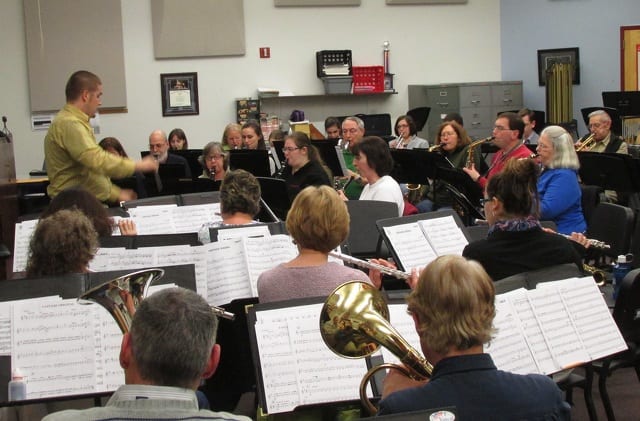
UNIVERSITY PARK — The Bellefonte Community Band, a group of more than 50 volunteer musicians of all ages from Bellefonte and the surrounding communities, will present a concert saluting the Golden Age of Bands at 3 p.m. Sunday, March 13, in the Esber Recital Hall on the Penn State campus. The concert is free and the public is invited to attend.
Band director Joshua Long is completing a master’s degree program in music conducting, which requires him to lead a recital in which his conducting abilities will be graded by a team of Penn State’s music department professors. Long said these recitals are typically performed by Penn State student musicians, but he chose to use the Bellefonte band instead. He also chose the “Golden Age” theme since it meshes well with research he is conducting on American community bands.
Long holds a bachelor’s degree in music education from Penn State, where he played the euphonium in the Blue Band. He earned a performance degree in euphonium from the University of Hartford, and is currently also pursuing a doctorate degree at Penn State.
The Golden Age of Bands in America extended from the post-Civil War era into the early 20th century. It evolved from the numerous military bands that were popular during the war. “What you had was mostly military bands in the beginning, and then the military guys came home, and they wanted to continue to play, so they created community bands,” said Long. From the late 1800s to the early 1900s, professional bands, such as the famed Patrick Gilmore and John Philip Sousa bands, toured all over the United States, and many towns across the country had their own amateur community bands. By the 1920s, as other attractions and entertainment developed, the popularity of the bands diminished and the ‘Golden Age’ of professional bands came to a close.
The Bellefonte Community Band concert program consists of music from that era, all composed over 100 years ago. Among the compositions to be performed are the “Poet and Peasant Overture” by Franz Von Suppe; “Old Folks At Home,” with variations in the musical styles of five different countries; “Under the Polar Star,” a movement from Sousa’s suite “Looking Upward”; the triumphant “March From Tannhauser” by Richard Wagner; the “American Patrol” march by F. W. Meacham; and several others.
A special feature of the concert is “Fantaisie Original,” a band-accompanied solo by band member and euphonium player Leigh Hurtz, who will perform the song on a vintage double-bell euphonium owned by Long.
The double bell euphonium is an instrument based on the euphonium. The larger bell produces the mellow tone of a standard euphonium, and the second, smaller bell has a brighter tone similar to a trombone. The last valve on the horn (either the fourth or the fifth, depending upon the model) is used to switch the sound from the main bell to the secondary bell. Both bells cannot play at the same time because each bell has its own tuning slide loop.
The double-bell euphonium was mass produced starting in the 1880s, initially by the C.G. Conn Company in the United States. Peak production of the instrument was from about the 1890s into the 1920s, although it was never one of the more popular brass instruments. Sousa’s and other bands all featured double-bell euphoniums in the early 1900s. By the 1940s, the instrument had disappeared from nearly all American bands.
Long found his 1936 vintage double-bell euphonium about four years ago intact, but needing cleaning and repair, and he restored it to playing condition.
“Fantaisie Original” was written by Italian composer Giovanni Picchi nearly 400 years ago. It was virtually forgotten until it was revived and arranged by Simone Mantia, a soloist with the Sousa band, and published in 1908.