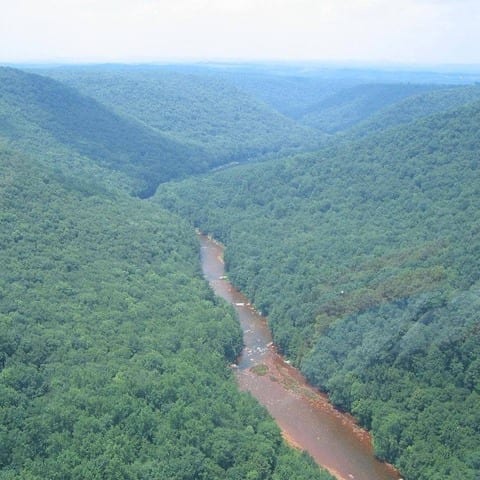
The newly reformed Moshannon Creek Watershed Association held an informational meeting in Philipsburg on Oct. 8 during which several attendees reiterated the same sentiment: The land surrounding Moshannon Creek is picturesque, but the water itself is an eyesore.
Moshannon Creek, the association’s website states, “is a major tributary of the West Branch of the Susquehanna River in west central Pennsylvania. The stream meanders considerably, but generally flows from southwest to northeast. Moshannon Creek forms the border between Clearfield County and Centre County over most of its length.”
Eric Skrivseth, who is leading the effort to get the MCWA going again — the Moshannon Creek Watershed Coalition disbanded in 2014 — said parts of Moshannon Creek are contaminated with acid mine drainage from abandoned coal and clay mines.
“It’s generally nasty water,” Skrivseth said.
The mission of the MCWA will be to “protect the clean water streams and improve the streams with tainted water.” To accomplish its goal, the MCWA will need to survey the watershed and apply treatments to improve water quality.
According to Skrivseth, “There is a whole host of treatment systems” already in place on parts of the watershed, but, “nobody’s maintaining them.”
The original MCWA collected data when it was active in the past, but much of the information is now at least 10 years old.
“We have existing plans that cover about half the watershed,” Skrivseth said. “We don’t need to reinvent the wheel. We just need to update some things.”
A report made for Trout Unlimited by two Penn State University researchers and a member of the Senior Environmental Corps in 2008 found, “In general, Moshannon Creek is strongly acidic year-round. In contrast, the main flow of Clearfield Creek is net alkaline essentially yearround. … Comparison with good data … indicates that Clearfield Creek has markedly improved in terms of AMD constituents since 1984, and imparts only minor degradation to the West Branch. In comparison, Moshannon Creek introduces a major flux of acidity, Fe and Al to the West Branch at Karthaus. Samples from the south bank at Karthaus are distinctly more acidic and metal bearing than the main flow represented by the north bank.”
Skrivseth has joined forces with Eric Rosengrant, mining permit and compliance specialist at the Pennsylvania Department of Environmental Protection, and Rachel Kester of Trout Unlimited.
“I’ve seen a lot of good things happen in a lot of other watersheds,” Rosengrant said. “Fish coming back, water returning to its best use. (The fact that) Moshannon Creek hasn’t been able to follow suit is sort of upsetting.”
Rosengrant also discussed the need to bring watershed assessments back up to date, adding that it could be possible to “see people having a trout fishing derby in Philipsburg” someday.
Concerned citizens who spoke at the meeting recalled cherished time spent locally in the scenic nature that surrounds the Philipsburg area and the disappointment that’s come with seeing the water remain at such consistently low-quality levels.
Community members also discussed the possibility of doing a project to get the community involved that includes Philipsburg’s Cold Stream dam, which was recently refurbished. Mike Minarchick, who leads the Philipsburg-Osceola High School Fly Fishing Club, said the organization would be able to provide “manpower and volunteers.
“(The club) is not all about fishing and having fun, there’s restoration and clean-up, too,” Minarchick said.
MCWA’s next meeting is TBA, but more information about the organization and future news is available on the group’s Facebook page and at www.moshannoncreek.org.