
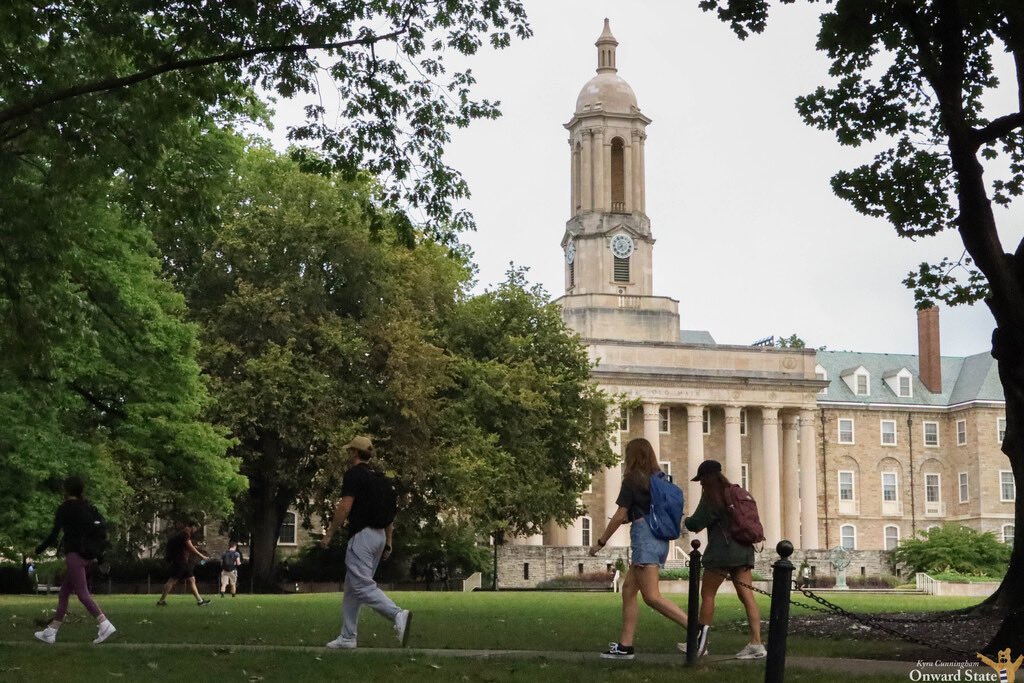
My academic home at Penn State is the College of Communications, but at heart, I’m a humanities guy.
My bachelor’s degree was in Creative Writing, the English department’s home for would-be poets and novelists. My graduate degrees are in folklore studies.
As anyone can plainly see, I was (and still am) a luftmensch, a Yiddish word for a person with his head in the clouds. My vague idea was that I would write for a living and if that didn’t pay the bills, I would also teach writing for a living. Which is what I’ve done, except what I write and teach is journalism, not poetry.
My parents couldn’t have known that it would all work out, so why did they allow their dreamy son to pursue such an impractical course of study? I asked my dad that question before he died. His answer: He didn’t want me to have the same regrets he did.
Dad had wanted a life in the theater, but as a child of the Depression, he needed steadier work. So he became a printer and directed community theater productions on the side.
It worked out OK: He and my mom put the three of us through college and eked out a middle-class life in New York’s suburbs and outer boroughs — though not without constant money worries. (Dad, too, was a luftmensch.) But he always wondered if he could have made it in the pros, which to him meant Broadway. So his attitude toward my ambitions was, you want to be a poet? Go for it.
The relatively low cost of a college education in the 1970s was clearly a factor. Would he have been as supportive if tuition had been $20,000 rather than $2,000?
Which brings us to the present moment. Headline in the Sunday Business section of The New York Times this week: “Is the Promise of a Degree Broken?” The illustration shows a trio of new grads in their caps and gowns, a faculty member outfitting them not with an academic hood but with a barista’s apron. “College graduates are mired in debt, with no path to jobs suiting their credentials,” reads the sub-headline.
This will not be news to my students, most of whom are graduating seniors. These are journalism majors, who hope their skills will serve them well in journalism-adjacent jobs if not in journalism itself. I tried to cheer them up earlier in the semester by showing them another Times story that was narrowly focused on un- and underemployed computer science majors whose “guaranteed” tech jobs have been wiped out by artificial intelligence.
My point wasn’t, hey, could be worse, you could have fallen for the STEM promise. Rather, it was that the whole careerist turn in higher ed appears shortsighted. When, in just four years, a meal ticket into the workforce turns into a one-way ticket to Palookaville, you may as well study what interests you – theater, poetry, art history — and hope for the best.
As I see it, the primary purpose of higher education is not to train us for a particular job but to make us aware that there are more things in heaven and earth than we thought – more ways of living and thinking, more kinds of people, more ways of answering the questions Paul Gauguin posed in the painting I saw in Boston’s Museum of Fine Arts over the weekend: Where do we come from? What are we? Where are we going?
I think of Walter Munk, a renowned oceanographer who, at 90, was still pondering the briny deep. When I met him, he was seeking pattern in sun sparkle on the surface of the sea. And the practical application of that? I asked. None, he said, a bit huffily. He was studying it because it interested him.
I also think of the poet Richard Hugo, who wrote: “I think literature should be studied for that most serious of all reasons: because it is fun.”
I know: “Fun” and “interesting” don’t cut it at $20,000 (in-state) or $40,000 (out-of-state) a year. So we must bring the cost down. We also have to offer more options than the one-size-fits-all university for post-secondary education.
One problem with trying to funnel everyone into college is that it implicitly disses the trades. Take it from me, a 28-year-man at Penn State: A lot of college students would be happier laying bricks or banging nails than reading books and writing papers. And you can’t outsource a new roof to Bangalore – or ChatGPT.
What we don’t want, though, is to go back to college being for rich kids and the trades for everyone else. So: Lower the cost so anyone can study Greek mythology without going into hock, and raise the prestige value of skilled labor so those who’d rather work with their hands than their heads will be proud to do so.
How? Remember, I’m a luftmensch.
More Columns
View all Columns
Penn State’s Road Ahead: From Michigan to a Brutal Home Schedule in 2028
Penn State football will get better. Nittany Lion head coach Matt Campbell said so on Saturday night, after he lost his third Big Ten game in 15 days as Penn […]

Penn State Football’s Identity? Déjà Poo All Over Again
Penn State football’s identity? We found it on Saturday, though it never went away: It’s an incredible fan base that turned out. Once again. After being punched in the stomach. […]
Column: It’s a Long Way Down for Penn State Football
Have you ever been scammed before? Merriam-Webster defines a scam as a fraudulent or deceptive act or operation. Joel Haas defines it as Penn State football in the first half […]


