“I’m with the government and I’m here to help.”
I began more than a few marketing presentations with that sentence early in my career. Because everyone immediately understood the humor, sarcasm and irony in that statement.
In addition, the humor eased the tension of what the potential customer and I both knew: They had a problem, were in need of a solution, the company I was with had a product and service that could fix it, and I wanted them to buy it.
So, it’s in that vein that I’m going to fix something for us today. An issue that, not coincidentally, actually does involve the government trying to help, And that issue is college sports.
If you listen to some people these days, college sports are broken and heading for the dump heap of history. Universities will soon be dropping tons of sports and thousands upon thousands of kids will lose opportunities to attend college. And we need the government to get involved or the whole enterprise will crumble.
Now, the irony of the “college sports are broken” mantra is not lost on many of us at a time when college sports have never been more popular. Revenues are skyrocketing and college sports are growing. Not least of which is because the student-athletes are starting to get a small bit of freedom. I know, imagine that. The “land of the free” didn’t actually offer freedom to its student-athletes.
Be that as it may, these “college sports are broken” folks believe that not just any government needs to get involved – but the federal government. And that there should be laws and orders and mandates governing how college sports are run.
But, we all know the problem with this “government will help” solution, right? Government involvement in a non-government activity rarely achieves a positive result. “I’m with the government and I’m here to help” is universally understood as humor/sarcasm/irony for a reason.
So here’s a simple and effective way to save sports: The NCAA should stick to its mission – and keep the federal government out. And, how do they do that?
Well, the NCAA is the body created and run by its more than 1,100 member colleges and universities, and its mission statement is “united around one goal: creating opportunities for college athletes.” So, it should be in the business of creating those opportunities, not creating roadblocks with federal government interference.
Besides the blatantly obvious method of continuing to give college athletes more freedom – no recruiting restrictions, transferring at any time, etc. — one enormously easy way to do that is make a rule that requires universities to offer more sports. More sports equal more opportunities.
To put it simply: To be a D1 FBS college, a school must maintain a minimum of only 16 varsity sports. And at the D1 FCS level they need to maintain only 14 varsity sports. Both of those minimums are abysmal if the NCAA’s goal is creating opportunities for college athletes.
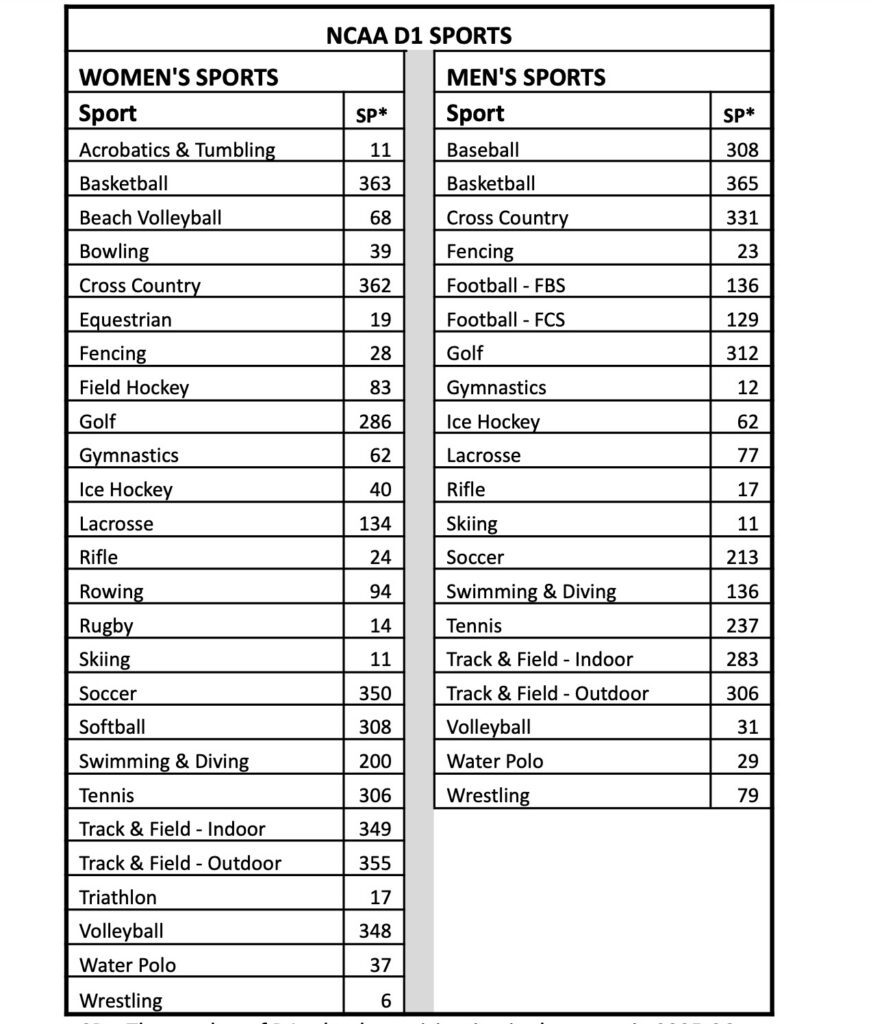
The reason they are abysmal is the NCAA sponsors 45 D1 varsity and emerging sports – 26 for women and 19 for men. The minimum D1 requirements the NCAA has created – 16 sports and 14 sports – are just slightly more than a third and slightly less than a third of all the D1 sports the NCAA sponsors. Only a third.
And guess what? There are only 19 sports with 200 or more D1 schools offering them, and only 13 sports with more than 300 D1 schools offering them (see the chart at the bottom of this column). Do you think it’s a coincidence that the number of sports being most offered lines up fairly closely with the minimum required numbers of sports the NCAA has set? I don’t think so.
Then the answer is obvious. The NCAA can create more opportunities for college athletes by requiring that its member schools maintain a higher minimum number of sports. Let’s say 30 sports minimum at the D1 FBS level instead of a paltry 16, and 20 at the D1 FCS level instead of 14.
Even at these increased levels we’re only asking D1 FBS schools to offer two-thirds of the D1 sports the NCAA sponsors, and D1 FCS schools to offer not even half, so it’s certainly not an onerous task. And, for schools with annual athletic budgets of $100 million or more, there should be no excuse for not offering at least 30 sports.
In fact, it’s already happening at some schools. By counting the number of sports listed on their athletic websites, and confirming it with the Knight-Newhouse College Athletics Database, we see that Penn State already offers 31 varsity sports. Ohio State offers 34. And Michigan offers 29. So, some schools are either already above or really close to this level.
Although, some Big Ten schools will have some work to do.
Indiana offers just 24 varsity sports, so would need to add six sports to conform if these guidelines were instituted. Minnesota only offers 22. And Oregon and Purdue both only offer 20 varsity sports.
In the SEC there are also schools that will need to add some sports. Alabama, Texas and LSU offer only 21 varsity sports. Ole Miss just 18. In fact, every school in the SEC would need to add sports to conform to this new standard as the school offering the most varsity programs – Kentucky – only has 23.
But all of the schools listed above have athletic department revenues in excess of $100 million. In fact, according to the Knight-Newhouse Database the median athletics revenue in 2024 for the 130-plus D1 FBS schools was $96,693,461. Half the schools at the FBS level made over that in 2024, and that number has only gone higher. For example, PSU’s athletic revenue in 2024 was $220,758,927 and climbed to $254,867,598 in 2025.
The point being that with annual revenue of $100 million a year – and the Big Ten, SEC, ACC and Big 12 schools are almost all well above that number – schools should be able to afford to field 30 varsity sports.
And in terms of creating opportunities, if just the members of those four conferences above offered a minimum of 30 varsity sports, that would be over 500 new varsity sports teams in this country creating opportunities for ten thousand plus new college athletes. How exciting and wonderful would that be?
Of course, I can hear the naysayers already. If you require these schools to offer more sports, some will say, “That’s it, we don’t need to be FBS anymore. We’re dropping down to FCS and we’ll drop a bunch of sports” Or, even further, to D2 or D3.
Which is why, if the NCAA institutes these new limits, whatever number they set for D1 FCS must be at or above what the average FBS school is currently offering. And, as you can already see, many of the biggest schools are offering right around 20 sports.
So, even if the teams in the so-called “G” conferences of the D1 FBS – the MAC, Sun Belt, Mountain West, American, Conference USA and the new PAC-12 – decide that they will move down to D1 FCS (and I’m betting most won’t), not only won’t they drop any sports, but in some cases they’ll actually have to add sports. For example, no school in the MAC offers 20 varsity sports. If the new D1 FCS limit were 20 sports, you would create more opportunities for college athletes even if every MAC school decided to drop down from FBS.
And continuing that thought, at the D2 and D3 levels, the minimum requirement for both is 10 varsity sports. Any D1 FCS schools dropping down in most cases would have had only 14 sports to begin, and any sports they do drop would be more than made up by the hundreds of new teams created at the FBS and FCS levels.
Plus, for those naysayers who suggest more athletics just ruins the academic side of the college equation, I need to remind them that the most academically-oriented colleges disagree. Harvard leads the nation with 42 D1 varsity sports teams. Princeton offers 38. Cornell offers 37. Yale and Dartmouth offer 35. Brown offers 34. Penn offers 33. Columbia offers 31. In fact, outside of Stanford (36), Ohio State and Penn State, the Ivy League schools offer more D1 varsity sports than any other schools in the country.
The overarching point is that for decades the NCAA has created restrictive rules that impede opportunities. How many visits a recruit can take, who and when they can contact schools, when and how they can transfer, how long they can play, and on and on. And only after losing in court has the illegality of what they did, not to mention the basic wrongness of it, been brought to light.
The NCAA asking the federal government to get involved is just a way of going back to the dark ages. Because if the federal government sets policies and rules and orders and mandates, then the college athletes have to sue the federal government, not the NCAA. And if you’ve seen how the NCAA’s legal bills have gone up the last number of years, you can certainly understand how they would appreciate saving some money. Let alone stop losing in court.
But we can all see how things have gotten so much better since the athletes have been given some freedom. Three different Big Ten teams have won the last three national titles in football. One of them, Indiana, went from the losingest major college football team in history to a national title in the same year. If that’s not creating opportunities for college athletes, I don’t know what is.
Again, interest in college sports is up. Revenue is up. The same old teams aren’t winning anymore. The NCAA has an outstanding and wonderful opportunity here. It can continue trying to get the federal government to roll back time, or it can unite around one goal and create more opportunities for college athletes by raising the minimum number of varsity sports for D1 FBS and D1 FCS schools.
Because when it comes to college sports, we don’t need the government’s help.
This chart lists each NCAA D1 sport with the number of schools participating in that sport as of the 2025-26 academic year (Football is split into FBS and FCS).