
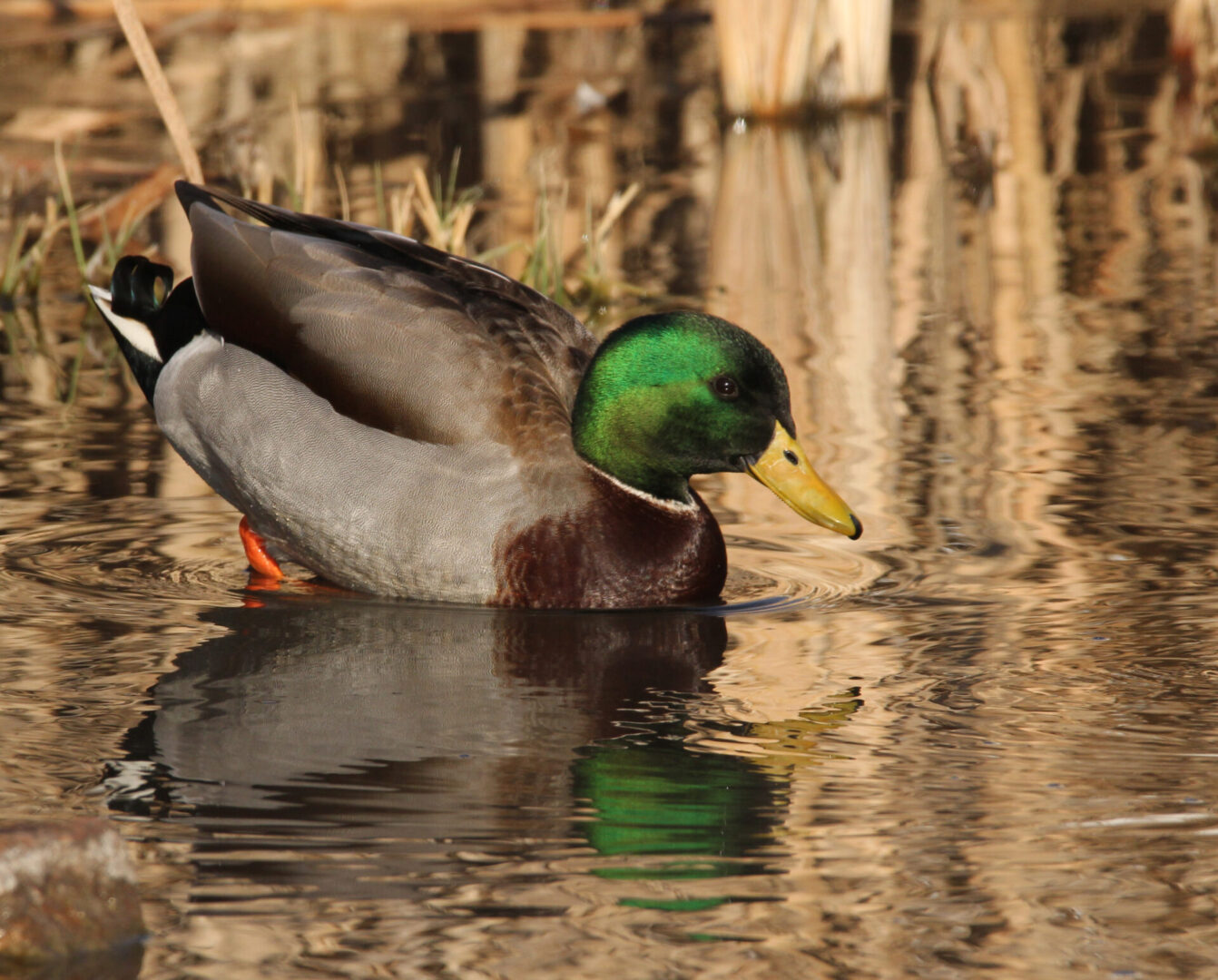
If it quacks like a duck …
Actually, if it “quacks,” it is almost certainly not just any duck, but a mallard duck or a white domestic duck (which was derived from mallards). Mallards, Anas platyrhynchos, are the most numerous and best-known ducks in the United States.
While most people associate them with wetlands, mallards are quite at home in city parks, farm country and along remote trout streams. Park ducks might seem tame, but their wild counterparts take flight at the slightest suspicion of danger.
Mallards are well distributed across North America, Europe and Asia and have been introduced in southern hemisphere locations. They breed and nest in all 67 Pennsylvania counties. Mallards are least common in the forested mountain regions along the Allegheny Front, and most common in the southeastern parts of the state as well as in glaciated regions in the northwest. The same holds true for Centre County, where they are much more common south of I-80 than in our heavily forested north country. In 2010, it was estimated that over 100,000 mallards lived in Pennsylvania. However, mallard numbers have decreased since then.
The reason for the decline is not known, but the areas with the greatest population losses are where development is taking over agricultural and grassland habitats.
Adults measure 20 to 28 inches long and weigh about 2 1/2 pounds. The female is mottled brown with blue and white wing bars. Males sport an iridescent green head accented with a white neck stripe, and bodies with patches of chestnut, gray, and white. Drakes also have two curled feathers visible on the top of their tail. Male mallards are quite colorful, but their plumage pattern — large blocks of differing solid colors — is a type of protective coloration called disruptive markings.
Breeding pairs nest in a depression lined with vegetation, often with overhead cover. The female-selected nest site can be over 100 yards from water. Eight to 15 eggs are laid in the nest, and a 28-day incubation period begins after the last egg is laid. Most broods hatch April through early July. The family leaves the nest within hours after the last egg hatches. Pairs nest again if a nest is raided by a skunk or raccoon. Snapping turtles are a big predator of baby ducks.
I sometimes run into a hen mallard with her brood when trout fishing. The hen often pretends to be injured and makes quite a ruckus, while the ducklings hide. Survival strategies in nature are always amazing.
Mallards are classed as “dabblers,” tipping their bodies to collect food and mud from the bottom. The ducks use their serrated bills to filter seeds, mussels and aquatic insects from the sediment. They also eat the leaves and stems of a variety of aquatic plants, along with cultivated grains such as corn.
Drakes leave their mates in May or June to head for larger wetlands, where the ducks molt. Hens don’t molt until their ducklings are old enough to make it on their own. Members of both sexes are flightless for about a month as they wait for their new wing feathers to fully develop.
Most Pennsylvania mallards fly south to open water for the winter, but a few do spend the colder months here. Migrating ducks fly to the Chesapeake Bay or as far as South Carolina.
Mallard numbers were stable or increasing throughout most of their North American range for many years, but more recently there has been a decline. The most recent U.S. Fish and Wildlife Service data show that the mallard population decreased by 18% from 2022 to 2023. The population is 23% below the long-term average. In the eastern region, the population is estimated to be down 4% from 2022, and down 6% from the long-term population average.
In Pennsylvania, wood ducks are now believed to outnumber mallards. My observations would agree with this estimate. I hope that sound management, habitat preservation and the duck’s adaptable nature ensure that there will continue to be good mallard populations in the future.
More Columns
View all Columns
Penn State Lost to Wisconsin: How Bad Was it?
How bad was it? Ahead 17-0 just 18 minutes into the game and lost bad. Ahead 20-10 until Wisconsin scored with just 211 seconds left in the game and lost […]

Penn State Football: Tonight, the Haters Were Right
On Dec. 11, 2023, Twitter user @drewjanda put out a since-deleted post that now lives in sports meme infamy. It read as follows: “The haters said I couldn’t do it. […]
Penn State Football After Dark: Homecoming Contest Begins a String of ‘Night Shift’ Games
Under coach Matt Campbell, Penn State football practice is held early in the morning, with coaches and players arriving at Lasch Building before the sun comes up. For the next […]


