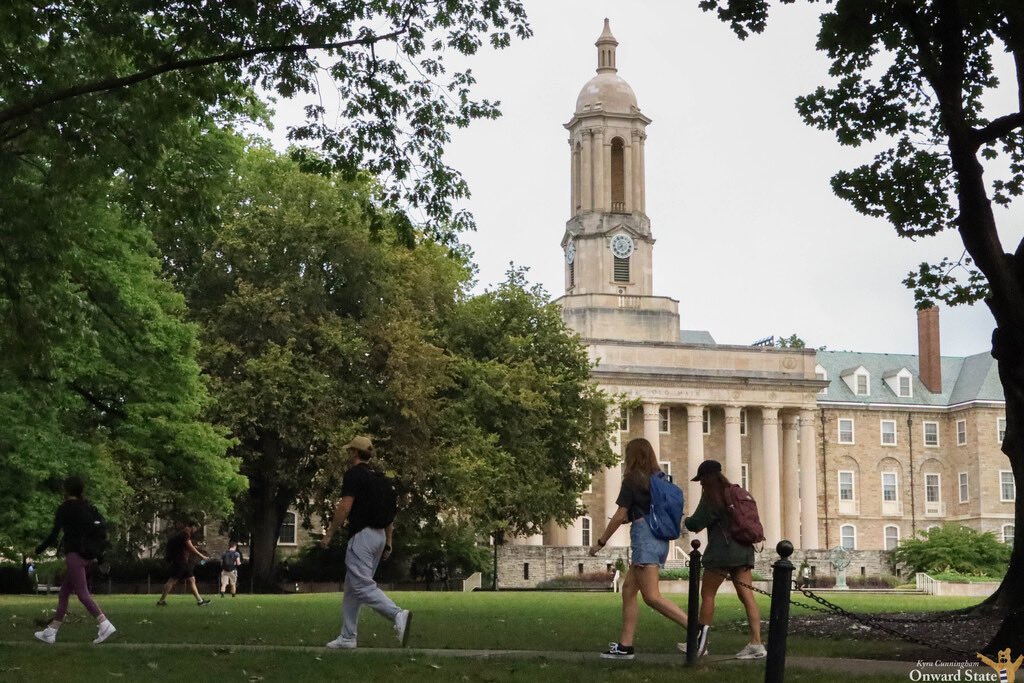
The great annual migration has occurred!
Like the historic return of the swallows to Capistrano, tens of thousands of young people have migrated back to Penn State. Except, unknown to most people, many of the swallows stopped returning to the Mission San Juan Capistrano because remodeling to the Mission affected their habitat. Fortunately or unfortunately, depending on your point-of-view, remodeling and new construction of dorms and apartments in State College has not caused a similar reaction in the migratory college students. They have maintained and even increased their numbers in response to these habitat changes.
This past week, town has been inundated with cars, trailers, U-Hauls, vans and anything else capable of transporting a college student’s needs. Traffic lanes were diverted for loading and unloading, signage was everywhere, and folks in iridescent vests directed the masses to their appointed abodes. By now everyone has settled in, classes have started for Penn State’s fall semester, and even the State College schools started their first day of classes. Meaning, for most, summer is officially over.
As we all know, the primary reason for this migration of over 46,000 students here to the University Park campus is their desire to become Penn State graduates and leave Happy Valley with, at minimum, a bachelor’s degree. A lofty and auspicious goal to be sure. But, with apologies to the Indigo Girls, should you want to spend four years prostrate to the higher mind to get your paper? And will you then really be free?
The value of a college education has been argued for years. Rich Karlgaard, the former publisher of Forbes magazine, wrote back in 2006 that beyond the degrees from Harvard, Yale and 10 to 20 other private colleges, “I suspect the price of a four-year, private college degree–$100,000 to $175,000–will be money poorly invested.”
Just two months ago, Forbes posted an advisory column on their website titled, “Is College Worth The Cost? Pros Vs. Cons” that lays out a fairly even-handed treatise for why college could or could not be a great decision. The cons include the realities that you will likely graduate with student debt, high-paying jobs aren’t guaranteed, and it can take more than four years to graduate.
A 2018 article on Inside Higher Ed cited a study that showed college graduates who took a first job that did not require a bachelor’s degree paid a lasting price. Those graduates, commonly referred to as the “underemployed,” were still underemployed five years later, and many remained underemployed 10 years after leaving college.
Then you have the Federal Reserve Bank of New York. Two assistant vice presidents from their Research and Statistics Group authored a column in 2019 with a position on the topic that is, not surprisingly, all about the money. Their contention is the college wage premium – the wages earned by college graduates versus non-graduates – makes college worth it. Their conclusion? “While the rising cost of college may be troubling, it has not yet changed the basic calculus as to whether earning a college degree is worth it. The benefits still outweigh the costs, at least for most people.”
Granted, their conclusion is based on their investigation that the “average college graduate with just a bachelor’s degree earned about $78,000, compared to $45,000 for the average worker with only a high school diploma.” They do offer some caveats to this research, including that at least a quarter of college graduates do not enjoy these monetary benefits — partly because they’re using averages for their back-of-the-envelope calculations and not medians. A few CEOs earning 350 times the average worker and some other highly-paid occupations (doctor, lawyer, etc.) can make those averages appear much greater than they are in reality.
But, as we live here in Happy Valley, where the largest industry is college education, and the borough boasts a rate of over 72% of the 25 years-and-older population having a bachelor’s degree, it would be almost heresy to suggest anything other than a college education is a great idea.
So what about those occupations that might not clearly require a bachelor’s degree? Jobs such as electrician, plumber, carpenter, mechanic, software coder or entrepreneur. One occupation I would suggest fits this bill is that of elected government official. Except, it turns out that our elected representatives, especially our federal representatives, don’t reflect the educational attainment of our country.
According to the U.S. Census, only 37.9% of Americans aged 25 and older have bachelor’s degrees. But the percentage of U.S. Congress with bachelor’s degrees is much higher. Of the 435 members of the House of Representatives, only 18 have no bachelor’s degree – although seven of those have associate’s degrees. In the U.S. Senate, the percentage is even higher – only one U.S. Senator does not have a bachelor’s degree.
How do I know this? Last week while doing some research I stumbled across the website of SoFlo Tutors – which is primarily an SAT and ACT test prepping company. They have a database compiling the complete education details for every member of the 117th U.S. Congress (The 117th Congress is the one currently in session – it convened on January 3, 2021, and will end on January 3, 2023).
The website presents some fun facts and allows you to download their spreadsheet to do your own research. Some of the fun facts are:
- Sen. John Boozman from Arkansas is the only U.S. Senator without a bachelor’s degree. He played football at the University of Arkansas but never graduated.
- President Biden and Vice President Harris are the first ticket in 36 years with no Ivy League credentials on their resumes.
- Harvard University and Stanford University have the most U.S. senators with undergraduate degrees, each with six.
- The Ivy League boasts a total of 15 U.S. Senators with undergraduate degrees and they are evenly divided between Republicans and Democrats – each with seven – plus one Independent. Although if you add in graduate degrees, 27 U.S. Senators have an Ivy League diploma. More than one-quarter of the U.S. Senate has a degree from a conference with only eight schools.
- Using Twitter followers as a gauge, the top three U.S. senators are all Democrats, led by Senator Bernie Sanders with 15 million followers – more than double second-place Senator Elizabeth Warren with 6.9 million followers. However, six of the top 10 are Republicans.
I would like to see a more egalitarian educational representation in the halls of Congress – a few more regular folks, that is – but as a Penn State supporter there is something we are missing at the highest levels of our federal government. That’s a Penn State senator. Or even more wishfully, a Penn State president. Currently there are five U.S. representatives with bachelor’s degrees from Penn State, and one other who got his law degree from Penn State. All of them represent districts in Pennsylvania. But there is not a single U.S. senator with a Penn State degree (and neither of the two current major-party U.S. Senate candidates in Pennsylvania has a Penn State degree), and there has never been a U.S. president with a Penn State degree.
Personally, I don’t know if we Penn Staters should consider those facts as a good thing or bad thing, but as long as we in Happy Valley are annually dealing with the migration of 46,000 or more students to our bucolic little area, maybe we should get a bit of federal-level love for our efforts. How about if our alumni base puts forth an effort to get some Penn State thinking into the halls of the U.S. Congress? I think that’s a migration that could have some positive results!