
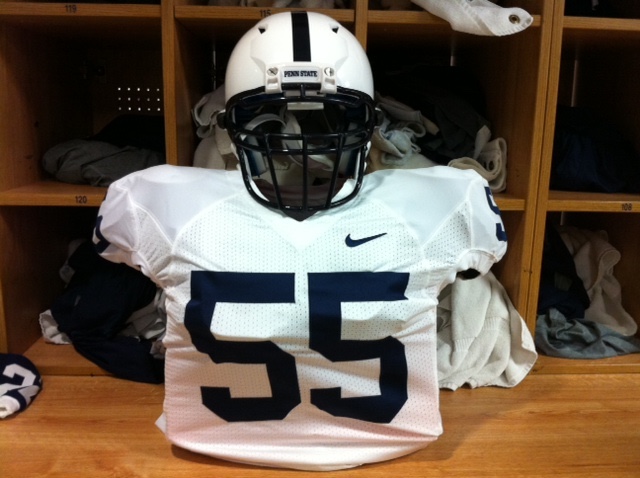
With Penn State headed to play a game in Yankee Stadium, let me tell you a story of an enduring Yankee/ Penn State connection.
In July 1985 the USFL spring football season was winding down. The Baltimore Stars (originally the Philadelphia Stars) made the championship game in Giants Stadium. Being an avid fan of the USFL, I asked my dad if we could go to the game. He (probably reluctantly) agreed to take my brother Scott, my friend Pete Eberhart and me to the game.
The day of the game he drove us to Hasbrouck Heights, New Jersey, and met two of his friends there. One friend was Nick Nicolosi, who owned the Hasbrouck Heights Sheraton. The other was a friend of both Mr. Nicolosi and my father, a guy named Joe DiMaggio (THAT Joe DiMaggio).
A crowd of just under 50,000 people were at the game and as we drove in through the tailgaters, many fans recognized Joe Paterno but then really flipped out when they saw “Joey D” in the car.
Joe DiMaggio had a poised presence that remained long after his playing days were through. The other retired athlete I’ve been around with that enduring charisma was Franco Harris. They just carried themselves with such class.
In 1999, a few weeks after Joe DiMaggio had passed, my father and I were reminiscing about that summer day in 1985. I’d been in San Francisco when he died. His private funeral was held in the beautiful white ornate Saints Peter and Paul Church in the Italian North Beach neighborhood where the Yankee Clipper had grown up. He was the son of Italian immigrants, his father being a fisherman.
We made a point to be outside the church when the funeral concluded. A crowd had gathered in Washington Square across from the church. Police motorcycles were gleaming in the sun as the officers waited to escort the hearse to Joe DiMaggio’s final resting place.
There were old Italian men along the streets, many of them wearing Yankee hats. As the pallbearers carried DiMaggio down the steps, all these men removed their hats and held them over their hearts out of respect. There were tears in their eyes.
After I shared that story, my father told me what he’d learned from the Yankees.
Joe Paterno grew up as a devoted Brooklyn Dodger fan. The family who owned the Dodgers were a Brooklyn Prep family, the Catholic high school he attended. For afternoon games at Ebbets Field they would ask kids from the school to work as ushers. He’d grown up listening to games on the radio, occasionally sneaking into games before becoming a part-time usher.
As such he hated the Yankees.
But in October of 1943 Joe’s high school football coach took him and some other players to an afternoon World Series game between the Yankees and the Cardinals. As fate would have it, Joe DiMaggio was in the military for World War II and was not on the Yankee roster that season.
In fact, DiMaggio’s parents, like many other Italians, were labeled “enemy aliens”. They were required to always carry a photo ID with them and were restricted from traveling more than 5 miles from their home. Giuseppe DiMaggio was not allowed to fish the bay where he made his living.
Joe remarked to me how Joe DiMaggio was missing from the lineup and what his Italian immigrant parents had to endure.
Amid world war, the nation needed diversion. Baseball played on without many of the game’s biggest stars. At that World Series game, when the Cardinals came out to warm up, Joe’s coach had a lesson plan.
“Look at the Cardinals. Look at their uniforms. Look at their shoes.” He said.
The Cardinals’ players’ uniforms were untucked and their shoes scuffed and unpolished. Many of them were unshaven and scruffy.
Then the Yankees came out and the lesson continued.
As Joe described it, the Yankee uniforms were pressed, shirts tucked in. Their black shoes were so finely polished they seemed to shine in the October sun. There were no names on their jerseys. The players had short hair and were all clean shaven. It was a team rule.
Their high school coach made a point to his players about the professional demeanor of the Yankees in every detail. That translated to their focus and performance on the field. The Yankees won that series and the lesson stuck with these high school players.
That Brooklyn Prep team would win the city championship. They lost just one game, in the metro championship to Saint Cecilia High School, coached by Vince Lombardi (THAT Vince Lombardi).
When the Dodgers later moved to LA in 1957, Joe Paterno made a conscious choice. He could not become a Yankee fan, and he would not root for the Dodgers. He would not attend a Major League Baseball game again for 22 years.
But the lesson from that fateful day in 1943 manifested itself 23 years later in the program he coached for 46 years.
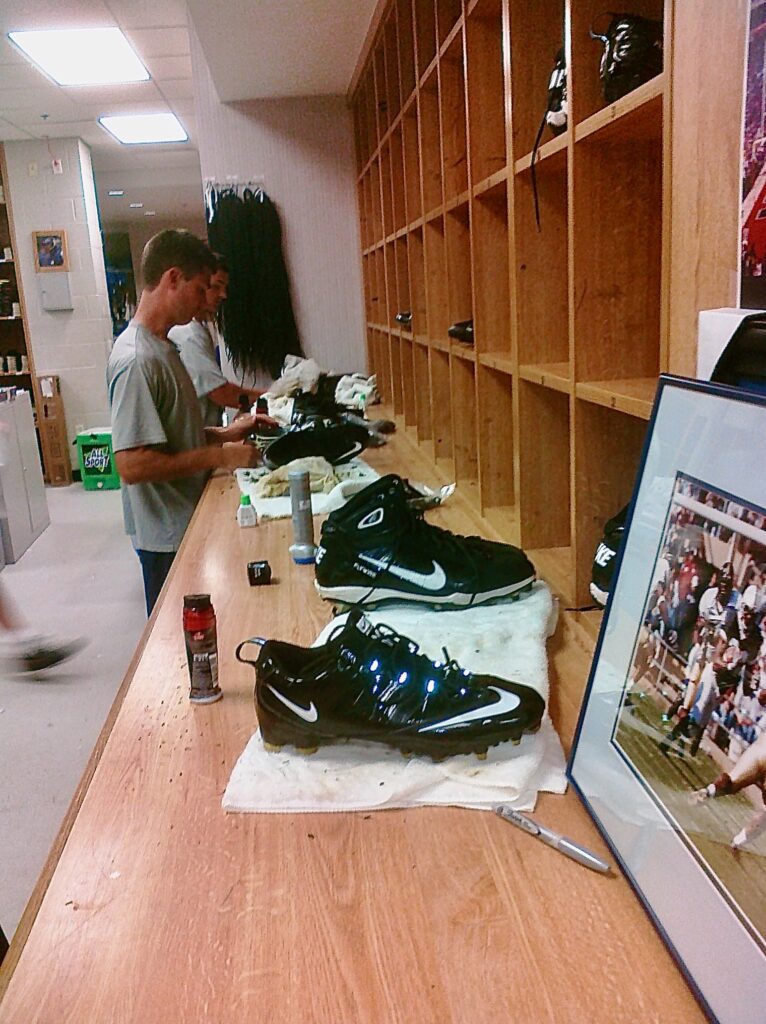
Penn State uniforms would be simple, with no names on the back. Before each game the helmets and shoes would be cleaned, and the black shoes would be polished to get that same shine he saw in Yankee Stadium. The players too would adhere to that same standard of the Yankees, short hair and clean shaven (mustaches but no beards or goatees).
Like the Yankees, the idea was that the team would have a professional appearance on game day. The haircuts and shaving were a year-round visible sacrifice of personal preference that everyone had to make to become a team. He wanted to reinforce that playing at Penn State was an honor and privilege, not a right.
“This place is not for everyone,” he’d tell his players, coaches and even recruits. “To be a Yankee, the best ballplayers in the world make a personal sacrifice. We want the same thing here.”
All these years later, as Penn State takes the field in new Yankee Stadium, the pride of those black shoes and no-name jerseys endures. As you walk into the game, if you look across the street to where old Yankee Stadium once stood, now you know where part of that pride began.
More Columns
View all Columns
Frank: To My Sister, on Her Birthday
Today is my sister Meryl’s 80th birthday. I could wrack my brains for the perfect gift idea, but when you get to be as old as Meryl is, and you’ve […]

Paterno: Upcoming Impact Award Honorees Represent ‘the Very Best of Penn State’
Penn State is the nation’s leading service-oriented university, a school where philanthropy and helping others is part of our DNA. That commitment is university-wide, including a long history of service […]
Penn State Coach Matt Campbell: ‘We Still Have a Lot to Prove’
Most of the 2026 Penn State football roster has been here before. “Here” is not a good place to be. “Here” is a three-game losing streak, as the Nittany Lions […]


