

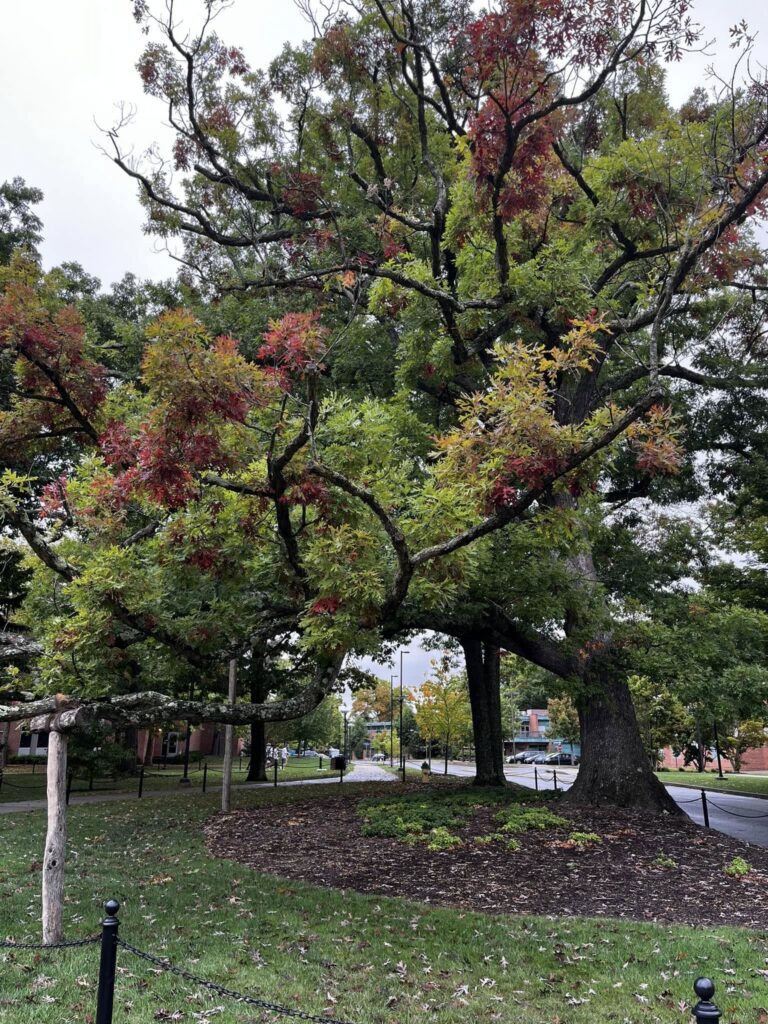
Let’s see: 10 times a week multiplied by 40 weeks multiplied by a dozen years. I’d say I walked past the big white oak on Allen Road by the Chambers Building roughly 5,000 times since I moved to East College Heights.
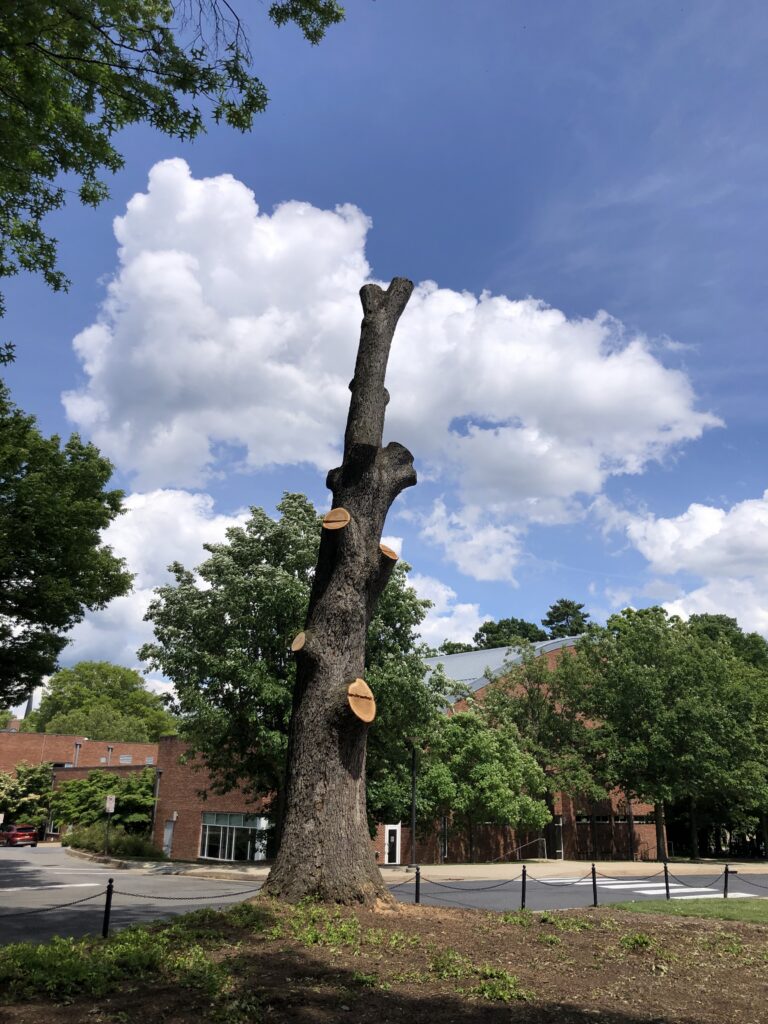
On the 5001st pass last week, I stopped in my tracks. The mighty oak had been reduced to a tall, limbless stump.
Blame a big wind that blew through town a week ago. A Penn State arborist noticed a crack down the middle of the tree. The danger that the oak would split and fall on a passerby (like me) or a passing car or a building was too great. Out came the chainsaws.
And a 200-year-old tree — older than the university, older than the endangered elms that line the walkways flanking Old Main — was no more.
“I’m heartbroken, but not all that surprised,” Tom Flynn told me. Flynn is Penn State’s manager of grounds services. Had the campus not grown up around it, he said, the oak might have lived longer, perhaps 300 years or more. Quercus alba does best in open fields. This specimen was squeezed between street and sidewalk, with utility lines running underneath. Not great for the root system.
Flynn tried to give the tree some breathing room by rerouting the sidewalk around it. (One collateral benefit of the little detour is that it made it less likely that I would pass the tree without noticing it, even though I walked by it every day.)
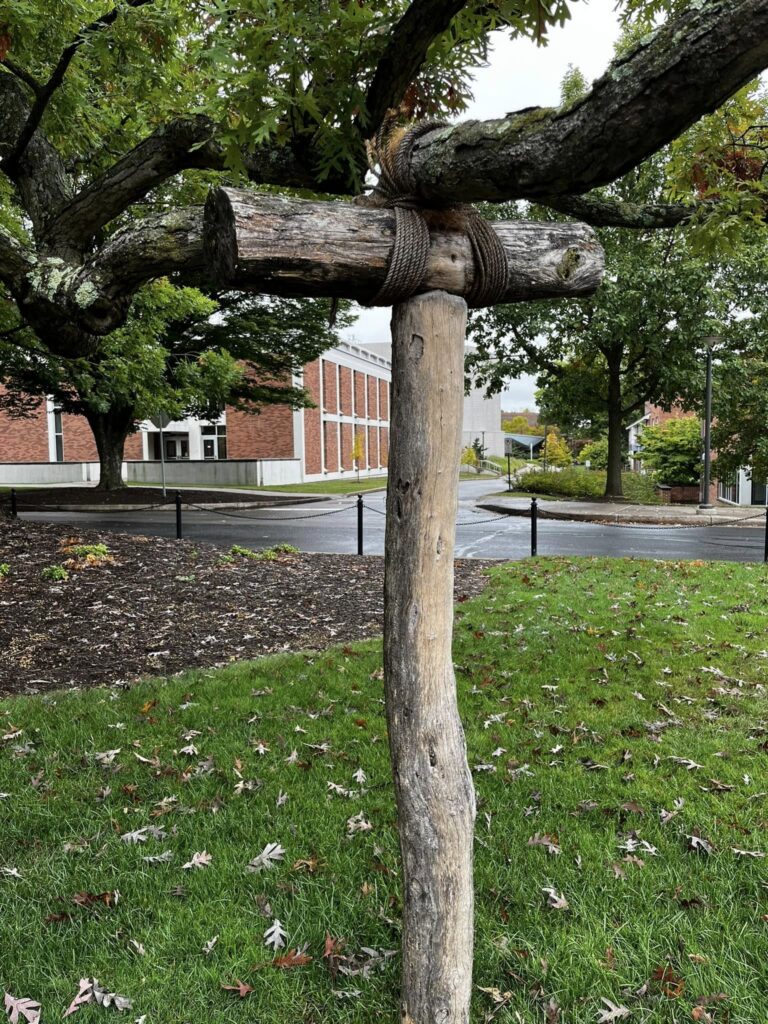
But it had been on life support for years, literally. Crutches had buttressed three of its lower limbs. Eventually, two of those limbs had to be amputated. Still, it hung in there until that gust of wind did it in.
How majestic was this tree? It stood 60 feet tall and had a diameter of 49 inches, which means, if I remember my high school math correctly (circumference equals diameter times π), its trunk was about 13 feet around, or slighter bigger than the wingspan of two tree huggers.
In other words, this was more than just one of 17,000 trees at University Park. This was one of a couple of dozen Penn State Heritage Trees. A plaque identified it, the way a plaque would identify a work of art in a sculpture garden.
Whenever I’m asked what I like about teaching at Penn State, I mention the campus itself. My job may not be a walk in the park, but that is exactly what circulating on campus feels like. At this time of year, the greenery – from the lawns to the shrubbery and on up to the tree canopy – is a feast for the eyes.
It wasn’t always this way. “We’ve come so far in protecting trees,” says Derek Kalp, senior landscape architect at Penn State. “Not long ago, trees were cut down that didn’t need to be, or root zones were not protected during construction.”
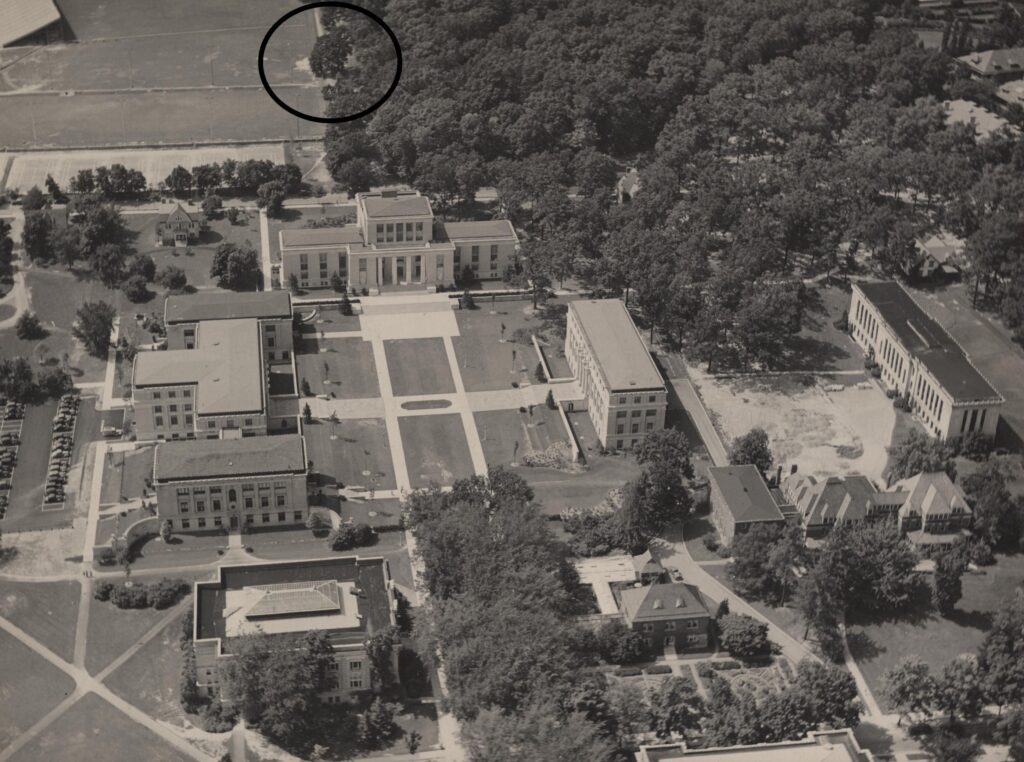
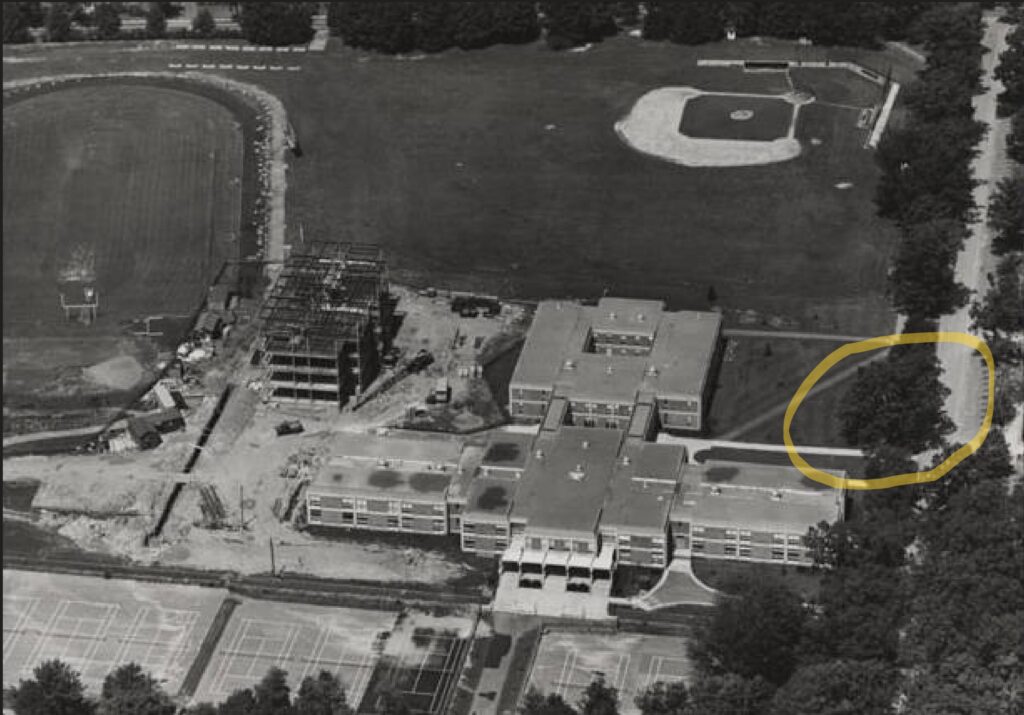
Histories of the white oak note that it stood on the periphery of Penn State’s athletic fields before they were moved to their present locations. A 1907 story in the Democratic Watchman about the construction of Beaver Field (peak seating capacity, 30,000) reported that “part of the ground is covered by trees which will have to be removed, even to the stumps and roots.” Fortunately, our white oak was spared.
(The same issue of the Watchman reported that:
- Miss Ione Donachy has been quite ill this week with an attack of quinsy [a complication of tonsillitis].
- Mrs. Florence F. Dale entertained two tables at bridge last Saturday evening.
- Tyrone borough council has passed an antispitting ordinance…Just why the fine is graduated from one to five dollars we are not informed unless it is according to the size of the expectoration.
- The price of milk dropped from 8 cents per quart back down to 6 cents per quart. Phew. At eight cents a quart it became next to a luxury.)
When I interviewed Tom Flynn, I confessed to being a “tree guy”: In recent years, trees have gone from background of my perambulations to foreground. I notice them, always. I have favorites. The white oak was one of them.
I was not alone. Kalp found a 2024 Facebook post that began thus: “Whizzing thru campus this weekend and this gorgeous tree stopped me in my tracks.”
Among the responses: “I swear this one stopped me and wanted to hug me.”
I think in terms of being the hugger rather than the huggee: This was the kind of tree one wants to wrap one’s arms around, to thank, to show proper reverence.
Flynn says he’s a tree guy also. Eventually, he said, what remains of the oak will be removed and a new tree will be planted in its place, something worthy of what stood there for so many years.
Derek Kalp’s vote is for another white oak – and maybe a tree planting ceremony. As a believer in dendrolatry – worship of trees — I’m all for it.
More Columns
View all Columns
For Starters, the Nittany Lions’ Identity? 42% Penn State, 40% Iowa State
Matt Campbell uttered the same three words again and again and again on Tuesday in his press conference in Beaver Stadium — where he and his Nittany Lions return on […]
100 Years for State High’s Band: Time Flies When You’re Having Fun
Since its inauguration in October of 1937 as the State College High School football field, Memorial Field has produced some remarkable memories. It has showcased the shining talents of six […]

Gibbs’ Rule No. 39: There Is No Such Thing as a Coincidence
Since I was young, I always looked forward to the fall, and growing up in western Pennsylvania, fall meant football. Yeah, I know, I’m a hockey guy, but I was […]


