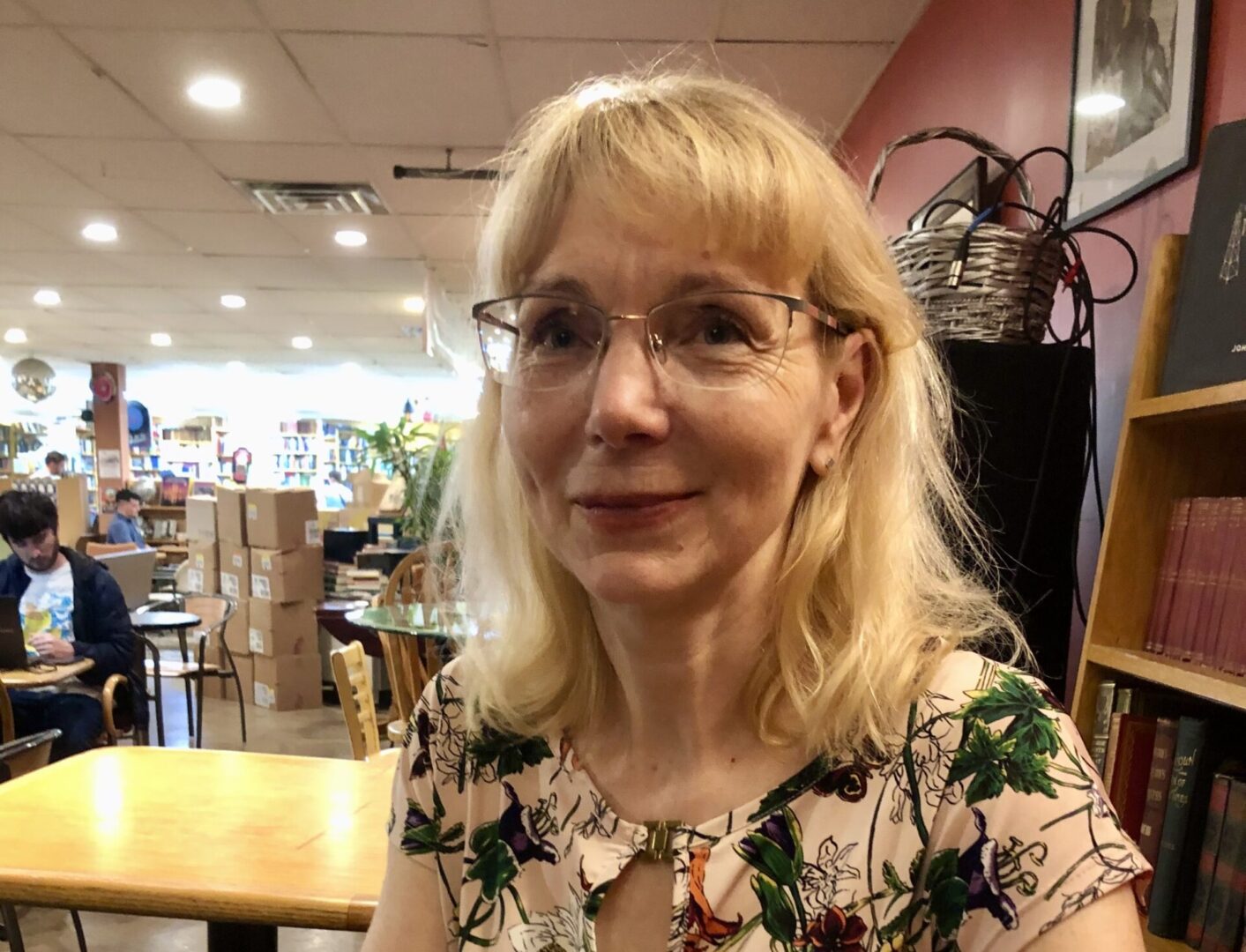
What does it mean to have a normal life? To Oleksandra Pyrozhok, it means that she and her husband Stanislav are together, have jobs and have their own apartment.
To appreciate what’s extranormal about the Pyrozhoks’ “normal life,” let’s go back to February 2022. The Pyrozhoks were living in Chernivtsi, a lovely city in southwestern Ukraine. There, too, they had a normal life: She worked as a realtor. He had an air conditioning business. They lived in a townhouse with a cat named Tom.
Then Russia invaded. Overnight, no place seemed safe.
The men in the Pyrozhok family, Stanislav and their adult son Vadym, were required to stay in-country to help with the war effort. Oleksandra, they all agreed, should join her older sister, Svitlana Budzhak-Jones, in State College.
About 8 million Ukrainians – mostly women, children and oldsters – fled the country. Oleksandra’s journey took two-and-a-half days: overland from Ukraine to Moldova to Romania by car and train; then Bucharest to Istanbul to Washington, D.C., by air.
At first, Oleksandra stayed with Svitlana and her family, helping around the house while checking in daily with her husband and her son and taking English lessons from the Mid-State Literacy Council.
In June 2023, Stanislav was able to join his wife in State College. Last September, Oleksandra and Stanislav both went to work for Designer’s Studio, a home décor business in Centre Hall owned by George and Nina Woskob, staunch supporters of State College’s Ukrainian community. In October, they got their own place.
Oleksandra and I met at Webster’s during a torrential rainstorm last Saturday. I had brought an umbrella; she hadn’t. She didn’t complain about being drenched.
She used a Ukrainian-English dictionary on her phone when she couldn’t think of an English word, but her English is a thousand times better than it was when we met two years ago.
She’s enormously grateful for the life she has now – grateful to have had a sister in the U.S. who is fluent in English and knows just about everything one needs to know about navigating life in this country (and who has been a dynamo in raising awareness and funds for her compatriots back home); grateful for the support of the Woskobs; grateful that her husband is with her and that their son, an IT guy, has not had to go to the front line; grateful for her English tutor, Susan Vidmar; grateful to have escaped a war zone.
“I like my job,” she told me. “I’m happy my husband is here, and we have Ukrainian people here. Every day is like a gift.”
But it’s not home. We Americans, told our whole lives that we live in the greatest country on Earth, sometimes imagine that everyone wants to come here. Fear-mongering politicians tell us we’d best close our borders or we’ll be overrun.
The reality is more complicated.
Yes, there are adventurers the world over who leave their native lands in search of something different and, they hope, better. And there are oppressed and impoverished people the world over who flee their native lands because to stay is to risk death, prison or unending misery.
Most of us humans, though, feel most comfortable in the land where we grew up, where we speak the language and understand the culture. Most of us would rather live among family and friends than among strangers. Emigration is usually a last resort.
That’s why soft-spoken Oleksandra, grateful as she is, is also fiercely homesick. If the war ended tomorrow, she told me, she would soon be making plans to return to her house in Chernivtsi and to Tom the cat. She showed me a photo. A handsome fellow.
“I miss my house, my cat, my city,” she said. “In Ukraine I had happiness. I don’t have happiness here. The war turned everything upside down.”
The war that turned everything upside down has been raging for almost two-and-a-half years now. That the overmatched Ukrainians have thus far held off a thug like Putin is astonishing and admirable in every way. But the cost has been horrific.
Reliable numbers are hard to come by. As many as 70,000 Ukrainian soldiers may have been killed so far. At least 11,000 civilians have died. Then there’s the damage – to the environment, the economy, the infrastructure, the cultural heritage – and to “normalcy.”
I asked Oleksandra the same question I asked her two years ago: Is the war worth it? Ukraine is a functioning democracy. Putin’s Russia is anything but. I witnessed Ukrainian democracy in action when I visited polling places as an international observer of their parliamentary elections in 2012. The freedoms Ukrainians enjoy are worth defending. But for how long? And at what price?
Now, as then, there’s no good answer.