
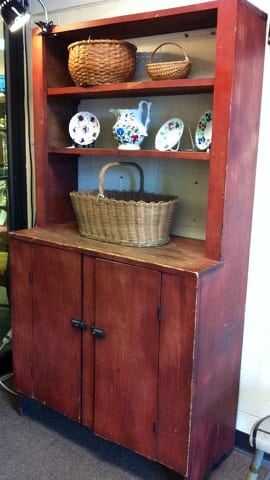
There was a time when people living in rural areas had to rely on themselves or local woodworkers when they needed a piece of furniture. In the 18th and the beginning of the 19th centuries, homemade or close by was the rule. But while sturdy and humble, country furniture reflected an enormous amount of ingenuity and creativity.
The influence of urban master craftsmen also played a role. About 15 years after their introduction in the major Colonial cities, sophisticated period styles began to filter their way out to the small villages and farmsteads in the countryside. Perhaps seen in a prominent local citizen’s home or on a visit to a Philadelphia relative, the distinct features of period furniture took hold of the imagination. Not too surprisingly, rural residents wanted to have these designs included in their own furniture although, overwhelmingly, the pieces had to be utilitarian first and foremost.
Some typical examples of utilitarian furniture in almost every rural home were chairs and tables, beds, dry sinks, jelly cupboards, pie safes and other storage pieces. Since there were no closets, a standing wardrobe was a necessity. This large piece, by the way, would be constructed so as to be easily dismantled for transportation from room to room, floor to floor, or house to house.
Another piece of furniture, borne of daily need, was the bucket bench. It was the charge of the eldest child to go out every morning to the pump or other water source and draw what was needed for drinking, cooking and washing. When brought in, the water buckets would then be placed on a bench constructed with a couple of shelves and thus stored for use during the day.
Even though basic and practical, utilitarian pieces could and often did include some of the attributes of period furniture. The leg shape on a kitchen table might echo the influence of a previous style: maybe a rudimentary ball and claw. Or there might be an intricate carving of a fan motif reminiscent of an earlier era on the headboard and footboard of a bed. These treatments to otherwise plain Janes added a touch of luxury, an impression of urbanism.
Sometimes stylistic details were painted on furniture. Freehand, stenciled or applied with a sponge, or even a carved potato, these patterns added color and interest to the piece. Many times the piece would be dated and might include the name of the person for whom it was made. Think of a blanket chest all embellished with flowers and birds, two sets of initials intertwined.
The technique of grain painting to lend the appearance of a more expensive wood was immensely popular. This was done by giving the piece, such as a chest of drawers, a coat of paint which was allowed to dry. Then another coat, most likely of a different color, would be applied. Using such common items as a comb, corncob or feather, and while the second coat was still wet, a simulated grain, usually to resemble oak, was created.
In addition to woodworkers, other trades contributed to furniture making. Local blacksmiths did more than shoe horses; they also fashioned hardware. Besides nails and screws, a varied output of drawer pulls, knobs and handles, hinges, hasps and latches, sometimes quite fanciful, came from the forge. Local or itinerant tinsmiths were responsible for the lining in dry sinks and created the panels for pie safe doors. Punched with a pattern of holes to let air circulate but keep out insects, one can find a whole galaxy of stars, swirls and other delights on the tin-paneled pie keeper.
Overall, the most distinguishing characteristic of country furniture is its individualism: no two pieces were made exactly alike. The uniqueness of design, detail and construction is a feature of these handmade products. Further, pieces could sometimes be attributed to a particular place and even to a particular woodworker. Did you know that in central Pennsylvania many towns boasted their own chair maker? Mifflintown, Aaronsburg and Lewistown, for example, each had a maker with a special, signature design and it was possible to identify chairs as coming from that specific location.
Country furniture was made to last, and last it did, in large part because of the attention paid to the inherent properties of the material. In the construction of a plank seat chair, for instance, legs, spindles and uprights would be made of kiln-dried wood. The seat, however, was not kiln dried. Thus, after assembly, as the seat dried, it would lock around the supporting structure.
Not only its durability, but the fact of its sheer quantity meant that much country furniture has survived and endured, and best of all, it is still available today to own, enjoy and appreciate.
More Community
View all Community
State College Borough Council OKs Free Holiday Season Parking Downtown
State College Borough Council on Monday approved a program that will once again offer free downtown parking options for the holiday season, starting before Thanksgiving and continuing until after New […]

State High Band Celebrates 100th Anniversary
More than 230 State College Area High School marching band alumni returned to the field on Friday night to join 240 current band members for a celebration 100 years in […]
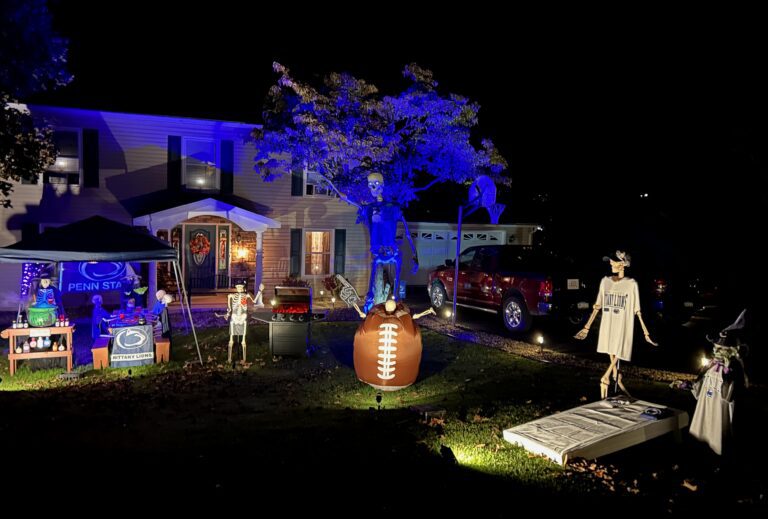
‘Big Leboneski’ and Friends Are Back in Bellefonte With Tailgate-Themed Display to Raise Money for St. Jude Children’s Hospital
A 12-foot-tall skeleton named Big Leboneski and his friends are back for another year on a Centre County family’s lawn to raise money for St. Jude Children’s Research Hospital. Now […]


