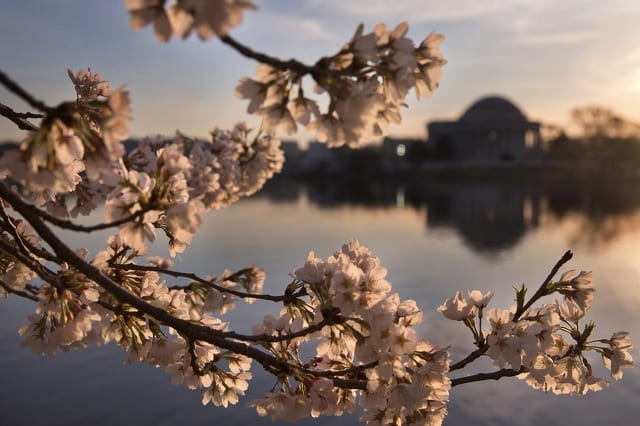
“Loveliest of trees, the cherry now is hung with bloom along the bough.” — A.E. Housman
For many, the National Cherry Blossom Festival in Washington, D.C., sponsored each year by the National Park Service, heralds the beginning of spring. This year it will be a month-long celebration, held through Sunday, April 16.
Fervor always builds as “watchers” report on peak bloom time for the stunning pink-blossomed Japanese cherry trees lining the tidal basin near the Potomac. This year, that peak is estimated to be Sunday, March 19, through Wednesday, March 22, recent cold and snowy weather permitting.
A group of National Park Service sites describe the variety of events to be held. There is a pink tie party, parade, wide array of musical performances, blossom kite festival and fireworks, all to commemorate the 1912 gift of 3,000 cherry trees from Mayor Yukio Ozaki, of Tokyo, to the city of Washington, D.C.
ORIGINS
These same park sites trace the interesting and somewhat convoluted origins of the trees.
Their arrival came about in part because of the persistence of one woman — Eliza Ruhamah Scidmore. She was a world traveler, writer, photographer, first female board member of the National Geographic Society and sometime diplomat at a time when it was unpopular for women to be recognized for accomplishments outside of the home.
It was after a first visit to Japan in 1885 that she began approaching the U.S. Army superintendent of the Office of Public Buildings and Grounds with a proposal that cherry trees be planted along the reclaimed Potomac waterfront. Her idea was dismissed for 24 years.
Finally, in 1909, she decided to try to raise the money to purchase the trees by enlisting help from first lady Helen Herron Taft. Taft had lived in Japan and was also familiar with the beauty of these trees.
She agreed to assist, and a day after Scidmore’s note arrived at the White House, a Japanese consul in New York, Kokichi Midzuno, suggested that 2,000 trees be gifted to the United States in the name of the city of Tokyo to celebrate the two countries’ friendship.
On Dec. 10, 2000, cherry trees were shipped from Japan to Seattle, Wash., arriving in the nation’s capital on Jan. 6. However, by Jan. 19 the inspection teams from the Department of Agriculture discovered the trees were infested with insects and nematodes. To protect American growers, President Taft authorized them to be burned.
Luckily, no diplomatic feelings were hurt, and a second donation, this time of 3,020 trees encompassing 12 varieties, was made. These were taken from Japan’s famous cherry tree collection along the bank of the Arakawa River in Adachi Ward, a suburb of Tokyo. This time, they were shipped from Seattle by insulated freight cars to protect against problems.
On March 27, Helen Herron Taft and the Viscountess Iwa Chinda, wife of the Japanese ambassador, symbolically planted two Yoshino cherry trees on the northern bank of the tidal basin. This ceremony, attended by only a very few, was the event from which the National Cherry Blossom Festival sprang.
By 1920, the remaining Yoshino trees were planted around the tidal basin, and the 11 other varieties were planted in East Potomac Park and on the White House grounds.
A TIMELINE OF EVENTS
■ 1938 — President Franklin D. Roosevelt’s plan to build the Thomas Jefferson Memorial was subverted by what has become known as the Cherry Tree Rebellion. A group of high society women chained themselves together around one of the trees to stop workmen from clearing ground that would destroy some of the iconic trees. A compromise was reached.
■ 1941 — On Dec. 11, four cherry trees were cut down and messages carved in their trunks in suspected retaliation for the bombing of Pearl Harbor by the Japanese. This bombing marked the beginning of the United States’ entry into World War II. For the rest of the war, the trees were referred to as “Oriental” flowering cherry trees.
■ 1952 — Japan’s famed cherry tree grove fell into decline during World War II, so the National Park Service shipped “budwood” from descendants of those same trees back to Tokyo to help restore it.
■ 1965 — An additional gift of 3,800 Yoshino trees from the Japanese government were planted on the grounds of the Washington Monument. This beautification was spearheaded by Lady Bird Johnson, wife of President Lyndon Baines Johnson.
■ 1997-2017 — Much work continues to be done to ensure that the genetic lineage of the original trees is preserved, both here and in Japan. Cuttings were taken from trees lining the National Mall and are being propagated at a nursery.
Over the years, the Cherry Blossom Festival has continued to grow, with all first ladies acting as honorary chairs.
JAPANESE CELEBRATIONS
For at least a thousand years, according to the Smithsonian Institution, the Japanese people have held cherry blossom parties with family, friends and colleagues, a tradition called ‘hanami,’ or “watching blossoms.” Today, these parties are often popular at schools and offices, where they help people bond and meet new friends.
Cherry trees are widespread in Japan, where their blossoms are exalted for their intrinsic beauty. They are called ‘sakura’ and are symbolic of spring’s renewal, as well as its fleeting quality: a metaphor for life.
Today, the Japanese flowering cherry serves as a reminder of not only the joy of ethereal spring beauty, but as an enduring emblem of continued goodwill between nations who were once at war.
OTHER FESTIVALS
Cherry blossom festivals are held in places other than Washington. Philadelphia has a popular one, as do many other U.S. cities.
For more information, visit www.pickyourown.org.