STATE COLLEGE — Ron Smith didn’t plan to write about Penn State and the Sandusky scandal.
However, following the news that shocked Happy Valley, Smith — similar to so many others —wanted to know how something like this could have happened.
“I was bothered by the whole thing and I wanted to find out how the way Penn State athletics were administered historically might have contributed to the Sandusky scandal,” said Smith.
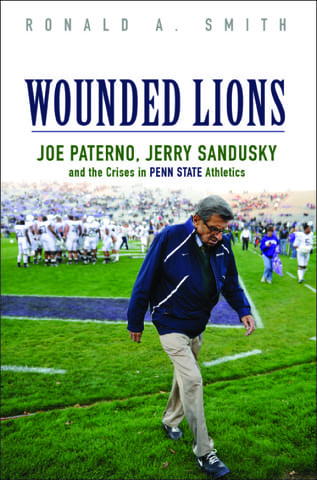
Smith addresses the history of Penn State sports administration and its effect on the Sandusky scandal in his new book, “Wounded Lions: Joe Paterno, Jerry Sandusky, and the Crises in Penn State Athletics.”
He will be signing the book from 1 to 4 p.m. Saturday, Feb. 13, at Forefathers Book Shop in Rebersburg.
Smith, originally from Wisconsin, is a professor emeritus at Penn State where he taught sport history from 1968 to 1996 and researched intercollegiate sport history throughout and after his career.
He worked alongside many of those involved in the scandal for years in Rec Hall at Penn State, including former head coach Joe Paterno.
“First of all, I didn’t believe it, like a lot of people,” said Smith. However, as time passed, “I wanted to find out why Penn State officials would keep this so quiet — some people call it covering up.”
Smith has written five books, most of which are about intercollegiate athletics. The research for these books and for his work with Penn State University have led Smith into “about 80 or 85 archives,” he said. So, he decided to look to the university’s history for answers.
He reviewed presidential files, alumni materials and board of trustees minutes, some of which dated back to the late 19th century. “I went back to see how it was governed,” said Smith.
Smith found an imbalance of power in Penn State sports administration that had built over many years. The power given based on the popularity and success of Penn State football allowed the eventual change of sports administration that resulted in athletics being taken out of an academic unit and placed in a business unit in 1980.
According to Smith, who was part of the committee that decided the switch, the two main figures in this change were Steve Garban, the president of the board of trustees, and head football coach Joe Paterno.
In Smith’s book, he noted, “The tradition at Penn State through most of the twentieth century was for profitmaking football to subsidize athletic and recreational facilities for the entire student body,” which frustrated Paterno.
When Paterno was asked to become athletic director at Penn State, he “would accept the position of athletic director only if athletics were removed from the academic unit, where he was a full professor, and became independent in the business office of the university,” said Smith in “Wounded Lions.”
According to Smith, the popularity of sports gives unusual power and notoriety to certain individuals — usually head coaches.
“They become godlike and iconic, and that’s what Paterno did, and he gains this power and he knows he can do almost anything he wants to do, and does it,” said Smith.
“We were essentially the only university in America where we were part of an academic unit. And in my estimation, it’s why we were so clean,” said Smith about Penn State University. “This is an academic institution, it’s not an athletic institution.”
That clean record led to the perception of Penn State as a place that, “was so clean that athletes never did anything wrong and the coaches were always perfect and all they wanted was an education and to win some games,” said Smith.
This perception solidified the idea of “Happy Valley,” which had been around since the Depression, when the isolated valley seemed to continue with little economic damage in comparison to the rest of the United States, according to Smith in “Wounded Lions.”
“Many believed that Paterno epitomized what was good about living in State College and the surrounding area. He was, to many, Penn State,” said Smith in “Wounded Lions.”
Following the case and investigation, Penn State implemented an athletic integrity officer and a very clear system of reporting suspicious events. The university also has many costs to pay off in the face to the scandal.
To Smith, the best course of action to prevent a repetition of this event would be to bring the university’s athletic programs back under academic control, but he also acknowledged the unlikeliness of this.
Smith doubts that the complete charm of Happy Valley will return in some time due to the impact of the scandal. However, “It’s still a wonderful place to live. Penn State has tremendous kinds of things that I enjoy,” said Smith.
The book has been published by the University of Illinois Press and copies are currently available for purchase online and in the Centre County Historical Society Centre Furnace Mansion at 1001 E. College Ave.