
A new public art initiative in downtown State College commemorates the 250th anniversary of the United States with works that celebrate the tapestry of American life.
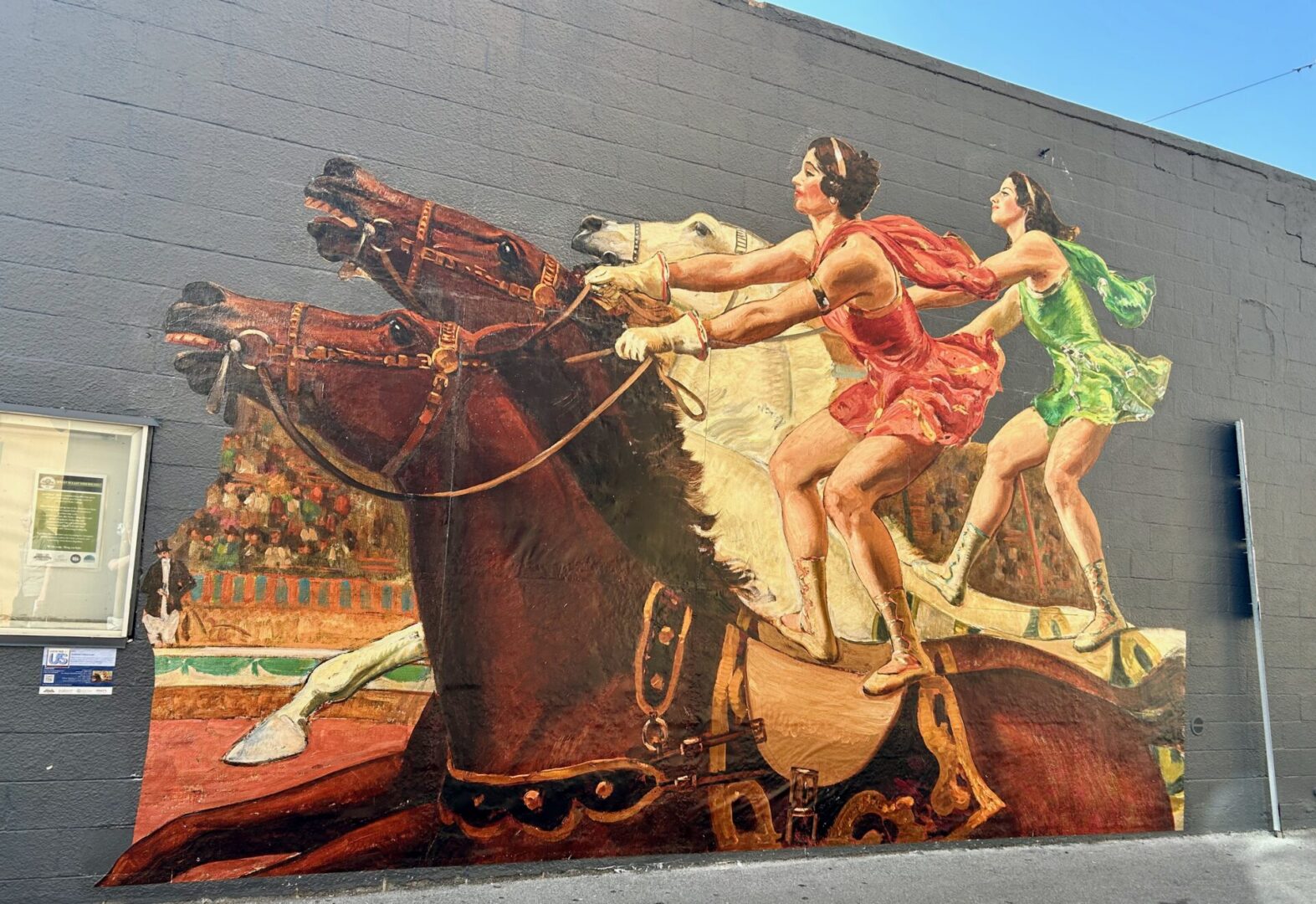
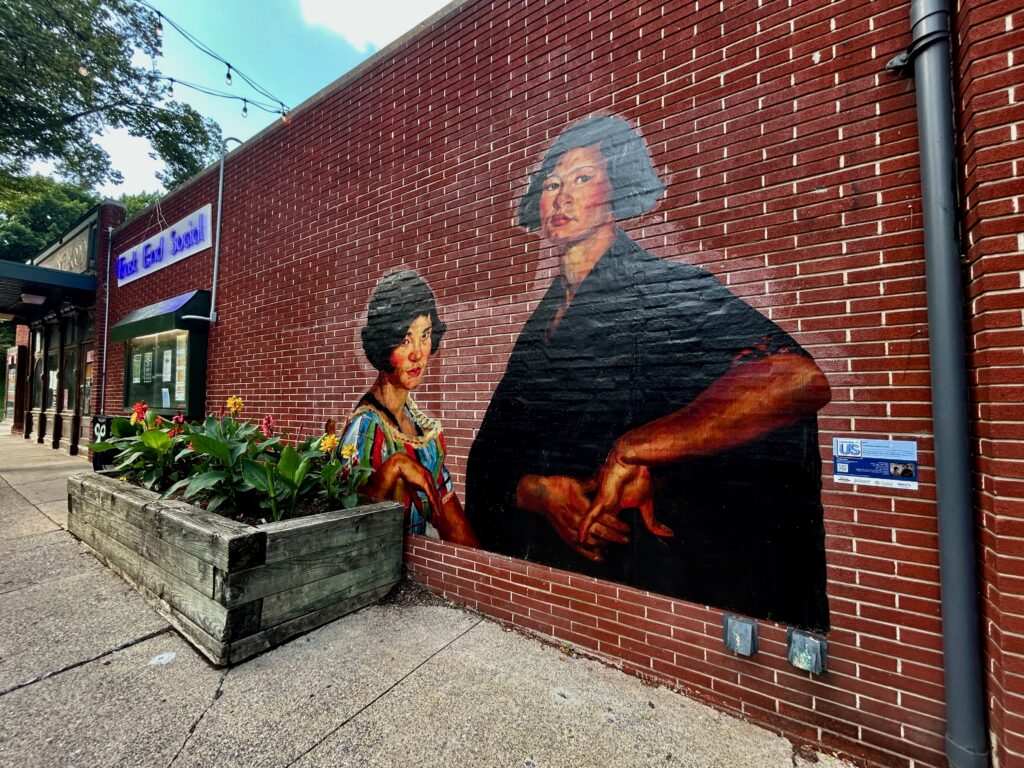
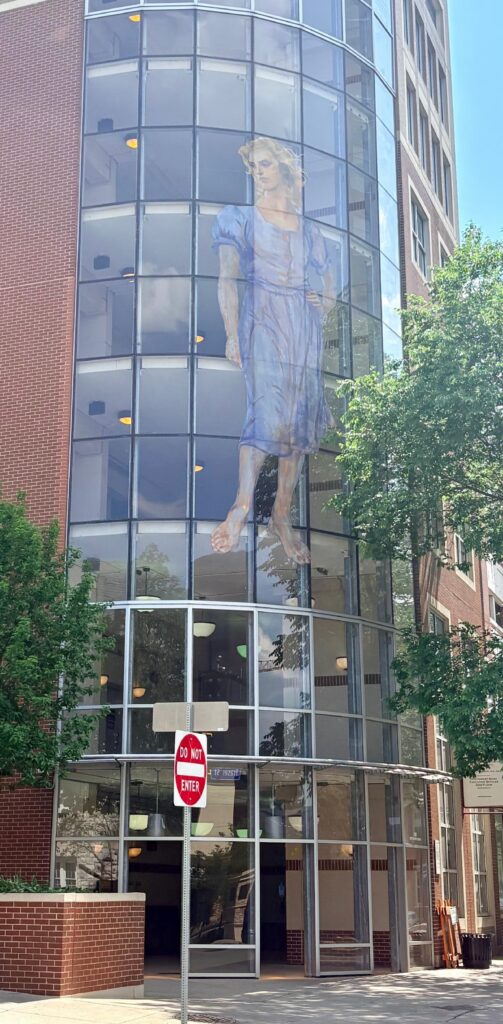
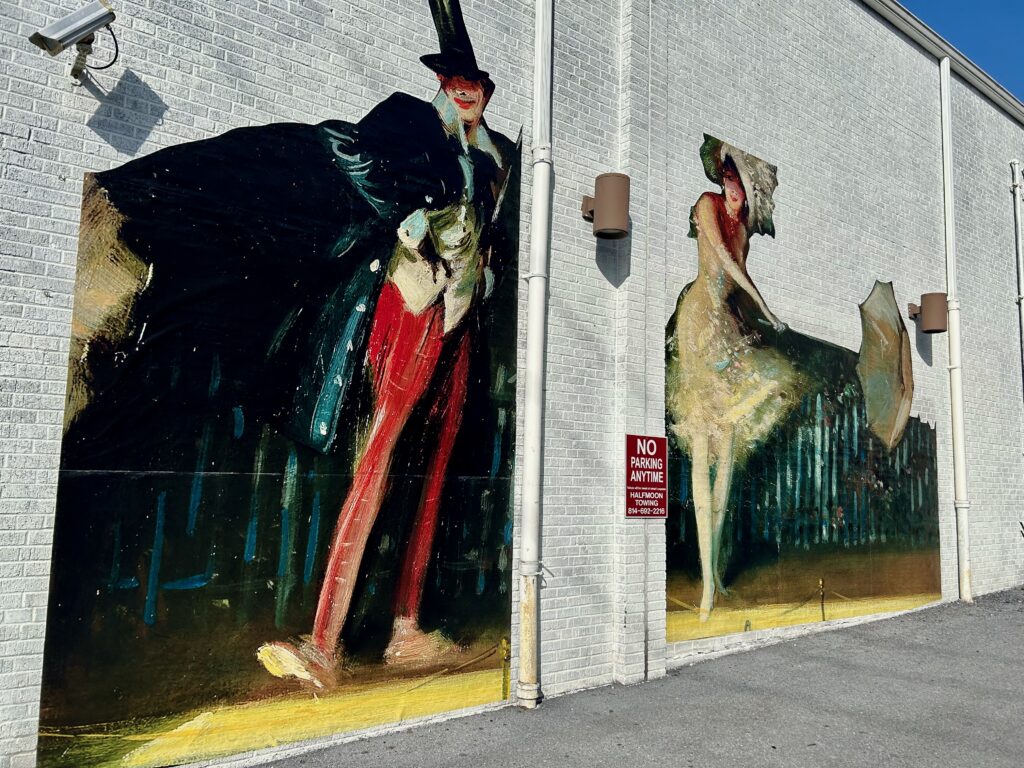
“Looking at US: Celebrating America’s 250th” includes 19 large-scale reproductions of portrait works by American artists from the Palmer Museum of Art at Penn State’s collection.
A partnership between the Downtown State College Improvement District, Palmer Museum, Centre Foundation, Happy Valley Adventure Bureau, Borough of State College and Central Pennsylvania Festival of the Arts, the larger-than-life murals spanning the 19th, 20th and 21st centuries are mostly located on the facades of downtown buildings, with a few inside local businesses.
The project was years in the making, and the partners celebrated its launch on Wednesday with a ribbon cutting at East End Social, the DSCID’s seasonal pocket park on Hiester Street where two of the murals are on view: John Sloan’s 1925 “Two Sisters” on the wall of Manny’s and Gifford Beal’s circa-1930 “The Roman Standing Race” on the Calder Way side of The Press.
“This is our way of celebrating America 250,” said Erica Quinn, DSCID consultant who led the project committee. “We really wanted to think about portraits of everyday Americans. So every one of the 19 new pieces of work, 19 new amazing murals stretching all throughout downtown State College, indoors and outdoors, all of Americans from the Palmer’s American collection, all portraits — people across time, people across space, people with connections to Pennsylvania.”
Lee Ann Jeffries, DSCID executive director, said the works selected for the murals represent a diverse array of everyday people throughout American history
“At first glance, the imagery may not look like the traditional symbols of America,” Jeffries said. “You won’t necessarily see red, white and blue or stars and stripes. But make no mistake, every person portrayed here, every artist represented is part of the American story. They are everyday heroes.
“Whether you’re viewing these murals downtown or seeing the originals at the Palmer, they invite us to look back at our history, look inward at our shared humanity, and look ahead to the future we hope to build together.”
The murals are located at 12 sites downtown, with information about each location available on the DSCID website and in a guide available from the DSCID office.
Each mural is accompanied by a placard with details about the original work and a QR code to learn more, as well as an explanation of the project. It also encourages viewers to visit the Palmer Museum to see the original up close.
“This mural project is not so much about gown supporting town as it is gown and town truly coming together to celebrate the country’s momentous 250th birthday,” Joyce Robinson, assistant director of the Palmer Museum, said. “And what better way to celebrate than with images of us, of Americans, drawn from the Palmer’s renowned collection of American art.
“As a public-facing museum, the Palmer strives to break down barriers that prevent visitors from feeling comfortable in our galleries, from seeing themselves reflected in the art in our care. The portrait banners distributed throughout downtown indeed are breaking down barriers by bringing highlights of the American collection to the people. And we hope that residents and visitors will recognize themselves in this diverse array of citizens. We also hope that passersby will be inspired to visit the real thing.”
Pamela Snyder Etters, executive director of the Central Pennsylvania Festival of the Arts and the founder and lead artist of the nonprofit organization Murals Talk, said murals are intended to “promote and provoke conversation among people that are viewing it, that want to talk about it, that want to discuss what they’re seeing.”
“I really hope that everyone gets a chance to take a look and a deeper reflection in front of these pieces to think about how they really do represent where we’ve been in the past, the struggles that we’ve all faced,” Etters said.
The project was a “labor of love” for Etters, who led the installation of each mural. She said that the placements took place over 10 days, with the time for each varying based on size and the number of assistants helping.
Etters explained that the Palmer scanned each work and sent the image to Mural Provisions in Philadelphia, which then printed them on to polytab, a mural cloth the company describes as “a non-woven fabric that is primed with 2 coats of the highest quality interior / exterior primer.”
She then used an adhesive called NovaGel to install the murals.
“I call it goop,” Etters said. “It’s a thick, gloppy substance. It’s actually like a painting medium, but it’s used by muralists for outdoor installation of mural cloth.”
NovaGel dries faster in heat and wind, so Etters and her partners had to do installations based on weather and time of day.
“It’s very expensive… so I don’t want to waste that,” Etters said. “So we have to be strategic about when we’re doing the work, what the weather’s looking like. I can’t just think about that day. I need to think about like the next day, too, just to make sure everything’s going to be fine. So it’s been a process for well over a month, but just picking out the days and times at work.”
A clear coat will be added to protect the colors, Etters added. They can be removed, but she expects they will remain in place for at least a year.
“Beyond that, it’ll be just a matter of just making sure that they’re maintained,” she said. “Maybe anytime something might peel, like just literally reinjecting it with a little bit of goop to just pull it back into the wall.”
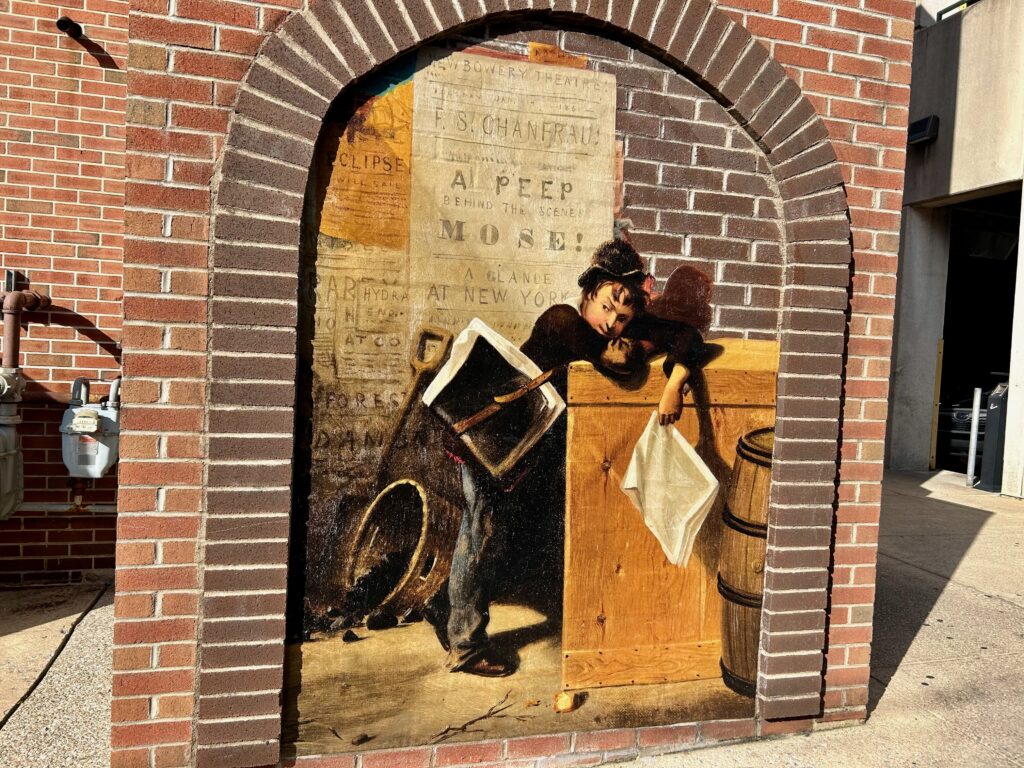
The end result of the collaborative effort has transformed parts of the downtown into a larger-than-life gallery, one which was supported by a grant from the Knight Foundation Fund at Centre Foundation.
“It reflects a shared commitment to community vitality and to creating spaces where people want to spend time,” Centre Foundation President and CEO Dave Lieb said. “As we celebrate the 250th anniversary of our great country’s founding, this project highlights local stories and perspectives through public art displayed here in the heart of our community.”
Melissa Roth, director of membership for the Chamber of Business and Industry of Centre County, said public art like “Looking at US” contributes to a thriving downtown that in turn supports economic development.
“Installations like these, they bring energy and activity to our downtowns,” Roth said. “They force us to slow down, to take notice, to see our community through a new lens…. Downtowns, public art like this, cultural experiences help attract talent, support our local businesses and strengthen our competitiveness. Economic development is about building communities where we want to live, we want to work, we want to visit and we want to invest in.”
The State College community is “fortunate” to have high-caliber art that children and adults can learn from and enjoy, Centre County Commissioner Amber Concepcion said. Commissioner Mark Higgins added that it “helps us see ourselves” and “allows us to interact with different ways of seeing things.”
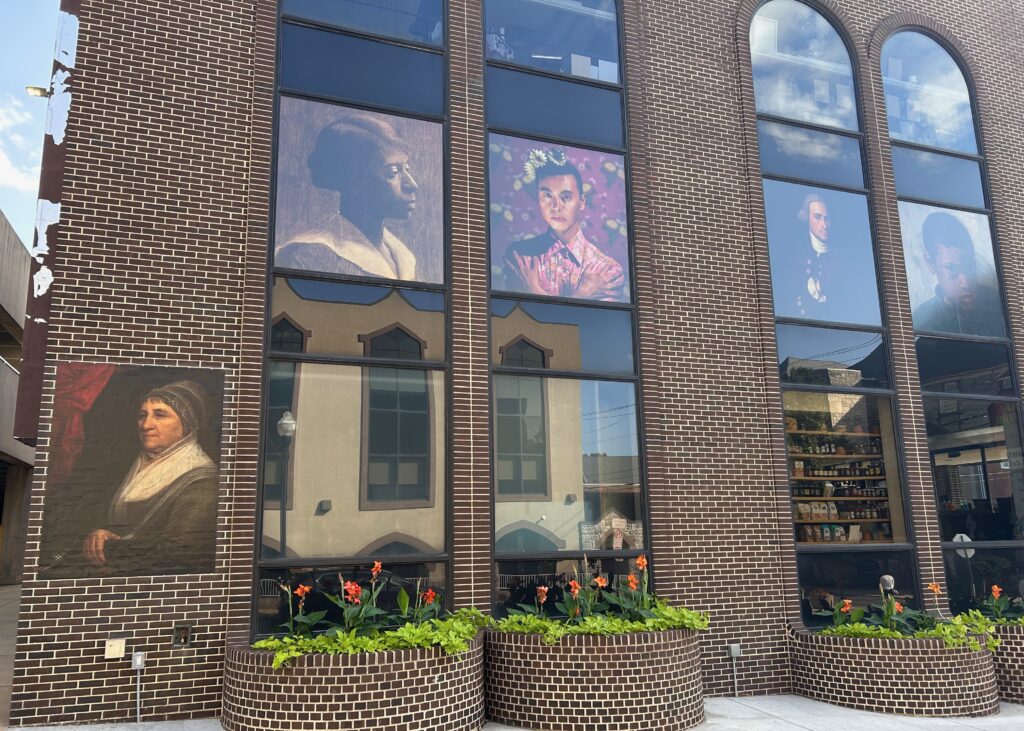
The project allows viewers to “zoom in” on some of the “incredible assets” of the Palmer Museum, State College Mayor Ezra Nanes said.
It also celebrates America’s 250th year by representing people from “a cross-section of our life” in State College and throughout the nation, he said.
“Anybody and everybody who comes downtown to see this mural project is going to say, ‘There’s something that represents me,’” Nanes said. “That’s very important because as we celebrate America’s 250th, this is a magnificent country. So much to be proud of. So much we can honor. America has not been perfect, and part of celebrating the country is recognizing where we’ve fallen short and that is in excluding certain people and certain identities, or even exploiting them or even trying to erase them.
“And here with a work of art like this, a project like this, we can honor dignity, we can heal those wounds and celebrate this country, because the diversity that we see on display in this project really is what America is all about. It is our greatest strength.”
More Community
View all Community
State High Band Celebrates 100th Anniversary
More than 230 State College Area High School marching band alumni returned to the field on Friday night to join 240 current band members for a celebration 100 years in […]
‘Big Leboneski’ and Friends Are Back in Bellefonte With Tailgate-Themed Display to Raise Money for St. Jude Children’s Hospital
A 12-foot-tall skeleton named Big Leboneski and his friends are back for another year on a Centre County family’s lawn to raise money for St. Jude Children’s Research Hospital. Now […]

Apple Fest Tradition Continues at Eagle Iron Works & Curtin Village
Eagle Iron Works & Curtin Village, located at 251 Curtin Road, Howard, will continue its Apple Fest tradition — a family-friendly fundraiser — on Saturday, Oct. 17 from 10 a.m. to 4 p.m.


