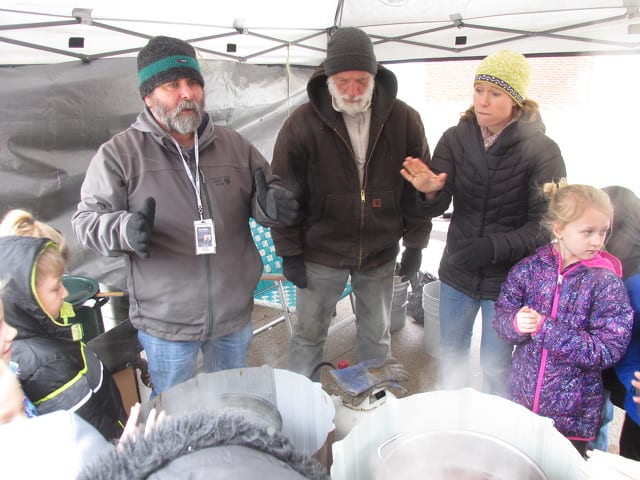
SPRING MILLS — Students at the Penns Valley Elementary and Intermediate School got a lesson in making maple syrup recently when Jim Flanagan, from the Penns Valley Conservation Association, and Dan Shimp, from Mountain Homestead Farm in Woodward, visited the school and made maple syrup, using sap collected from red maple trees on the school property.
“They don’t have as much sap as sugar maples, but we got enough,” said Shimp. Students were shown how to install taps and collection buckets on the trees. After the sap was collected, it was placed in metal pots on gas-fired burners, under a canopy and tarps to protect it and the student from the day’s cold winds.
Shimp explained the process of making syrup. “It’s pretty simple — you just boil out the water.”
He said it takes around 30 hours of boiling to make good syrup, and it takes about 40 gallons of sap to make 1 gallon of syrup.
Shimp told the children that the finished syrup you find in the store contains about 66 percent sugar. “If you buy syrup at the store, you’ll see it has many ingredients, but this syrup has just one.”
The men had two pots of sap boiling, one that had just started and one that had been going for several hours. They showed the students the difference between the two, and Shimp noted that “the longer it boils, the darker and thicker it gets.”
After some of the finished syrup had cooled, the students dipped crackers in it to get a taste of real maple syrup. Their consensus was that it tasted good.
“It was cool,” said fifth-grader Kaiden Marshall.
Maple syrup was first collected and used by the indigenous peoples of North America, and the practice was adopted by European settlers, who gradually refined production methods. The Canadian province of Quebec is the largest producer of maple syrup, responsible for 70 percent of the world’s output. Vermont is the largest producer in the United States, generating about 6 percent of the global supply.