
This article originally appeared in the December 2025 issue of Town&Gown magazine.
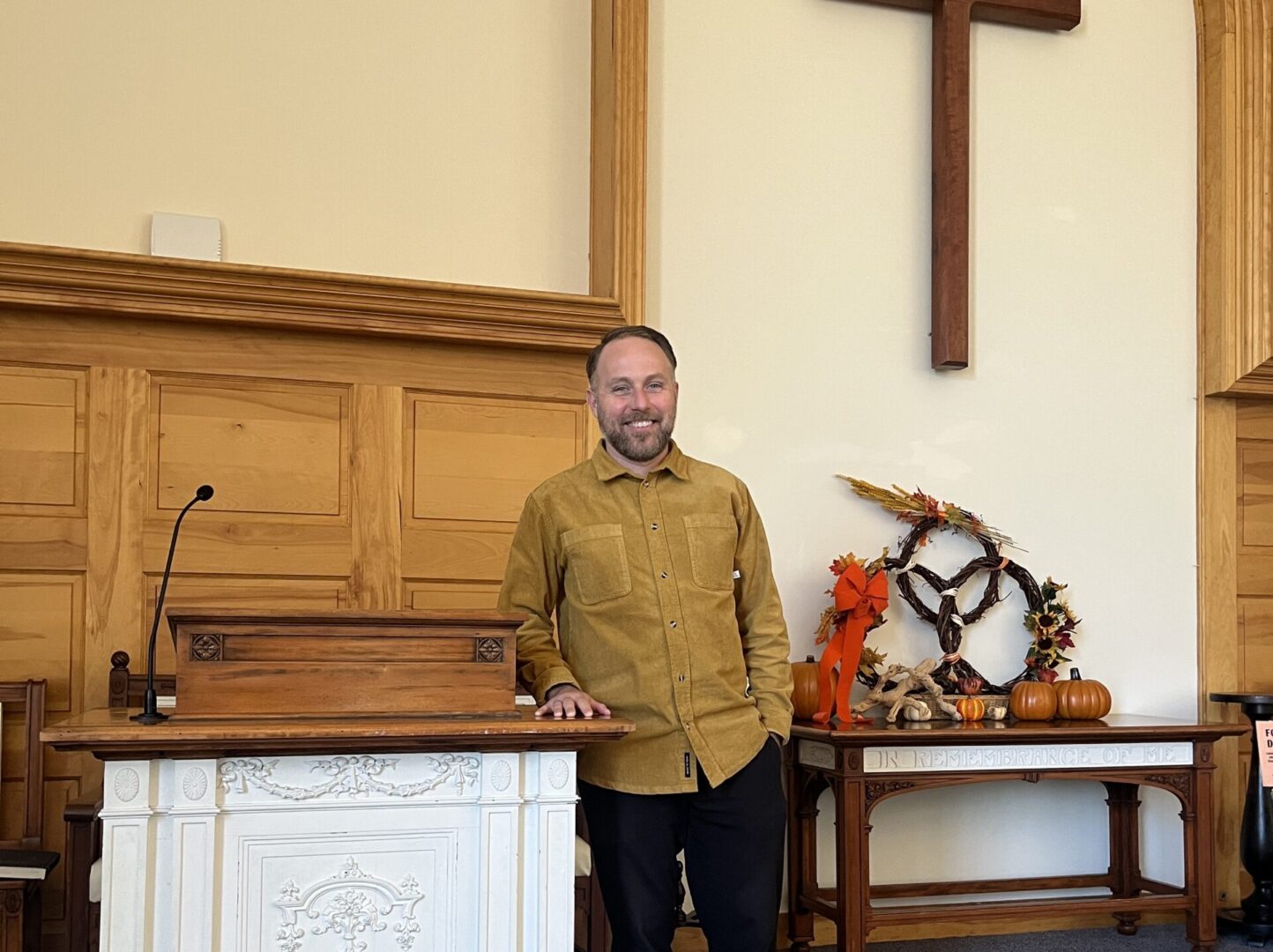
When the Rev. Jeremy Richards was looking for a new ministry last year, the University Baptist and Brethren Church in State College stood out.
But there was an obstacle. A 2,700-mile-wide obstacle.
Richards and his family were living in Oregon and love the Pacific Northwest.
“I came across the church’s profile in February of 2024,” he says. “And I thought, ‘Oh, that looks like a cool church; too bad it’s in Pennsylvania.’”
The thought of UBBC never went away, however. He learned that August that the church was still searching for a pastor, and he finally applied for the position in October 2024.
“The church drew me from the very beginning. It was coming to State College, just because it’s so far from home, that was the really big obstacle all along,” he says. “But then when we came and visited, we loved the church and we loved the people and it all just fell into place.”
Richards, a native of New Meadows, Idaho, arrived this summer to lead; he was officially installed on Sept. 21. He succeeds Bonnie Kline Smeltzer, who retired as pastor in 2022 after leading the church for 20 years. She remains a church member. (Richards says it’s typical for Baptist churches to take time between pastors to “help the church reset, think about where it wants to go in the future.”)
Prior to the move east to State College with his wife, Brie, and their daughter, Esther, Richards spent 5-1/2 years serving at a Baptist church in Portland, and for the past three years was the university chaplain and director of service leadership at Linfield University in McMinnville, Oregon.
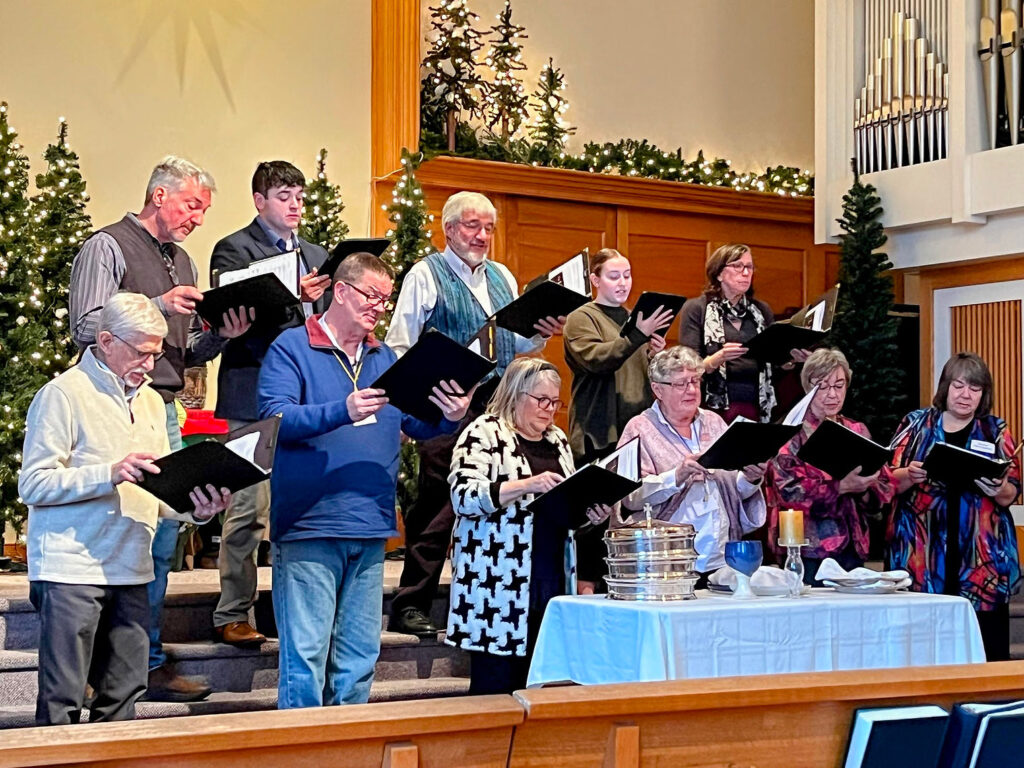
UBBC is known as a congregation that is welcoming to all and for its service in the community. That open-arms spirit even extends to its web address, ubbcwelcome.org. The church traces its founding to 1922. The Baptist congregation, with 40 charter members, met in private homes and on the Penn State campus until the first church building was dedicated in 1928. In 1968, the congregation was joined by a group from the Church of the Brethren. UBBC has about 300 people on its mailing list and about 150 active or semi-active congregants attending services.
Among many acts of service, church members are active in helping resettle refugees in the area and in raising money for charity.
UBBC’s big annual Alternative Christmas Fair has helped raise more than $1 million for charities over 40-plus years. This year’s fair takes place Sunday, Dec. 7, from 10:30 a.m. to 2 p.m. at the church, 411 S. Burrowes St. in State College.
Richards says he’s impressed by the work of his new congregation. “I just want to support them from the spiritual standpoint as they’re continuing to do the work that they’ve been doing.”
Writing sermons for his congregants is “therapeutic,” Richards says.
“To write a sermon, you have to work through your own stuff, too. So … it sort of helps me make sense of the world to try to say, this is what’s happening in the world, this is what’s happening in my community, this is who I believe God is. How does all that stuff work together? And how do I present it in some kind of engaging way each Sunday? So, it’s an exciting job to have.”
Here’s more from our conversation:
I think a lot of people’s impressions of Baptist churches are that they are pretty conservative. But that’s not this church?
Richards: What people expect when you say you’re a Baptist preacher isn’t always what I am. Historically, Baptists’ biggest thing is freedom. Baptists believe in four fragile freedoms. I’ll try not to get too nerdy about this, but there’s soul freedom, which is your kind of freedom of conscience; Bible freedom, which is freedom to interpret scripture for yourself; church freedom, which is to say that we believe in the freedom of the local church; and then religious freedom, that the government shouldn’t interfere in religion.
That isn’t always how a lot of Baptist churches function these days, but historically, those are the freedoms that we have. And so, you can really have the full spectrum of perspectives, like liberal, progressive, or conservative, or however you want to dice things up.
UBBC is very focused on being welcoming. What does that mean in practice?
Richards: I am blown away by this church, and I’m new enough that I can say that without taking any credit for it. They do so much to be welcoming and to reach out to all different people. Something that more and more people are thinking about, but maybe people don’t think of right away, is accessibility issues. The church just did a huge renovation in our narthex. And the point was, among other things, to have a lift so that people could get down into our fellowship hall and also up into the sanctuary, which is raised a little bit.
Unfortunately, it’s such a line in the sand at this moment, but so many churches are un-affirming of LGBTQ folks. And so, that’s another way that we want to be very clear that that group that has been so marginalized and ostracized by so many churches is welcome here. We do our best to make that plain.
I brought what I call “Litany of Belonging” that I wrote from my last church: Wherever you’re coming from and wherever you’re going, you belong; whatever your race and your ethnicity, you belong; whoever you love, however you identify, you belong; whether you’re a kid or a grownup, you belong. We try to say that at the beginning of each service to who’s new, to remind ourselves, and to state what we’re about. But then we also sort of put our money where our mouth is, whether it’s supporting organizations out in the community, advocating for folks, updating our building so it’s more accessible. We try to have our welcome be a part of everything we do.
In today’s cultural and political climate, does that create any new challenges?
Richards: Yeah. I just talked to a church member today about the way that we want to be welcoming to everyone. Regardless of, for example, political affiliation. We’re not partisan. We aren’t going to tell you how to vote or who to vote for, or what party to belong to. And yet everything is so politicized. To welcome queer folks can be seen as political. To advocate for the poor can seem political. To advocate for immigrants is political, right?
Almost anything you do or anything you don’t do, by saying it or not saying it, can be political. I think our biggest thing is we just want to follow Jesus and the teachings of scripture. For example, it’s throughout scripture that we care for immigrants and refugees, we care for foreigners. That’s maybe a Baptist thing … we are all about the Bible. So, I think tying it to scripture and saying, “Look, we aren’t trying to be aligned with this political party or that political party. We are trying to do what our faith teaches us, to the best of our ability as we interpret that.”
Is there a role that churches can play together in helping bridge this divide that the country seems to be in right now?
Richards: I hope so. I think it is hard. I think we should, and we have to. I think unfortunately churches often follow culture more than they should. Churches also divide up along basically political lines. But I think we have this common story, these common beliefs, that tie us together. And so, there’s this potential that we can come around the table on the things we do agree with and start there. It is tricky though, because none of us belong just to our church. We belong to all kinds of other communities and sometimes we feel certain fidelity to other communities as well. And how do those mix?
As a clergy member, do you have any advice for people on how to talk to folks who don’t share the same viewpoint?
Richards: The starting point is that from a Christian perspective, we all are made in the image of God. I think that we can disagree over issues, but we have to always see the humanity of the other. Like Dorothy Day said, “I only love God as much as the person I love the least.” We always have to start from a place of love. We need to talk about, we need to be passionate about, what we’re for more than what we’re against.
This isn’t so much explicitly Christian, but I’m taking a class on internal family systems theory right now and there’s an idea that people want to do good. Everyone is doing the best in their own circumstance. Even if, from my perspective, that person looks like they’re doing harm, I think we need to come into every encounter knowing that that person is doing the best from the perspective that they have right now. We have to be open enough to listen to the other person and what is the motivation for their views. What are the fears that are behind those views? Where is maybe the hurt that’s behind those views? And the same with ourselves. Where are we fear-motivated? Where are we hurt? And to see that kind of common humanity and to start there. If you have the trust and the respect for one another, then when you get into these topics that are much more difficult, there’s a foundation or a grounding that can hopefully sustain the disagreements.
What do you see as your mission here for the church?
Richards: It goes back to [a two-year] program I [completed] that connected spirituality to social justice. I think that churches in general tend to emphasize one over the other, like churches that get labeled more progressive or whatever are often out in the community and they’re all about what they do. But sometimes, and I’m painting with broad strokes here, they don’t have the kind of spiritual grounding. And I think there’s other churches that are very into spirituality, that pray often, that worship with lots of enthusiasm, but it stays sort of individual and sort of in-house and doesn’t always make its way out into the world.
My passion is the connection between those two things. I hope that I can continue to support the church in being both spiritually grounded in our Christian faith and also active, because I think those two things are two sides of the same coin. T&G
Mark Brackenbury is a former editor of Town&Gown.



