
In today’s fast-paced world, we often don’t have time to smell that Keurig coffee, let alone figure out how it made it into our morning mugs. However, it’s never too soon to understand some of the simple science behind how things like coffee beans grow, because some day they could disappear. And so could our cold watermelon, tortilla chips, blueberry pie, (shudder) chocolate or a total of about one-third of all global human food crops.
This is simply because all of these foods rely on pollinators to reproduce, and pollinator population numbers are decreasing.
In order to understand the process of pollination, we need to understand pollen. Many of us associate it with either the yellow dust that covers our cars in spring, responsible for the sneezing and itchy eyes of hay fever (a malady from which I suffered for more than 30 years), or the natural bee pollen extract being sold, purporting to protect the human body from a series of conditions such as arthritis and prostate cancer.
Actually, pollen is in many ways the fairy dust of the plant kingdom. It is the male germ seed of the plant, transferred from the anther of one flower to the stigma of another to help the plant reproduce (if you can recall your basic high school botany flower diagram). This process can be carried out by the plant itself, such as a willow tree expending its pollen into the wind, or by having animals called pollinators accurately and efficiently transfer it by visiting each flower and brushing against the flower’s anthers while looking for nectar.
Contrary to common beliefs, pollinators are not always honeybees. Actually, you may be surprised to know that pollinators include not just bees (of which there are many types), but hummingbirds, beetles, bats, wasps, butterflies and some flies and moths.
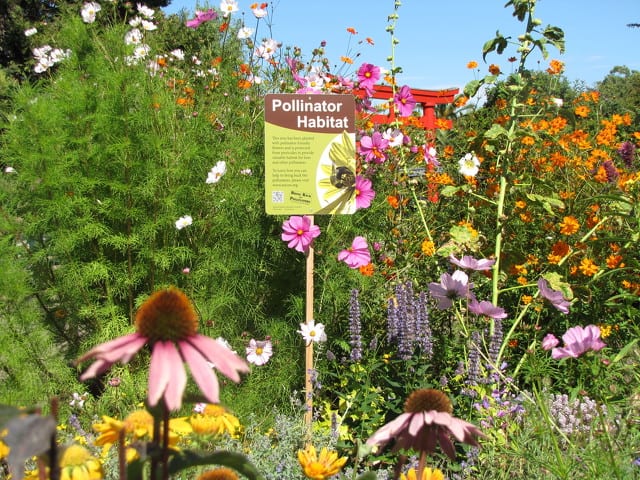
Pollinators are tirelessly working to keep our food supply abundant, so what can we do as gardeners to help and attract them? There are a number of things.
First, we can plant some native plants. One great example is native milkweed, which attracts monarch butterflies and provides a nursery for their eggs and a food source for the young caterpillars. Native plants are adapted to your area’s pollinators so they can offer a good fit for your garden. The Native Plant Society is a great place to look for guidance in this area.
Next, when we are planning and planting our flower gardens for the spring and summer months, we can use a wide array of different colored flowers to appeal to the many types of pollinators. These should be planted in masses or clumps of the same variety, rather than single plants, so the pollinators can find them more easily.
Interestingly, not only do honeybees see flowers in a different color spectrum than we do, they also see ultra-violet light patterns, invisible to us, at the center of each flower. It’s as though the colors and patterns announce the flower’s “stash” of nectar and pollen and act as a landing pad. Many flower landing pads beat one.
Most importantly, we can reduce (or eliminate) pesticide use around our gardens by using it as a last resort. Sometimes beneficial insects can control an issue. For instance, aphids are eaten by lady bugs, who may suddenly appear on our infected roses if we are patient and don’t treat at the very first sign of trouble. And, if pesticides do appear to become necessary, we can switch to those that target specific pests, follow the directions on the packaging carefully, and spray when pollinators are not in the garden, such as at dusk. We can also support businesses and farms that limit their use of pesticides to protect pollinators.
The support of pollinators is serious business. Their numbers are diminishing, blamed on everything from over-development, irresponsible pesticide application, outdated farming practices, disease and parasites. One indication of this seriousness came as far back as 2008 when Haagen-Dazs, a major ice cream brand, awarded a gift of $150,000 to Penn State University toward honeybee-related programs in its College of Agricultural Sciences.
Some gardeners (539 in 55 counties in Pennsylvania) are already very knowledgeable about the dire straits of pollinators and have taken serious steps in their own home gardens to make them Pollinator- Friendly, which is a specific certification. On the Penn State Master Gardener site there is a link which will take you to information, as well as an application to have your own yard certified.
In my recent years of gardening experience, I have a new-found appreciation for the wondrous world that pollinators inhabit. I am hesitant to do away with any living thing, be it bee or fly. They each, in their way, play a role in our ecosystem.
As for my suffering from hay fever, one day it mysteriously disappeared. Go figure. A gift from the gardening gods, I’d say.



