“Nature is a haunted house.” – Emily Dickinson
Dickinson, the reclusive American poet, felt the world of nature to be a hauntingly mysterious place, and what better time than Halloween to explore a sampling of its spookier and more malevolent residents.
The natural world is full of many insects, plants and even natural formations that are best for us humans to completely avoid.
One of the nastiest insects is one of the most common — the cockroach (Blattella germanica), believed to have been on the planet for 350 million years.
In 1940, the Carmelitos Housing Project in Southern California, a “new design for living,” opened to much hoopla, complete with a band and speeches. This huge complex of 712 town-house style apartments was one of the first built to offer people a way out of the Great Depression.
Fast forward 20 years when a disturbing pattern began to emerge. Almost 40 percent of all hepatitis A cases in the community were coming from the housing project. The carrier was found to be cockroaches.
Luckily, at the time, a group of UCLA scientists had developed a relatively safe insecticide called “Dri-die,” which eradicated them and almost completely eliminated new cases at Carmelitos.
Today we know that cockroaches transmit lots of diseases, even though only 5 percent of the total cockroach population live near humans.
They are able to crawl through any crack or opening and can easily travel through ductwork, sewer lines and electrical wiring, living off a wide variety of food waste and even things like book bindings, stamp paste and fingernails.
The pathogens they carry with them include E. coli, salmonella, leprosy, typhoid, dysentery, plague, hookworm, hepatitis, staphylococcus and streptococcus.
To compound the problem, a new set of health concerns have arisen because of home pesticide exposure, caused when homeowners try to eradicate them. What’s best to be done?
To be honest, the best defense has been found to be the use of safe roach baits, cleanliness and a well-sealed home. (“Juice” of dead roaches also acts as a repellent, but isn’t liable to catch on.)
It’s not only the insect world that has its share of villains.
Poisons made from various parts of some plants can cure or kill, sometimes depending on the type of dosage.
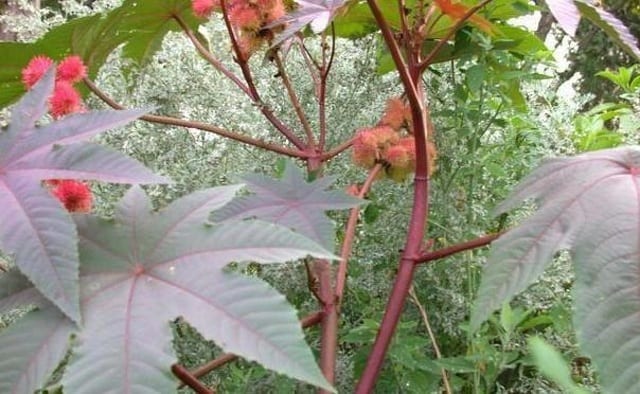
Take the castor bean plant (Ricinus communis).
In 1978, there was the very public case of a BBC journalist and communist defector Georgi Markov, who was waiting at a bus stop in London when he felt a painful jab to the back of his leg. He turned in time to see a man with an umbrella quietly apologize and run away. Within the next few days he developed a fever, began throwing up and went to the hospital, where he died in agony shortly thereafter.
Hemorrhages were found in almost every organ in his body. Upon examination, the puncture mark in his leg held a tiny metal pellet of ricin, the poisonous extract of the castor plant.
Though KGB agents were suspected of the “umbrella murder,” no one was ever charged.
This poisonous plant, the castor bean, can be grown as a striking annual with red stems and burgundy foliage to a shrub over 10 feet tall. It has deeply lobed leaves, seedpods that are prickly and large speckled seeds. It’s the seeds that are poisonous, with only a dosage of three or four necessary to cause serious illness or death. Luckily, people do survive it if it is purged quickly.
Castor oil, however, has been used as a laxative, a muscle soother and an additive to cosmetics. A daily spoonful for children has been thought to be a restorative for eons.
The good news is that in the case of castor oil, the ricin is removed in the manufacturing process.
The castor plant is not the only harmful one by far. A top 10 list of potentially dangerous plants includes the western water hemlock, castor plant, wolfs bane, strychnine tree, bushman’s poison, white snakeroot (reported to have indirectly poisoned Abe Lincoln’s mother), common bladderwort, giant pitcher plant, angel trumpet and white baneberry.
A word of caution: it is important at this point to stress that every plant in the plant world deserves respect. A plant’s power should never be taken lightly. Gloves should be worn when handling plants, and no one should experiment with ingesting any parts, especially those that are unfamiliar.
Finally, let’s conclude with a truly frightening prospect — a stream that swallows people.
In Yorkshire, England, there exists one of nature’s most terrifying traps. It appears to be a small innocent-looking mountain stream that is about 6 feet across. It’s known as Bolton Strid, or simply the Strid.
No one who has attempted to “stride” across this small mountain brook has come out alive (and most bodies were never recovered).
This is because, in reality, the small stream is a river (less than 100 yards upstream it is the River Wharfe), but this river has been forced through a narrow gap, with the water gaining tremendous speed and unknown depth. Apparently, hidden within the seriously undercut banks is a network of caverns and tunnels that hold all of the rest of the river’s water. All it takes is one slip and … .
Today, there are prominent signs warning against leaping across, as well as a policeman who patrols the area.
Sadly, one supposed victim of the Strid was young William de Romilly who attempted the leap in 1154, never to return. His mother, in her sorrow, donated surrounding land to establish the Bolton-Priory monastery and William Wordsworth commented about it in his poem “The Force of Prayer.”
The Boy is in the arms of Wharf(e),
And strangled by a merciless force;
For never more was young Romilly seen
Till he rose a lifeless cor(p)se.
Ah, yes, nature’s dark secrets. And many are found in our own homes and backyards.
Garden notes: Want to lose some more sleep? Pick up a copy of Amy Stewart’s books, “Wicked Bugs” and “Wicked Plants,” for information on other diabolical members of the natural world.