
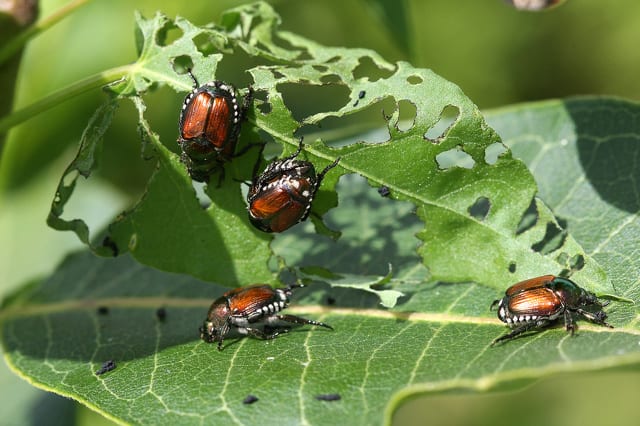
Although gardening in the very early twentieth century was a challenge, there is one annoyance with which our predecessors in the eastern part of the United States did not have to contend – Japanese beetles (Popillia japonica).
This is because the beetles were not discovered in the United States until 1916 in a plant nursery near Riverton, New Jersey.
It is believed the larvae arrived from overseas in a shipment of iris bulbs before 1912, the time when inspections of imports began.
In Japan, where these beetles originated, there were natural predators to keep them in check. We were not as lucky. A century later, east of the Mississippi, we are still suffering the spreading aftereffects: severe damage to turf grass, as well as to the foliage, flowers, and fruit of more than 300 species of plants. Their skeletonizing habits have become a major annoyance.
I found it useful to learn about their life cycle and habits in order to better control them in my yard.
The adults, which emerge from the ground here in mid-June to mid-July, are about ½” long and ¼” wide, and a metallic green with coppery wing covers. If disturbed, they tuck in their legs and drop off of plants, poking up their back legs to ward off threats.
They feed over about a six-week period, most eagerly in full sun from about 9:00 AM to 3:00 PM, and move downward on plants from the top as the leaves are consumed. Odors (also known as pheromones) coming from beetle-damaged leaves, as well as other adults, attract more beetles to feed on the same plant. Besides feeding, they also mate.
At sunset, once the pheromone is no longer produced, the females fly to the turf to lay eggs several inches below the surface.
These eggs mature into larvae (grubs) which are C-shaped, plump, and grey-ish white with light-brown heads. They feed on the roots of grass until cold weather eventually drives them further underground. There they overwinter below the frost line.
When the warmer weather arrives in the spring, the grubs once again feed on grass roots until they mature and pupate about 1-3 feet below the surface during May or early June, later emerging as adult beetles to begin the cycle once again.
Homeowners often try to attack the Japanese beetle in its underground phase as a grub or later as an adult beetle.
Attacking the grubs is complicated. There are many approaches which require prudent and knowledgeable strategies, and some are only available to places like golf courses.
One I read about included applying an insecticide like halofenozide, (more likely to conserve beneficial insects), at some point between July-September.
A different type of method, using biological control (think harnessing nature), has included purchasing something called milky spore disease (Bacillus papillae), which is a bacterium that causes a disease in the grubs. This, according to a University of Minnesota Extension site, is no longer as successful in scientific trials as was reported in the 1960’s.
A third (also biological) control is using a beneficial nematode (a microscopic parasitic roundworm), Heterorhabditis bacteriophora, that finds a grub, penetrates and inoculates it with bacteria. Then the nematode feeds on the bacteria, which kills the grub.
However, for any of these grub treatments to be done by the homeowner, as an Iowa State University Extension site explains, “…the relatively small area you can treat (compared to the grassy sites in the surrounding area) will not have any impact on the following year’s adult population.” This is because the beetles are strong fliers that can travel long distances from where they emerged to where they are feeding.
The good news is that there is one inexpensive preventative measure shown to have success. It is to withhold water from the lawn in late summer, letting it go dormant at the time when the female beetles are laying eggs. The eggs and young grubs require moisture to thrive, so the next year’s adult population will be decreased.
For those suffering through a particularly annoying infestation (A friend told me that someone she knows has a 5-gallon bucket of dead beetles in his garage), there are some organic strategies that can be used to help control the adult population.
The number one way to decrease the population, especially in smaller areas, is to hand-pick the beetles from plants, which has been found to be about as successful as spraying. The best times of day are in earlier morning or evening when the insects are more sluggish.
When a jar of soapy water or rubbing alcohol is held beneath the infested leaves, the disturbed beetles will drop off into the jar, not only killing them, but removing the pheromone they release. If there are fewer beetles, there are fewer released pheromones to attract a crowd.
Other ideas include laying a plain cloth under a tree and shaking it so that the beetles drop onto it, or using floating row covers (or other similar gauzy material) to protect smaller or more valuable plants.
There are certain types of plants that attract the beetles, such as roses, grapes, flowering crabapple, and American linden. Replacing common landscape plants that are inevitably attacked with others seldom damaged, like holly, rhododendron, common lilac, euonymus, and yew, is another approach.
Finally, it is considered wise to steer clear of any Japanese beetle traps that use lures. The reason is that these traps capture as few as fifty-four percent of the insects in the garden (as shown in a University of Kentucky study), while attracting far more to do damage on adjacent plants.
There is some good news in all of this. Though beetle damage may look unsightly, it rarely seriously harms the health of the attacked plant, so confining control to more noticeable areas around the yard or building may be an option.
Also, I did learn that Japanese beetles particularly like to feed on poison oak, sumac, and ivy plants. That warmed my heart.



