“A flower is not a flower alone; a thousand thoughts invest it.” — Mandy Kirkby
With Valentine’s Day fast approaching, thoughts invariably turn to beautiful flowers to help express our deepest emotions. A dozen red roses, for instance, traditionally signals passionate love.
We are not the first people to express feelings with flowers. For thousands of years, traditional cultures around the globe have found flowers highly meaningful, and this language told through the use or arrangement of flowers is called floriography.
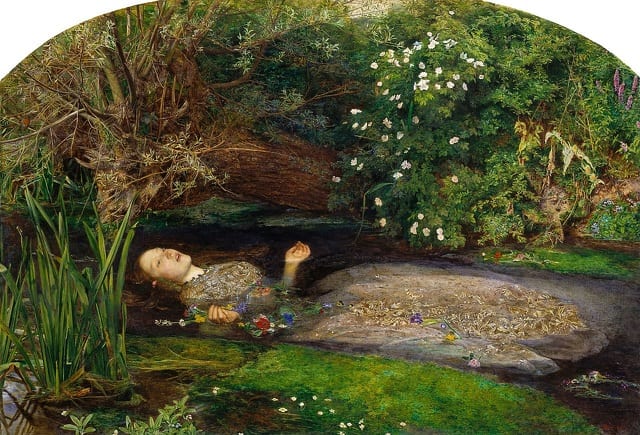
Flowers have long been symbolic in art, religion and in popular folk culture’s songs, pictures and writings. An example is the famous painting of Shakespeare’s character Ophelia by British artist Sir John Everett Millais, completed between 1851 and 1852. She is shown floating in a river before her death and each of the flowers pictured carries a symbolic meaning, including a poppy that to the Victorians represented sleep and death.
It is difficult to say how the interpretation of flowers as symbols came about, and today the same flower may have multiple meanings.
Vanessa Diffenbaugh related in her introduction to “A Victorian Flower Dictionary” by Mandy Kirkby that the symbolism of flowers became very popular in both Victorian England and the United States in the 1800s. This was a direct result of the publication of floral dictionaries that listed meanings of individual flowers and targeted genteel young ladies who associated flowers with romantic love.
At that time, the Victorians used flowers more in everyday living than we do today. Gentlemen were known to put carnations in buttonholes, and ladies wore flowers in their hair. According to the author, flowers’ symbolism was evident in many occasions: roses, violets and forget-me-nots were given during courtship; orange blossoms were used at weddings; and wreaths of cypress were present at funerals and laid on graves.
This genteel way of life gradually faded as the world wars and the rise of technology did away with what was considered sentimentality. However, the giving of flowers never went out of fashion.
For a sampling of floriography, here are a few of my favorite flowers, along with their symbolic meanings and Victorian era uses, as related in Kirkby’s book:
■ The daisy represents innocence, and with it purity and simplicity. This idea came from the fact that the Celts believed that “when a child dies at birth, an angel throws a daisy down upon the earth to console the bereft parents.” In addition, petals of daisies would also be plucked one by one to indicate whether loved by another.
■ Forget-me-nots are a delicate blue flower that blooms in spring. These flowers signify remembrance and were engraved on lockets worn by ladies whose beloved men were soldiering away from home. Their image appeared on things like china, writing paper, hats, slippers and silver brooches.
■ Orchids, as might be guessed, represent refined beauty. Orchids were all the rage in England due to their elegant and exotic beauty. As Kirkby said, “An orchid worn in the hair, an arrangement in a vase, and entire orchid house even — the flower never failed to impress, not least because it was so costly to buy.”
■ The lovely and fragrant rose represents affection and love in all its stages, from first love through mature, depending on its varied color. There were many different colored roses from which Victorians could choose. There was even a color to represent infidelity: yellow.
In addition, the stronger the affection, the deeper the color to match, and the rose’s budding and blooming represented young womanhood to full-blown beauty, along with the transitory state of love.
One of the most interesting aspects of this modern “Victorian Flower Dictionary” is a section on “Flowers for Special Occasions,” in which the meanings of flowers are applied, along with a few cautions.
First, the author explains, there are not any hard or fast rules about what flowers should go together. She implies that no combination of flowers sent from the heart can be truly wrong, whether designed at home or by a florist. To me, another thing to keep in mind is whether a flower is available during that season.
The areas covered in the dictionary are courtship, weddings, births and christenings, illness, friendship and funerals. There were also many subcategories for particular situations.
Interestingly, the category of courtship includes everything from “The First Bouquet,” to “The End of the Affair.” One of the subcategories there caught my eye. It was “A Passionate Bouquet.” Kirkby’s book recommends, “For this, rich colors and bold shapes are advised and the darker the color, the stronger the passion. Here are suggestions of flowers and their meanings:
■ A mixture of colored roses — orange (fascination), red (love), purple (enchantment)
■ Bird of paradise (magnificence), bougainvillea (passion) and lily (majesty)
■ Jonquil (desire), tuberose (dangerous pleasures) and nasturtium (impetuous love).’
The Victorians obviously had a great appreciation for the expressive potential of flowers, and that has not changed much even today, even though many of these exact meanings have been lost to time.
No matter whether your intent is to show friendship or express undying love, it surely can be a more meaningful Valentine’s Day if you decide to “say it with flowers.”