
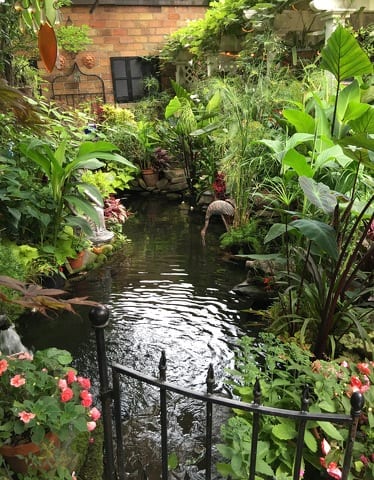
“It is life, I think, to watch the water.” — Nicholas Sparks
What do many ancient Italian Renaissance villa gardens, as well as many modest U.S. residential gardens, have in common? Lovely, classical and unique water features.
The term is thrown around casually today and can actually describe anything from a bird bath to a fountain, pond, waterfall or stream.
Prior to the 18th century, more elaborate water features were powered by gravity, animals, or man. Later, some were powered by steam engines. Today, many have pumps that are electric or solar powered, and some are even musical. Water features delight and entertain in almost every country around the world.
Water features are hugely popular in home gardens for two reasons. First, they enhance the garden by providing a scenic place of peace and tranquility for family and friends. Second, water is very effective in encouraging desired wildlife to visit a backyard — everything from birds, to butterflies, dragon flies, frogs and other insects.
The addition of a bird bath is the simplest way to provide a place for birds to drink and bathe. Some bird baths are elaborate and can be bought at most places like garden stores, but others are rudimentary — made of materials like saucers or pots found at home. They can be hung in trees from chains or hooks, placed on pedestals, or put directly on the ground.
A Penn State Extension article about attracting wildlife explained that birds that visit feeders, like chickadees and finches, are most likely to use those bird baths above the ground; less common species that prefer a natural stream or pond may prefer ones on the ground.
Apparently, it’s also a good idea to provide birds’ feet with a non-stick surface by adding some small rocks or bathtub stickers when using a material like smooth glazed pottery or plastic for the bird bath.
Another idea for attracting birds, especially when the weather is steamy, is to employ a dripping or misting water feature, some of which are sold in stores.
Bird baths should be preferably placed in a shady spot to keep the water cooler and free of algae and in a spot where birds have cover and a clear view of any approaching dangers, such a neighbor’s cat.
Because of the current concern about mosquitos, I try to change my bird bath water every day. If I know that I will not be able to change the water frequently, I add a doughnut-shaped gray product called Mosquito Dunks. It is a biological control containing BTI, a bacteria toxic only to mosquito larvae (non-toxic to wildlife, pets, fish and humans) that lasts for 30 days or more. I also try to scrub the bird bath with mild soap and water about once a week to help prevent algae.
This year, however, it was time for me to graduate to a small pond. While I was thinking about it, these are some factors I considered:
■ Would it be a focal point or blend in with the surroundings? (A wildlife pond, unlike an ornate water garden, blends in with the garden and usually has other plantings like trees or shrubs that attract wildlife.)
■ Should it be dug using a liner or made with a pre-made pond form; I aimed for a desired size that was reasonable to maintain.
■ What was the sun exposure and was it protected from wind; was there runoff from surrounding lawns or roads that could contaminate the water?
■ Did I have a nearby power source to power the pump and water source to add water?
■ Was there a spot that was not too rocky or with large tree roots?
■ Were there safety issues? (It is wise to check with the insurance company for liability issues and local ordinances for restrictions about water depth or fencing.)
■ What type of water features did I want? These could include such things as waterfalls, bog gardens, dripping fountains and separate fish pools in a large pond.
There are flexible liners that do allow for a self-designed pond, but they can be bulky and require a few people to install.
To keep it simpler and less costly, I used a preformed plastic liner, specially designed for pond use, so it was not coated with toxic chemicals. Many garden stores stock them.
Once the hole was dug and leveled, the pond form was inserted (by my brother who kindly engineered the installation and did much of the labor) so that it was flush with the ground and the soil around the pond was sloped away in order to lessen run-off.
Next, we determined the volume of water needed to operate a submersible pump properly while maintaining the desired flow level. It was important to remember that if the pump was run continuously, a considerable amount of water would evaporate, especially in the summer.
The plastic liner would need to hold 2-1/2 times the volume of water required, and this helped in buying the correct size pump and filter box to hold it.
After filling the pond, we positioned the pump in the filter box and placed one of the chosen types of water features over the pipe extension. Next we connected the pump to the electrical source, following the safety precautions, and adjusted the flow.
There are additions that I can make to the pond in the future, such as plants and fish. These will require some thought, but the basic installation is complete, and I can decide on those things later.
There are lots of types of plants that can be added, such as deep water, floating, submerged and marginal. It’s a good idea to be sure that the ones selected are native and have the appropriate depth, sunlight and temperature requirements for my pond, so I will need advice from an aquatic plant supplier and a good plant guide.
One such guide is “Pocket Guide to Mid-Atlantic Water Garden Species” by Diane J. Oleson of Penn State Extension. A few examples of natives include water hyacinth, Illinois pondweed, hornwort and sweet flag.
If I do decide to add fish, native species like smaller sunfish or minnows would be good for a wildlife pond. The recommended ratio of fish to water is 1 inch of fish per gallon, with a suggestion of at least 15 inches of depth. It’s also a good idea to let the water stabilize for a few weeks prior to adding any fish, and to float the bag with the fish on the water for 15 minutes or so to acclimate them to the water’s temperature.
I can add a heater to the pond in winter or remove the fish and place them in an aquarium. I can also store the plants in their pots in a cool place until spring.
Good maintenance will require topping off the water in summer, cutting back any overgrown plants, removing algae and cleaning out the pond by completely draining it in the spring, every two to three years.
I have already enjoyed my little pond immensely this summer. Birds hop and dip along the pond each day, and other visitors like the chipmunks are always scurrying back and forth. I am certain it will continue to relax, entertain and attract backyard wildlife for years to come.



