

Many people assume that because State College is not Philadelphia or Pittsburgh, it must be an affordable place to live. Those of us who live and work here know that is no longer the reality.
State College doesn’t have Pittsburgh wages with rural Pennsylvania costs. It’s increasingly becoming big-city housing costs without big-city pay.
The cost of housing in Centre County continues to rise, driven by limited inventory, continued growth and the unique pressures of a university community. Rent, mortgages, childcare, groceries and everyday expenses have all increased. Yet too many workers are expected to make ends meet on wages that have not kept pace with the cost of living.
At Mount Nittany Medical Center, this affects more than just one department. Nurses, environmental services workers, dietary staff, laboratory professionals, patient transporters, maintenance workers, technicians and countless others all play an essential role in providing care to our community. A hospital cannot function without every member of the team.
When workers struggle to afford living in the community they serve, the consequences are felt throughout the hospital. Recruitment becomes harder. Experienced employees leave. Vacancies grow. The people who remain are asked to do more with less. Ultimately, patients feel the impact.
Mount Nittany has built a reputation for excellence and has earned recognition as one of the best hospitals in the region. That success was not built by buildings or equipment alone. It was built by the people who show up every day and provide care, comfort, safety and support to our neighbors.
A five-star hospital requires five-star investment in its workforce. That means investing in all workers, especially those who play an essential role but are the lowest paid. It means recognizing that every employee contributes to patient care and deserves wages that reflect the realities of living in Centre County.
The people who care for this community should be able to afford to live in this community.
Linsey Guisewhite,
Registered Nurse
Insight into PSU Board Executive Focus
Recently, Jay Paterno provided candid insight into relationships between university presidents and boards of trustees. Given his PSU Trustee role, it is reasonable to assume
his recent column, to some degree, applies to Penn State. Jay wrote “Boards dread few things more than searching for a new president,….. And it has caused some boards to forget who is supposed to be running the show.”
I applaud Jay for both his enduring support of Penn State and raising concern about the absence of guidance of board leadership as a national issue.
Here are some other concerns, in my view, that our Board should also “dread” :
1) National Rankings
USNEWS Best Value 185th of 206 national universities and 16th/18 in Big10, Forbes338th/500 (national universities and colleges), Wall Street Journal 431st/584. Th e Forbes and Wall Street Journal rankings do not include any “peer assessment” and rely only on “outcomes”, led by “return on investment”(ROI). Not a good look in an environment in which the future value of a college degree is being increasingly questioned.
2) University Prestige
Penn State yield (enrolled/admitted) is 17% and 17th/18 in Big 10. Big 10 average is 33%. (Michigan 46%). Fewer than one in five students admitted to University Park actually enrolls. (Peterson’s commondataset.org)
3) Incoming Student Credentials
Since COVID, most universities have made SAT/ACT test scores optional. Of course, those students with excellent scores will include the results in their applications. In fact, in the Big10 last year 55% of enrolled students (averaged by school) included their scores while Penn State reported 34% (16th /18). Of particular concern is a comparison with peer Ohio State. Last year, 73% of incoming students at Ohio State were in the top 10% of their high school classes, while at PSU only 37%. (commondataset.org)
4) Influence on Harrisburg
At one time, Penn State boasted that 90% of Pennsylvanians live within 30 miles of a Commonwealth Campus. As such, fostering a PSU caucus in our House and Senate to support Penn State should have been an easy task. Instead, we have had six years of flat funding with future prospects further dimmed with recent campus closings. Furthermore, the fact that the proportion of out-of-state students enrolling at University Park is approaching 50% (up from 46% in 2023 to 49% in 2025) likely diminishes our funding priority. (commondataset.org)
5) Pacesetter in Athletics Debt
“Penn State closed fiscal year 2025 with $534.7 million in athletics debt … and positions Penn State as the apparent pacesetter among the nation’s most indebted athletics departments. … That liability will linger on the athletics department balance sheet for years to come, and is likely only to grow.” (Sportico.com, Feb. 2026)
In spite of these depressing performance metrics, this past year our Board voted 34-1 to increase President Bendapudi’s annual compensation to exceed $2.5 million, making her the second-highest-paid public university president in the country. That our Board continues to acquiesce to these alarming metrics illuminates the depth of just how “dreadful” a presidential search must really be.
Al Soyster,
Boalsburg
More Letters to the Editor
View all Letters to the Editor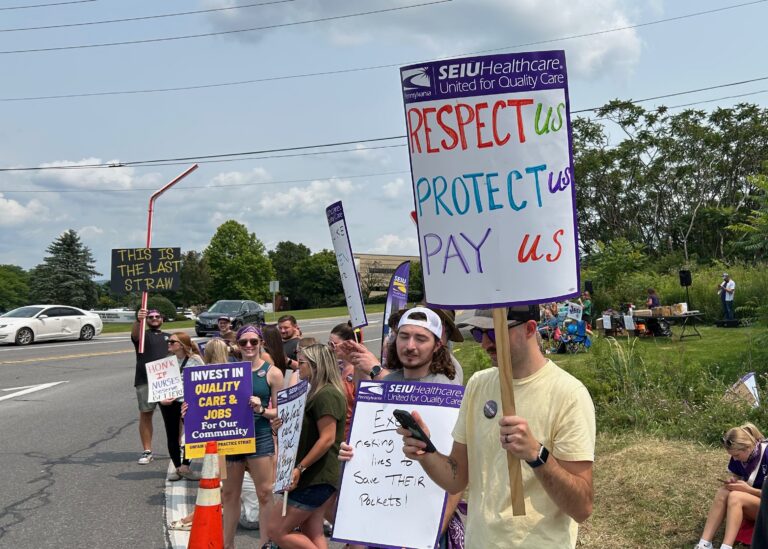
Letters: Standing With Mount Nittany Workers This Labor Day; AI Needs a Constitution
I’m a proud union member who works just down the street from the Mount Nittany hospital workers still fighting for a fair contract. With Labor Day coming up, I wanted […]

Letters: ‘Convenience Gambling’ at Pa. Mini-Casinos Becoming Obsolete; GT’s Empty Agricultural Promises, Failure to Support Healthcare
Despite significant increases in July tourist traffic to the State College area due to Arts Festival and the People’s Choice Festival, as well as further additional tourist traffic to the area due to hosting the State Games […]
Letters: Mount Nittany Medical Staff Committed to Community Care; Casino’s Underwhelming Revenue
The Medical Executive Committee is saddened to hear that SEIU Healthcare Pennsylvania has reportedly voted to issue a strike notice in response to Mount Nittany Medical Center’s latest proposal. As […]


