
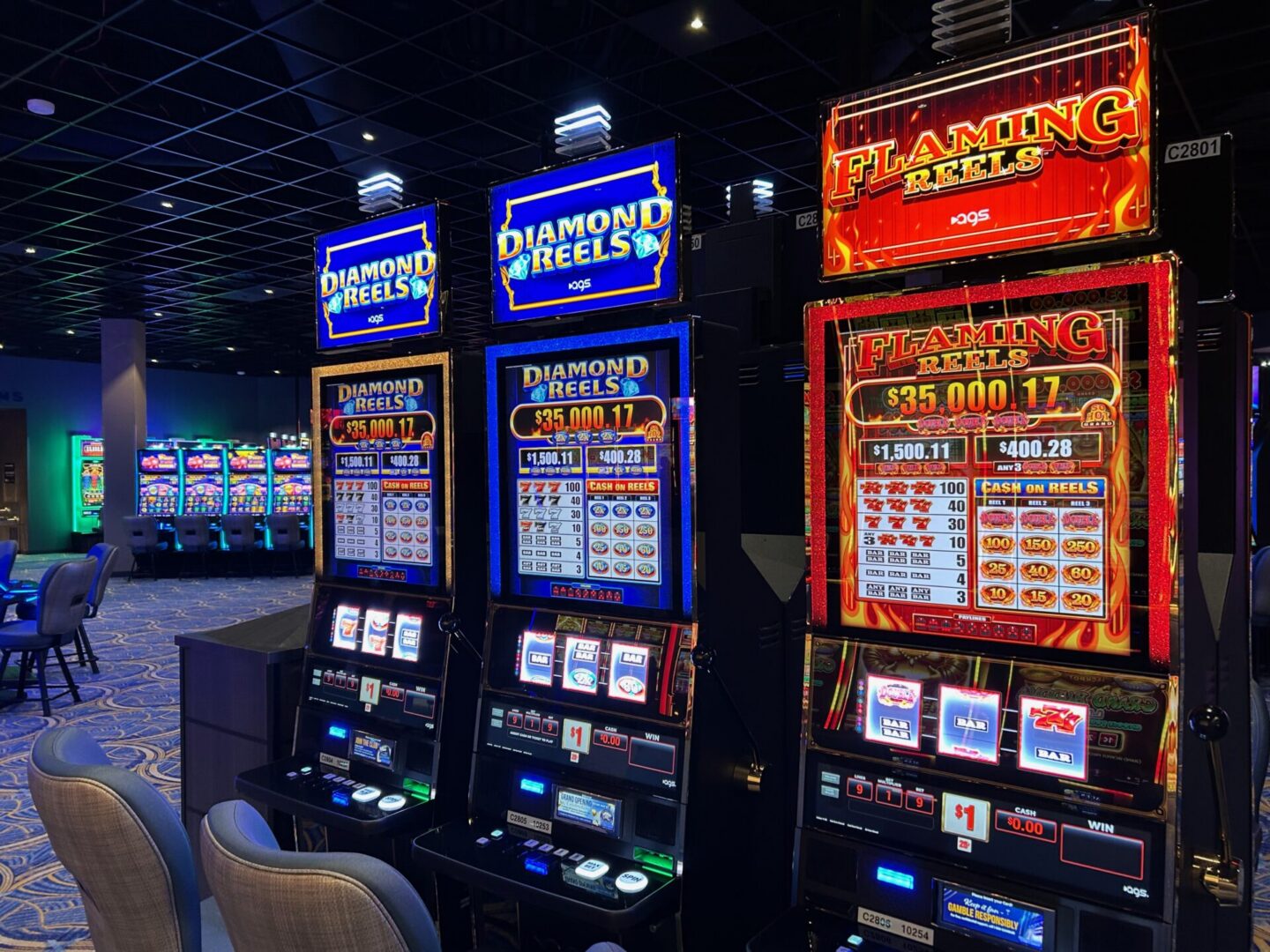
Despite significant increases in July tourist traffic to the State College area due to Arts Festival and the People’s Choice Festival, as well as further additional tourist traffic to the area due to hosting the State Games of America, Happy Valley Casino’s reported July gambling revenues were essentially flat with its already low levels from June. This suggests further declines in the casino’s revenue extraction from its core market of local residents, which were temporarily offset by some additional revenue from tourists.
The casino achieved a monthly gambling revenue of only $2,508,296 in July. This is an increase of only $98,678 from its June gambling revenue of $2,409,617.
Accounting for July having 31 days while June has only 30, the casino’s average daily gambling revenue increased by only $592.18 per day from June to July (rising from $80,320.57 per day in June to $80,912.74 per day in July).
Approximately 84% of the casino’s July revenue derived from slot machines, consistent with every prior month since it opened. PA casino slot machine revenue is taxed at rates of 48%-54%, while table game revenue is taxed at a rate of 16%. After paying these taxes, the casino’s annualized after-tax gambling revenue based on its performance in June and July is estimated to be only slightly more than $15 million per year.
To put this number in perspective, College Township’s independent casino impact report estimated the casino’s payroll expenses alone would total $16.5 million per year (i.e. 350 Full-Time Equivalent positions at an average of $47,000 per year each). While the casino has reportedly already laid off employees, it still must cover other significant operating expenses, and possibly also pay for debt servicing on any financing used during the casino’s development.
It remains questionable whether or not the casino is even profitable.
What is now beyond question is that the surge in tourist traffic to the region in July due to Arts Festival and other major tourist events failed to boost the casino’s annualized gambling revenues. Its revenues have never remotely approached what the casino developers initially projected.
No one should be surprised by this. Category 4 “mini-casinos” like Happy Valley Casino were originally created to provide “convenience gambling” for people who are willing to accept fewer amenities in exchange for not having to drive more than half an hour to gamble. People who live farther away have easier access to better gambling options — including larger casinos that offer a true destination resort experience, as well as online casinos and smartphone gambling apps that offer 24/7 access from anywhere.
The visitors for July’s major regional tourist attractions did not rescue the casino. We should not expect Penn State football visitors to rescue it, either. Now that online and smartphone gambling are widely available, the “convenience gambling” offered by Pennsylvania’s mini-casinos has become obsolete.
Andrew Shaffer,
State College
Glenn Thompson’s Agricultural Promises Yield No Fruit
Since he was first elected back in 2008, Glenn “GT” Thompson has presented himself as an advocate for Pennsylvania’s farmers, and he’s in a good position to do it too — he’s been the Chair of the House Agriculture Committee since 2023. But despite almost two decades in Congress, and this leadership position, there’s little to show for GT’s time in office.
Despite claiming to represent Pennsylvania’s farmers, GT’s priority is clear: support Trump, even when it hurts his voters.
GT has repeatedly supported and voted for Trump’s ICE raids that, combined with restrictions on temporary farm worker visas (H-2A), have created labor shortages. Since Trump’s second term, the U.S. has lost over 150,000 agricultural workers. This has been particularly harmful to the dairy, livestock and mushroom industries, all vital to central Pennsylvania — making it harder to collect harvests, and forcing some Pennsylvania farmers to leave crops to rot, uncollected. None of these harmful policies are recent; many news articles and agricultural organizations have pointed out these policies have been harming Pennsylvania farming communities for all of Trump’s second term, while GT, as chair of the House Agriculture Committee, has been in a position to do something about it! But, for 18+ months, GT did nothing.
Then, as his re-election looms, GT briefly proposed a revision to the H-2A visa that would allow badly needed temporary farm workers (currently traveling back and forth across the border every few months, disrupting important labor supply for farms) to stay for extended periods.
On the surface this sounds good. It sounds like GT heard our needs, and acted. But look a little closer and that’s not what’s happening. It’s too little, too late. It’s too little because, despite his position of power as a long-tenured politician, and as chair of the Agriculture Committee, GT proved unable or unwilling to pass laws that would help out Pennsylvania farmers. Like so many of GT’s plans, the visa change was just another proposal that led nowhere.
And it’s too late because GT has had two years of Trump’s second term, three years as committee chair, and 18 years in Congress to do this, but he never acted. His decision to act now, right before the election, clearly shows GT’s priorities: not helping Pennsylvania farmers (if so, he would have acted long ago and more forcefully), but instead, helping his reelection chances. He wants to be able to say that he “tried” when it’s time to campaign. So he can get two more years to do nothing.
GT has had his time in Congress and on the committee “representing” us. And we have nothing to show for it. It’s time to find someone new, who will put Pennsylvania’s farmers before political interests and the president’s harmful agenda.
Tracy Witmer,
State College
Thompson Does ‘Worse Than Nothing’ to Support Healthcare
Few issues are as important as the healthcare system which keeps us, and our loved ones, safe and healthy. This is especially true here in rural central Pennsylvania where the few hospitals must serve people across large areas, and people must drive long distances to receive care. One of the most important jobs of our representatives in Congress is to speak for us to improve this essential service.
Here in Pennsylvania 15th Congressional District, “Representative” Glenn Thompson, claims he knows this need. As he said last November, “most of my congressional district is rural and many constituents must drive long distances to get the care that they need… [they face] doctor shortages and hospital closures” (Thompson 11/18/2025). He’s right, this is a crisis, here in north-central PA we face a “void” of healthcare options.
Thompson’s words sound great, but what has he done in practice? Nothing.
Actually, worse than nothing. Thompson actively supported Trump’s budget, the so-called “One Big Beautiful Bill.”
But that budget that Thompson voted for just stripped funding from the rural hospitals he claimed to support. The bill cut $1 trillion over 10 years from Medicaid, which is critical to sustaining rural healthcare. Independent experts estimate that “rural hospitals could lose around $137 billion over the next decade because of the budget measure. As many as 300 rural hospitals were at risk for closure because of the GOP’s spending package.” Here in Pennsylvania, the bill cut an estimated 15% of spending on medical services – between $34.3 and $57.2 BILLION over the next 10 years! For us in PA-15, this is a critical loss, at a time when every dollar matters.
Trump sycophants, like Thompson, might point to the $50 billion healthcare fund in OBBB, but taking away $137 billion, then giving back $50 billion is a lot like stealing someone’s meal, then giving them back their appetizer bread and telling them to be grateful for it!
These closures are not theoretical; they are already happening across the country. The Associated Press reports that hundreds of rural hospitals face closure due to these cuts. And these problems are not distant for those of us in PA-15. A recent analysis found that a dozen rural PA hospitals were at risk of closing due to these Medicaid cuts from Trump’s OBBB, a bill that Thompson voted for.
Does this sound like supporting our healthcare – at a time when this money is badly needed?
Nicholas Dudek,
State College
More Letters to the Editor
View all Letters to the Editor
Letters: Standing With Mount Nittany Workers This Labor Day; AI Needs a Constitution
I’m a proud union member who works just down the street from the Mount Nittany hospital workers still fighting for a fair contract. With Labor Day coming up, I wanted […]
Letters: Mount Nittany Medical Staff Committed to Community Care; Casino’s Underwhelming Revenue
The Medical Executive Committee is saddened to hear that SEIU Healthcare Pennsylvania has reportedly voted to issue a strike notice in response to Mount Nittany Medical Center’s latest proposal. As […]
Letters: Support Mount Nittany Medical Center Workers
I was employed by Mount Nittany Medical Center from 1975 until my retirement in 2017. I stand by the employees in their struggle to gain fair wages and benefits. I […]


