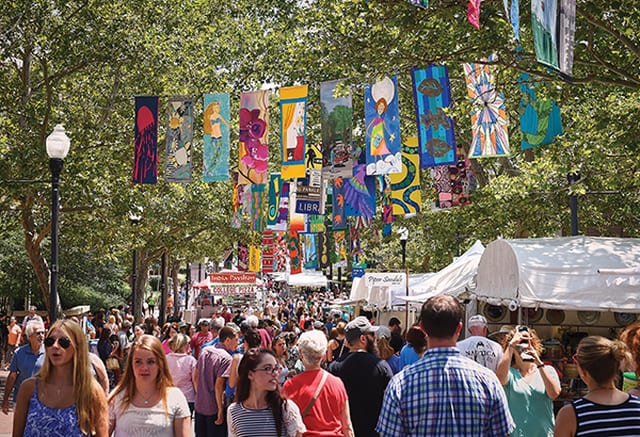
The Central Pennsylvania Festival of the Arts has come to mean many things to the many people who have experienced it. It means music, food, and getting together with old friends. It means lounging on the lawn of Old Main and listening to a favorite local performer. It means checking out the creative offerings and exhibits of hundreds of talented artists.
But more than anything, Arts Festival means a summertime tradition that keeps people of all ages coming back to downtown State College year after year.
Since it began in 1967, times and tastes have changed, but the sense of tradition surrounding the festival that happens each July has become only stronger through the years, according to Rick Bryant, who has served as executive director of the festival since 2005.
“Arts Fest is a huge tradition. We are trying to keep it that way,” he says.
One of the biggest changes the festival experienced was when the Sidewalk Sale became a juried show in 1971. The sale had been open to all exhibitors during its first four years.
“It wasn’t juried when it began,” Bryant says. “Juried means that people are weeded out, so not everyone can bring their work.”
During the first years of the festival, Bryant says that anyone could have a display, meaning that professionals and amateurs alike were selling all types and qualities of art. Along with who exhibited, people’s taste in art also has changed over the past several decades, as well.
“Let’s say macramé and candles used to be very big. The art would reflect those tastes,” Bryant says. “Those things aren’t as big as they used to be, so we see different art on display. Art today is very ‘of the moment.’ ”
In defining what that means, he explains that anything with found objects is popular — types of art that incorporate objects or products that have nonart functions — such as pieces made out of sneakers or tires or buttons, for example.
Other notable changes in the art scene in recent years include the emergence of robots as art and increased popularity in representational painting (paintings depicting physical appearances of reality).
“Photography has always been popular at the festival. We have just seen differences in the popularity of different subjects to be photographed through the years,” Bryant says.
Some artists, such as Dick Brown of Bellefonte, participate in the festival year after year, Bryant says. Brown, a photographer, has been at the festival all 50 years. According to Bryant, along with Brown, there are a few other artists who are regulars at the festival, including the “basket lady” Mary Jackson and broom-maker Marlow Gates, who is a “second generation Arts Festival guy.” Others include some jewelers and Robert Zarcone, who brings his leather pieces.
According to Pat Little, a photographer from State College who is a long-time exhibitor at the Arts Festival, the biggest change is the quality of work that is shown.
“The talent level has skyrocketed,” he says. “The reason it is a premier arts festival is really the quality of the work that patrons come to see.”
Along with the changes in artistic tastes and quality, the festival has simply grown over the decades to make sure that the event has something to offer for everyone, regardless of age or interest. Events such as Children and Youth Day, a juried gallery exhibition, the Italian Street Painting Festival, sand sculptures, festival races, BookFestPA, and other activities have become part of the tradition and what makes the festival so special.
The festival attracts approximately 100,000 people each year, and while it continues to be a fun and high-energy event since the very beginning, the atmosphere has changed to accommodate the changing world.
“We are extremely conscious of safety. We want this to be a fun event, absolutely, but we also recognize that it’s just as important for people to feel safe,” Bryant says.
He says that doing small things, such as putting up large barricades and increasing security are measures that they have taken through the years. Also, things such as recycling options and trash pickup have changed and improved the atmosphere of the festival.
Of course, the festival continues to attract young and old alike, but Bryant has noticed a bigger contingent of college students gathering to reunite during the event.
“It’s a very ‘Penn State-a-rific’ event,” he says. “Students keep coming back for Arts Fest. You see lots of young people out and about all week long.”
He says that since the festival’s beginning, life has changed in general with the digital era. He says that people are not just strolling through the festival, looking at exhibits, and listening to bands. They also are capturing it on social media — taking photos with their smartphones and showing the world what’s happening in State College and Penn State.
More changes can be seen and heard from what’s performed on the many festival stages. The festival features local acts as well as national performers.
“We don’t just have ‘garage bands’ anymore,” Bryant says. “We have something for everyone. Music reflects the audience demographic.”
According to Bryant, each and every year, there is a wide variety of performances on outdoor and indoor stages. From blues to jazz, from bluegrass to rock, from musical theater to cabaret, the Arts Festival truly offers something for each and every musical taste.
The first festival had performances from the Festival Theatre, a professional company that performed Tennessee Williams’s The Rose Tattoo, Murray Schisgal’s Luv, and Edward Albee’sWho’s Afraid of Virginia Wolf? The Penn State Music Department performed three chamber music concerts.
Classical and chamber music highlighted many of the early festivals. The next year, in 1968, the festival had a piano concert by Phyllis Triolo and Bach’s Brandenberg Concerti performed by Alard Quartet and Soloists. It also had calypso singer Stan Shepard, folk musicians, and a Dixieland band.
Some other performance highlights through the years include:
• A festival fiddle contest in 1976.
• The US Army Band’s performance in 1980 (that same year there was a disco dance demonstration).
• The popular Phyrst Phamly plays at the festival for the first time in 1983. The band gives its final performance in 2008.
• Cartoon holds its first reunion concert in 1984. (Three Cartoon members, Randy Hughes, Glenn Kidder, and Jon Rounds, will perform at this year’s festival July 16.)
• The Earthtones perform Sunday night for the first time in 1986 (the reggae band continues to be one of the final performances of the festival each year).
• Margaret Whiting and Sonny Rollins perform in 1989, with paid seating available on Old Main lawn.
• Penn State bands from the 1970s and 1980 — Morning Song, Backseat Van Gogh, Sweet Pain, The Rounds Brothers, and The Intrigues — perform reunion shows in 1991.
• James Taylor’s brother, Livingston, performs in 1995.
This year, the festival again has popular local acts such as My Hero Zero, Pure Cane Sugar, and Velvetta as well as regional and national acts, including Alex Meixner, Molly Ryan, River Whyless, and Dustbowl Revival.
“Let’s talk about what hasn’t changed over the years. There have always been strains of local bands writing their own music, making their own mark. There has been a continuity to the high level of quality here. It says so much about the creativity and music scene here in State College,” says Charlie DuBois, who worked for a number of years to get the word out about local musicians. He says the festival is a perfect place to get a first-hand look at the musical talent in and around State College. And, he adds, that the quality of musical talent at the festival has always been top-notch.
“It’s like the song says, ‘The heart of rock and roll is still beating.’ And in this town, like the local food movement, there is a local music movement, too,” he says.
Bryant agrees that the festival’s music scene is a big draw for area music lovers. He says that festival-goers often offer their input about what they want to hear from year to year.
“We get new musical acts each year,” he says. “We listen to what people want. The public tells us what they like or what they would like us to try, and we do our best to accommodate.”
J.R. Mangan will be performing at his 31st Arts Festival this year. His first performance was in 1985 with the band Space Good, a trio featuring Mangan and brothers Mike and Dave Biddison. He has performed solo, with the group Stolyn Hours, and as a duo with various female singers through the years, including this year with Sharon Bove, who was the first female vocalist to join Mangan on stage at the festival. The two will perform July 14 at 7 p.m. on the Allen Street Stage.
“My favorite part of playing the festival, besides playing music outside with great musicians, is seeing old and new friends over the years,” he says. “I have literally watched my kids and others grow from the stage over the years. We live in such an incredible community, not to mention the extended Penn State community, that has always valued and supported live music. … At my age, I am so beyond lucky to still be doing what I love, and the Arts Festival is one event that makes that possible.”
DuBois himself has been a familiar face at the Arts Festival since 1969, when he moved to State College from New Jersey during festival week. He says the festival is a time for reunions and people seeing their favorite performers and artists.
“My first taste of the festival was in 1969, just a couple years into it,” he says. “I arrived in State College just in time for Arts Fest. I thought, ‘This must be what this place is like all the time.’ Then I realized that it was special. It was tradition. And that tradition hasn’t changed in 50 years.”