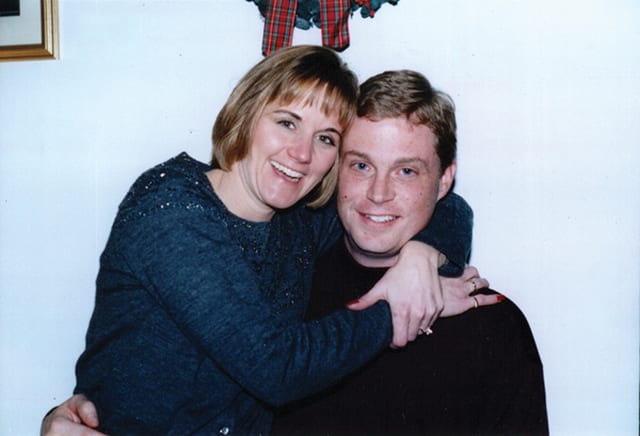
In 2006, Doreen Perks started the Bob Perks Fund in memory of her husband, who died from cancer just five months earlier. For 10 years now, the fund has helped ease the financial burden for almost 1,700 people in the community battling cancer.
‘In the beginning, we just wanted to do something good,’ Perks says. ‘I don’t think anyone realized how big it would become, especially not this quickly.’
Since its inception, the fund has raised and allocated more than $1 million to give to families with cancer patients who are struggling financially.
“The Bob Perks Fund is having a tremendous impact on cancer patients and their families, offering a lifeline to those who are suffering from the burden of unpaid bills in addition to suffering from the consequences of cancer,” says Norma Keller, executive director of the fund. “By easing the burden caused by eviction and utility shut-off notices, as well as helping to put food on the table and gas for travel to cancer treatments, the fund is helping patients worry less about their finances so they are able to focus their energy on their treatment, health, and recovery.”
The fund helps families battling cancer who live in Blair, Centre, Clearfield and Huntingdon counties. They have to be referred to the fund by their patient navigator at the hospital or through their oncologist’s office. From there, the fund’s allocation committee reviews the application, discusses the merits of helping the individual or family, and gets started on the assistance. According to Keller, the process can be pretty efficient.
“I have such respect for the critical mission of the Bob Perks Fund, and every day I see its enormous impact on cancer patients who experience increased expenses and decreasing income while undergoing cancer treatment,” she says. “I greatly admire the allocation committee’s decision-making process, which often results in the Bob Perks Fund paying cancer-patient bills within in 10 days or less.”
Keller, who headed up the Centre County Youth Service Bureau for 30 years until she retired, was hired part-time in 2013 to develop fundraising opportunities in Blair, Clearfield, and Huntingdon counties. Prior to that, 90 percent of donations came from Centre County.
Each year, the Bob Perks Fund hosts three large fundraising events in Centre County. This year’s season kicked off Feb. 27 with the annual “Rock the 80’s” benefit concert at the State Theatre. Ten bands played an array of songs from the 1980s with proceeds going to the fund. On June 4, the fund holds its first Summer Slam, a 3-on-3 basketball tournament at the State College YMCA. The fund is still trying to figure out what event it will hold in the fall to replace a tailgate party it had held each year during an away Penn State football game.
While past events have seen a lot of success, Perks admits she doesn’t want to see the events become stale, and she will periodically change them up. The basketball tournament is new and something she believes people of all ages and ability levels will enjoy. Additionally, she hopes to expand fundraising efforts to the four counties the fund helps. Perks and Keller hope the next 10 years will be even more successful than the past 10.
“I would like to see increased fundraising opportunities in Blair, Centre, Clearfield, and Huntingdon counties, and when we are able to fulfill the needs presented by cancer patients in these counties, consider serving adjacent counties that have requested our help,” Keller says. “The Bob Perks Fund is a one-of-a kind organization — it provides significant and ongoing support to cancer patients in need of financial aid, and it regularly receives requests to consider serving other counties.”
Running the Bob Perks Fund can often be heartbreaking for Perks, who admitted that learning sad news about clients can take its toll and really wear her down. But for her, walking away was just not an option — especially when she sees and hears about the results of the work the fund does.
• • •
In August of 2012, Michael Kraft of Altoona was diagnosed with throat cancer. The 53-year-old was first treated with chemotherapy and radiation. According to his wife, Cindy, when the cancer came back a year later, Michael had a complete laryngectomy — his entire larynx was removed. He spent a year without a voice, but last year he was given a speaking valve, which has allowed him to have a voice again.
As if cancer and a laryngectomy weren’t enough to deal with, he and his wife had very little money to pay the hospital bills that piled up, regular travel to and from Pittsburgh, and their everyday finances, such as utility bills and rent. According to Cindy, a social worker at the hospital told them about the Bob Perks Fund and helped them ll out the application to receive some help with their bills.
“They were like little guardian angels that just popped into our lives,” Cindy says. “They were so great, helping us pay off a few bills, like our rent and electric bill. They even gave us a gift card for groceries.”
She says she recalls hearing other patients who were receiving radiation talk about the fund in the waiting room, trying to gure out how to get help. She is grateful and says it was such a blessing for them to receive the financial support, adding that it really helped them pull through a really rough time.
“From the social worker that told us about the fund and helped us fill out our application to the board that approved it and quickly got us help, it just really put our minds in a better place,” she says.
• • •
Last April, Audrey Hanscom, 54, was diagnosed with pancreatic cancer. The Julian resident had surgery, but doctors were unable to remove the tumor. She recently completed radiation treatments and will return to her doctor’s office in a few weeks to see if the radiation has helped shrink the tumor so doctors can remove it.
After an appointment in her oncologist’s office last year, she heard about about the Bob Perks Fund from a patient navigator.
“They’ve helped us [her husband and daughter] pay some of our bills — heating and utility bills — and what’s leftover they’ve put on Sheetz and Weis gift cards for help with groceries and gas,” she says. “My family and I are very thankful for their help and kindness. This is such a wonderful organization.”
• • •
In March of 2014, Wendy Bechtold of Clearfield found a bump on her breast. She had been hospitalized after a seizure, and when she returned home she found that the hospital had left a sticker from her electrocardiogram on her. When she pulled it off, she found the bump. She waited a week before going to see her doctor. Her diagnosis was triple-negative-stage breast cancer, an aggressive form of cancer that can be difficult to treat.
She started chemotherapy and was able to continue working for a while, but when she was became too tired and sick, she had to stop. Her doctor’s office told her about the Bob Perks Fund, and she received help.
“I was constantly playing catch-up with my bills at that point. I had no money coming in because I was too sick to work. I am so thankful for the fund and all that it did for me,” she says. “The program and the patient navigator that told me about it were lifesavers.”
When she completed her chemotherapy, she had surgery followed by radiation. She completed the radiation in January 2015. She found a new job and has had checkups every six months.
While she’s still a bit tired at the end of the day and her strength isn’t completely back because of the side effects of the chemo, she hopes to do more volunteer work and to give back to a community that really helped her out when she needed it.
• • •
Martha Claar of Hollidaysburg found out in July 2010 that she had ovarian cancer. She was exhausted and just felt bad all the time. A friend took her to the emergency room, and it was there that doctors told her about her cancer.
“I went home and cried all night,” she says. “But I was fortunate enough that when I told a nurse at Danville my blood value, she said they would operate the following Tuesday.”
Claar explains that most people have a blood value of 30 — hers was 630. She’s thankful that they operated so soon, and after, she was receiving chemotherapy closer to home. She had a complete hysterectomy and had her omentum removed.
In 2013, the cancer came back, and she did four cycles of chemo again. She ended up with pneumonia and battling a pulmonary aneurysm. She was hospitalized for 21 days, and through all her illness, she was unable to work. A cousin told her about the Bob Perks Fund.
“They have all the safeguards in place,” Claar says. “The application for assistance has to come from your doctor’s office, and the patient doesn’t get the money, the utility companies do, so you can’t scam the charity. The Bob Perks Fund responded quickly to my needs and made a big difference in my life.”
Claar, who was given six months to live after her stay in the hospital, has since moved to State College to be closer to her sister. Before her diagnosis, she had her own business, but had to close it while she was sick. She’s not sure what she would have done without the fund.
“I know that Doreen lost her husband, and it’s really touching that she took her sorrow and put it toward helping others,” she says. “Everybody has been touched by cancer, and maybe they give money toward cancer research, but actually don’t know if the money goes directly toward that. With the Bob Perks Fund, the money goes directly to the people. They don’t pay the medical expenses, but they free up some money for those bills by helping with rent and utilities, gas and food. I’m still here today to spend more time with my nephews. They know I love them — and Bob Perks gave me that.”