

Back in my newspapering days I covered a search-and-rescue operation in a river canyon in California.
While a chopper maneuvered overhead, a reporter from a competing paper joined me at the rim. Side by side, the two of us scribbled in our reporters’ notebooks.
Then, my competitor’s pen slipped from his grasp. We watched as it bounced from boulder to boulder before disappearing from view.
“Got a spare?” I asked him.
“Nope,” he said.
I did.
I considered keeping this information to myself: Without a pen, he was going to be at a serious disadvantage. Without a word, I handed him one of mine.
I hoped he would do the same for me.
I recalled this incident while reading a commentary in The New York Times on Sunday.
“For many Americans,” writer Anne-Marie Slaughter begins, “life has become all competition all the time.”
The result, she says, is an epidemic of stress.
“The people who can compete and succeed in this culture,” Slaughter contends, “are an ever-narrower slice of American society.”
So far, I’m with her. For a long time I have wondered why so many of us well-fed, comfortable people are unhappy, why we have so much suicide, so many shootings, so much drug and alcohol abuse.
My sense of things, derived in part from British historian Tony Judt’s book, “Ill Fares the Land,” is that the capitalist ethos has spread from the business world to every other sphere of activity so that we feel pressured to not only compete professionally, but also socially, recreationally, materially and so on.
Whatever we have – money, looks, goods, friends, prestige – we don’t have enough of it. We need more.
And talent alone is not enough to get us more. We also need drive. In fact, drive is more important than talent.
The current crop of candidates for the presidency illustrates how far drive can take a person in America: That quality might be all most of these characters have. They epitomize that narrow slice who can “compete and succeed.”
Those of who lack that quality, as seen through the eyes of a Donald Trump, are losers.
Slaughter’s narrow slice means something else, though: “largely young people who are healthy, and wealthy enough not to have to care for family members.”
Her focus is a work culture that remains all too inflexible when it comes to giving employees the time they need – either during the work week or in the form of leaves of absence — to tend to personal business.
“If we really valued care,” Slaughter writes, “we would not regard time out for caregiving…as a black hole on a résumé. We would see it as engaging in a socially, personally and professionally valuable activity.”
I don’t disagree, but by framing the matter thus, Slaughter pits younger workers against older workers, and parents against those who do not have children.
Not surprisingly, some of the 1,000 readers whose comments were posted on The Times website objected to Slaughter’s column on just those grounds.
Also somewhat predictably, Slaughter drew the ire of the status quo defenders. One reader denounced Slaughter as “an enabler of the whining generation.” If you have friends and relations who demand your time and energy, this commenter argued, that’s your problem, not your employer’s.
In other words, it’s still a dog-eat-dog world (or, in a classic example of a student blooper, “a doggy-dog world”).
I might have agreed when I was younger. I didn’t have much sympathy for the cares and woes of my peers. Buncha spoiled brats, I thought.
We can flip a switch and lights go on! We can open a valve and potable water rushes out! We say we’re starving at lunch when we haven’t eaten since breakfast! And so on.
In other words, if you hadn’t experienced real suffering, you had no right to complain.
It is by no means a bad idea to compare your situation to the situations of others when you’re feeling blue.
I have since learned, however, that the blues are real. Boredom is real. Dissatisfaction is real. Anxiety is real. And happiness is fleeting, no matter how well fed and well housed and well clothed we are.
But I think we’d be a lot happier if we didn’t feel so pressured all the time.
More and more, cutthroat capitalism seems like a stage in the development of complex societies that we will eventually get beyond. The “narrow slice” that thrives in the existing system is understandably loath to let it go.
I’d like to hear us talk about competition and competitiveness a little less and about cooperation and caring a little more.
That said, I compared my search-and-rescue story with the one my competitor was able to get, thanks, in part, to the use of my pen.
I kicked his butt.
More Columns
View all Columns
Matt Campbell Is Good for Penn State. And Vice Versa
Two things can be true: Matt Campbell is good for Penn State. Saturday was proof positive of that — on, going onto and off the field. Also, though: Penn State is […]
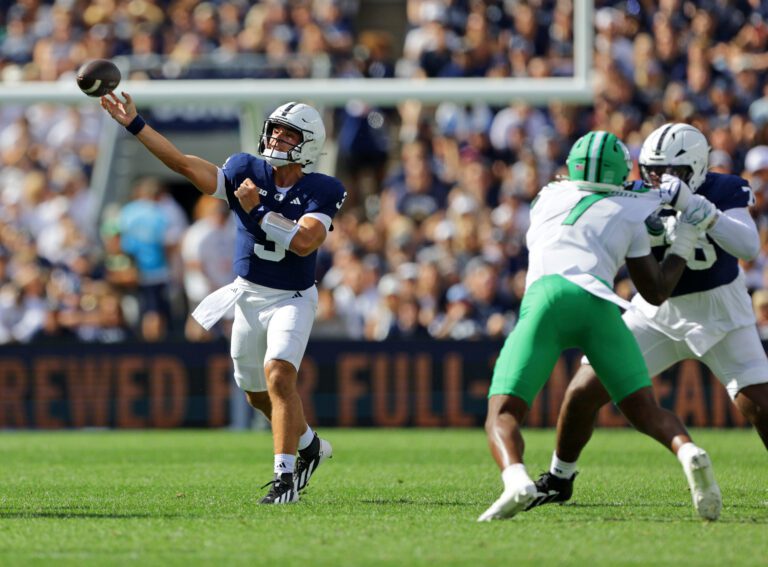
With a Career-High 4 TD Passes, Penn State QB Rocco Becht Shows He’s the Real Deal
Penn State’s Rocco Becht made his 40th start as a college quarterback on Saturday in Beaver Stadium. No one playing in the FBS season has more — and that would include […]
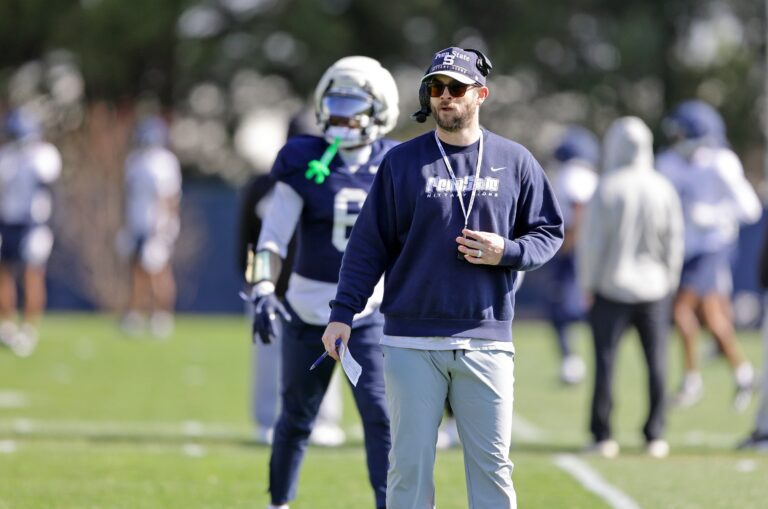
Penn State Game-Planning and Play-Calling: What Campbell, Mouser and Becht Have to Say
Over the course of his 2024 and ’25 seasons at Iowa State, offensive coordinator Taylor Mouser called 1,813 plays. Give or take. The Cyclones’ offense ran that many. But head […]


