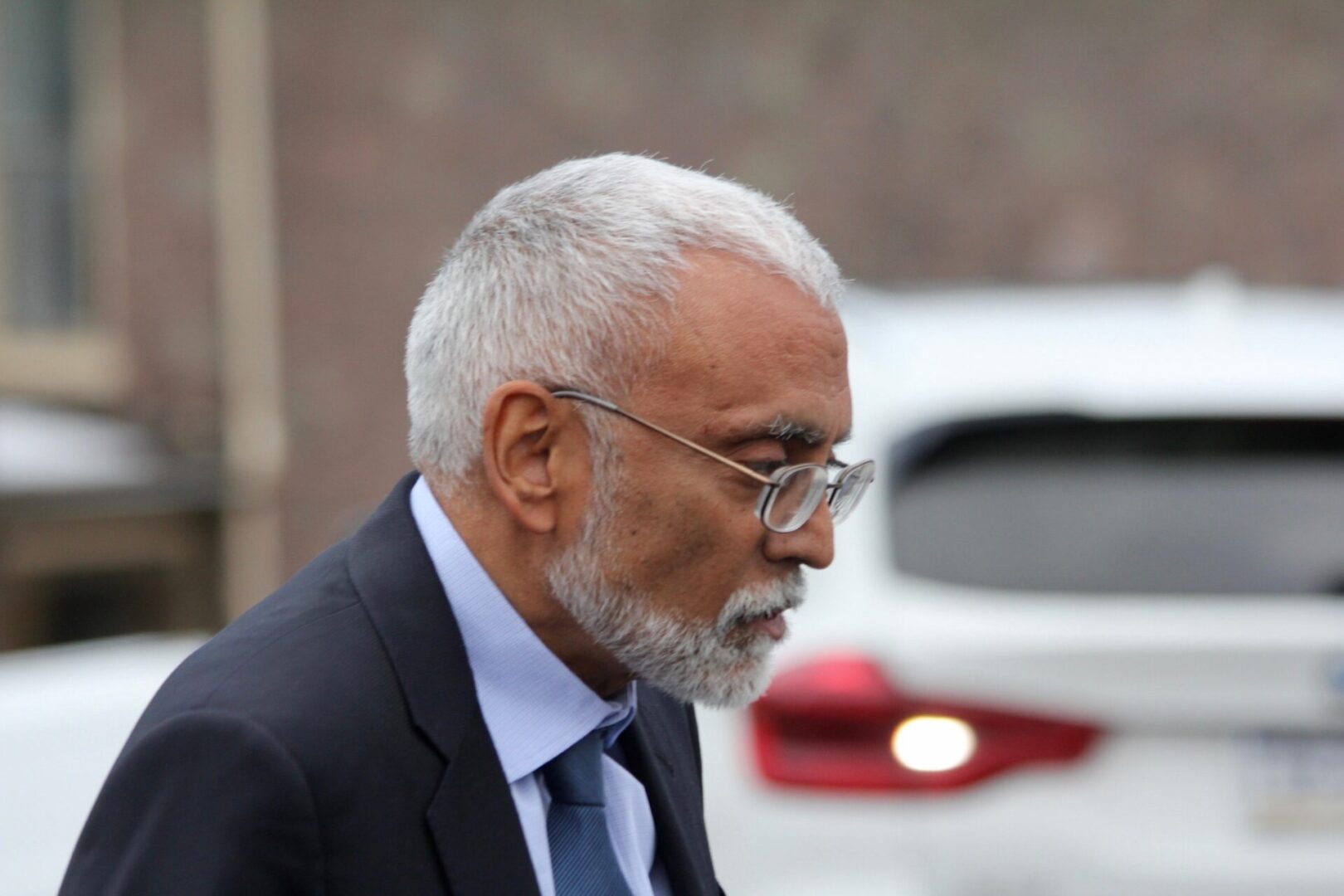
A Centre County judge’s Monday deadline came and went without prosecutors appealing his decision to order a new trial for the State College man who has spent more than 40 years in prison for a murder he maintains he did not commit
District Attorney Bernie Cantorna declined to comment on his office’s decision not to appeal Judge Jonathan Grine’s August ruling that Subramanyam “Subu” Vedam was deprived of due process rights and a fair trial when he was found guilty of the 1980 murder of Thomas Kinser.
It avoids what would have been a lengthy appeal process and appears to effectively leave Cantorna’s office with two choices: push forward with the new trial or drop the case and set Vedam free.
“We’re happy that the Commonwealth chose not to appeal Judge Grine’s thoughtful and thorough decision,” Gopal Balachandran, Vedam’s attorney, said on Tuesday. “This brings us one step closer to correcting this gross injustice and exonerating Subu.”
A pre-trial conference is currently scheduled for Nov. 10.
Vedam was convicted in 1983 and again after a 1988 retrial of fatally shooting Kinser in 1980, when both were 19 years old.
After Kinser’s body was discovered in 1981 in a sinkhole at Bear Meadows in Harris Township, prosecutors said Vedam used a .25 caliber handgun to kill his friend. A murder weapon was never recovered, but Vedam’s conviction was based in part on his purchase of a .25 caliber gun, which he said he did not acquire until after Kinser’s death.
The DA’s office granted Vedam’s current appeal attorneys access to the full case file in 2021. A handwritten note with the size of the bullet hole in Kinser’s skull, believed to have been written by former Centre County DA Ray Gricar, who prosecuted the 1988 retrial, led them to ultimately gain access to an FBI report that was never presented at trial and that they say would have been critical to Vedam’s defense.
They contend it shows that bullet hole in Kinser’s skull was too small to have been made by a .25., and that the prosecution suppressed data generated by an FBI Comparative Bullet Lead Analysis conducted on a test-fire bullet and one found at the site of Kinser’s remains.
Experts for the defense and prosecution offered competing interpretations of the evidence during a hearing in February. Grine wrote that his decision was not a matter of which expert was correct, but rather what impact the the FBI file would have had if it had been disclosed at trial.
“No amount of due diligence” would have enabled Vedam to obtain the FBI measurements and bullet analysis data for his 1988 trial, Grine wrote, and “there is reasonable probability the jury’s judgment would have been affected” if an FBI agent’s bullet hole measurements had been provided. He added that the report could have been used for the defense to undermine the credibility of the agent who testified the bullet came from a .25 and “severed the link” between Vedam and the crime.
“The Commonwealth cannot meet its burden of demonstrating beyond a reasonable doubt that this error did not contribute to the verdict, and consequently, [Vedam’s] conviction cannot stand,” Grine wrote in August.
Prosecutors have not indicated whether they are inclined to move forward with a new trial, but it would likely prove a difficult task, with certain evidence and key witnesses no longer available.
Cantorna has said that he remained confident in the original convictions based on facts presented at the trials and the expert witness testimony at the February evidentiary hearing.
He said in August that his office was considering all its options.
“We are sensitive to how difficult and confusing this news is to the surviving family and friends of Mr. Kinser, and we are committed to following the facts and the law in pursuit of a just outcome,” Cantorna said at the time.
Vedam, 64, has been incarcerated at Huntingdon state prison since 1983.
READ ALL OF STATECOLLEGE.COM’S COVERAGE OF THE SUBU VEDAM CASE HERE.