
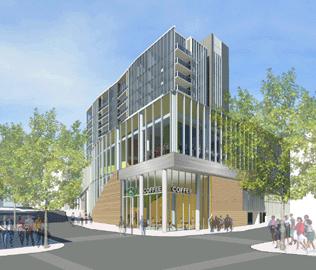
Practically from the start, questions have followed the Fraser Centre plans in downtown State College.
Early on, skeptics questioned whether the borough should sell public land to enable the $51 million redevelopment project, planned for the 100 block of South Fraser Street.
Then came the first, $2.5 million commitment of state grant money; another $2.5 million promised through local tax-increment financing; and, most recently, an additional $1.5 million commitment of state funds.
This from a Harrisburg that’s saddled with a multi-billion-dollar budget deficit and — as Borough Council member Peter Morris noted — struggling to pay even for libraries.
In any event, the debates surrounding Fraser Centre thus far have centered mostly on the role of government: whether the borough government should be encouraging the project; whether the state government should be supporting it; whether the school board and Centre County commissioners should have endorsed the tax-increment financing. (The TIF would allow a portion of the new tax revenue generated by the project to help pay for its debt obligations.)
Taken by themselves, those alone are heady questions.
But this whole development issue, some five years in the making, is about to get more complicated still.
That’s because the very definition of Fraser Centre is changing, and the newly evolved vision encroaches on sensitive turf.
To help keep the project viable, York-based developer Susquehanna Real Estate is trying to add a boutique hotel and a fuller-service dining concept as part of the plans. The hotel would occupy a couple floors, effectively shrinking the condominium portion of the project, and the dining feature would expand the cinema part of Fraser Centre.
The latter feature would allow moviegoers to enjoy a full meal in the facility before taking their seats at the big screens, Susquehanna President and CEO Jack Kay said this month.
Sounds simple enough at first blush.
It’s tough to imagine, though, that established restaurateurs and nightlife providers in downtown State College are going to embrace this tweaked concept. Fraser Centre was, in large part, supposed to drive foot traffic and business across the downtown, not keep visitors entirely under one roof. Restaurant and bar operators who contribute heavily to the Downtown State College Improvement District — a primary ally and booster for Fraser Centre — may have choice words about the in-house dining now envisioned for the complex.
Meanwhile, Kay has said that any hotel operator who sets up shop inside Fraser Centre will almost certainly want a liquor license.
The Borough Council hasn’t talked much publicly yet about that nuance. But here again, it’s tough to imagine that council members — some of whom have been loathe to celebrate more drinking options in town — will applaud another liquor license in the downtown.
And if they do? Well, someone will have to collect my jaw from the floor and snap it back into place.
Not to mention another question: Would a new boutique hotel on South Fraser Street siphon business from current hotel operators in and around the downtown?
If so, that may not be such a big problem on Penn State football weekends and during the Central Pennsylvania Festival of the Arts, when accommodations seem to fill quickly. But what about the rest of the calendar year? And would it be fair for the Fraser Centre hotel operator to benefit from what amounts to taxpayer subsidies?
Hold up, Fraser Centre supporters will say. The TIF and state support will go toward the cinema and other public elements of the project — not the hotel, they’ll argue.
Plus, they’ll say, government subsidies have, in effect, helped suck business away from downtown State College for years, financing the public infrastructure and roadways that have driven suburban sprawl and shopping centers.
But in these troubled times, it’s a safe bet that they’ll now face more vigorous and spirited debate from a variety of critics, both inside and outside the borough.
This debate is not only being renewed; it’s being reshaped.
Stay tuned.
Earlier coverage



