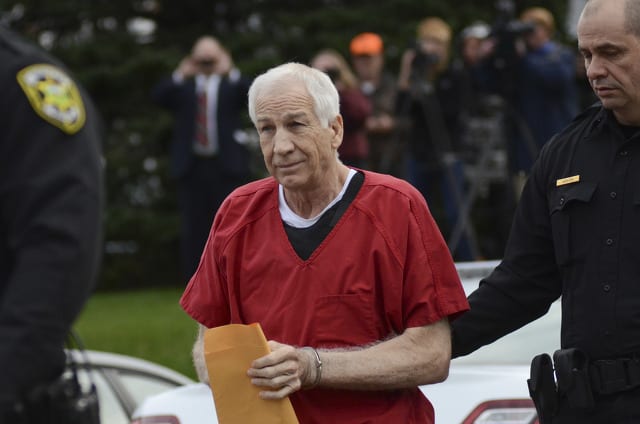
Just a week ahead of a court hearing that will bring Jerry Sandusky to the Centre County Courthouse in Bellefonte, the commonwealth has responded to a list of discovery request’s by the convicted child sexual abuser.
As part of his appeal of 45 counts related to child sexual abuse, the former Penn State assistant football coach filed the discovery requests in late September, asking for a number of subpoenas.
In the commonwealth’s filing, deputy attorney general Jennifer Peterson argued that Sandusky and his attorneys didn’t come close to meeting the requirements for his various discovery requests.
“It should be remembered that Sandusky no longer enjoys the benefit of the presumption of innocence. A jury of his peers has spoken,” Peterson wrote. “…At this juncture, the burden rests squarely on Sandusky’s shoulders to prove that he is entitled to discovery. A review of his latest motion, however, reveals a mere juxtaposition of speculation and emotional appeal rather than a solid foundation to support his requests.”
Peterson argued that Pennsylvania courts have previously held that “mere speculation that exculpatory evidence might exist does not constitute exceptional circumstance warranting discovery.” In other words, Sandusky’s argument that evidence proving his innocence may be out there doesn’t legally grant him the right to have his discovery requests approved.
The first discovery request is related to Victim 2, who graduate assistant Mike McQueary claimed to have seen Sandusky having sex with in the Lasch Building locker room. McQueary’s story — and what he did or didn’t tell Joe Paterno in the following days — has changed over the last few years.
In the filing, Sandusky attorney Alexander Lindsay stated that his client’s trial counsel failed to demand a retrial when “the prosecutor made a blatantly false statement to the jury in his summation.”
Sandusky is requesting that state police officers Joseph Leiter and James Ellis, Inspector Corricelli, Victim 2, and prosecutor Joseph McGettigan be subpoenaed.
In the commonwealth’s response, Peterson wrote that this request is an abuse of the court.
“Indeed, the fact that Sandusky is even submitting such a request underscores and highlights that he is still searching for evidence to support his self-serving narrative on appeal, namely, that the prosecutors engaged in misconduct,” Peterson said. “He is thus seeking this court’s permission to conduct his own ‘pre-hearing’ of sorts and evade his burden of establishing exceptional circumstances that entitle him to discovery.”
The second discovery request involves any agreements signed between six witnesses and their private civil attorneys. Lindsay argued that the testimony of those witnesses, who are Sandusky victims, could be tainted if it’s proven that they retained attorneys for free with the agreement that they receive a portion of settlement money from Penn State University after the trial.
The filing essentially argued that this would show a financial motive for the witnesses to testify, which the jury should have been informed of. A number of quotes from the witnesses at trial are provided in which they stated during cross-examination that they signed paperwork with their attorneys or that they were being represented at no charge.
In the commonwealth’s response, Peterson explained that the court doesn’t possess or control the files of private attorneys.
“The commonwealth certainly does not possess or have access to the files of private attorneys,” Peterson wrote. “To the extent that Sandusky asks this court to issue a subpoena for these records, the commonwealth contends that unless and until this court determines that he is entitled to an evidentiary hearing on this claim, any request for a subpoena is premature.”
The third discovery request delves into a report from attorney James Reeder, who was appointed to investigate and prosecute leaks coming from the grand jury that eventually recommended charges be filed against Sandusky. That report, as Lindsay admits in the filing, may not exist.
The filing requests that subpoenas be issued to any individuals who had access to the proceedings before the grand jury and access to all records between members of the judiciary and members of the Office of Attorney General from the timeframe in which the Sandusky investigation was before the grand jury.
Peterson argued that this is an attempt by Sandusky to use the court for his own personal investigation into a grand jury leak through the guise of discovery. Sandusky’s appeal, in part, claims that convictions on any charges pertaining to victims who came forward after grand jury information was leaked and published in the media should be dismissed.
In the commonwealth’s argument against this request, Peterson wrote that Sandusky essentially negated his own claim by admitting that he has no evidence in support of it. “How in the world would Sandusky be able to produce the supporting evidence without having the opportunity to question, under oath, the players involved in the leaker of information?” Lindsay said.
“Since he has conceded that he has no evidence in support of this claim, he petitions this court for permission to do what he is expressly precluded from doing under the law: conduct his own personal investigation into the grand jury leak,” Peterson wrote.
The presiding judge, John M. Cleland, will hear arguments related to these discovery requests at a hearing on Thursday in Bellefone regarding Sandusky’s appeal.