About 100 people received a crash course in forensic anthropology in Centre County Court in Bellefonte on Thursday. It was the first installment of a two-day hearing to determine whether key evidence was suppressed when Subramanyam “Subu” Vedam was convicted of murdering Thomas Kinser in 1980.
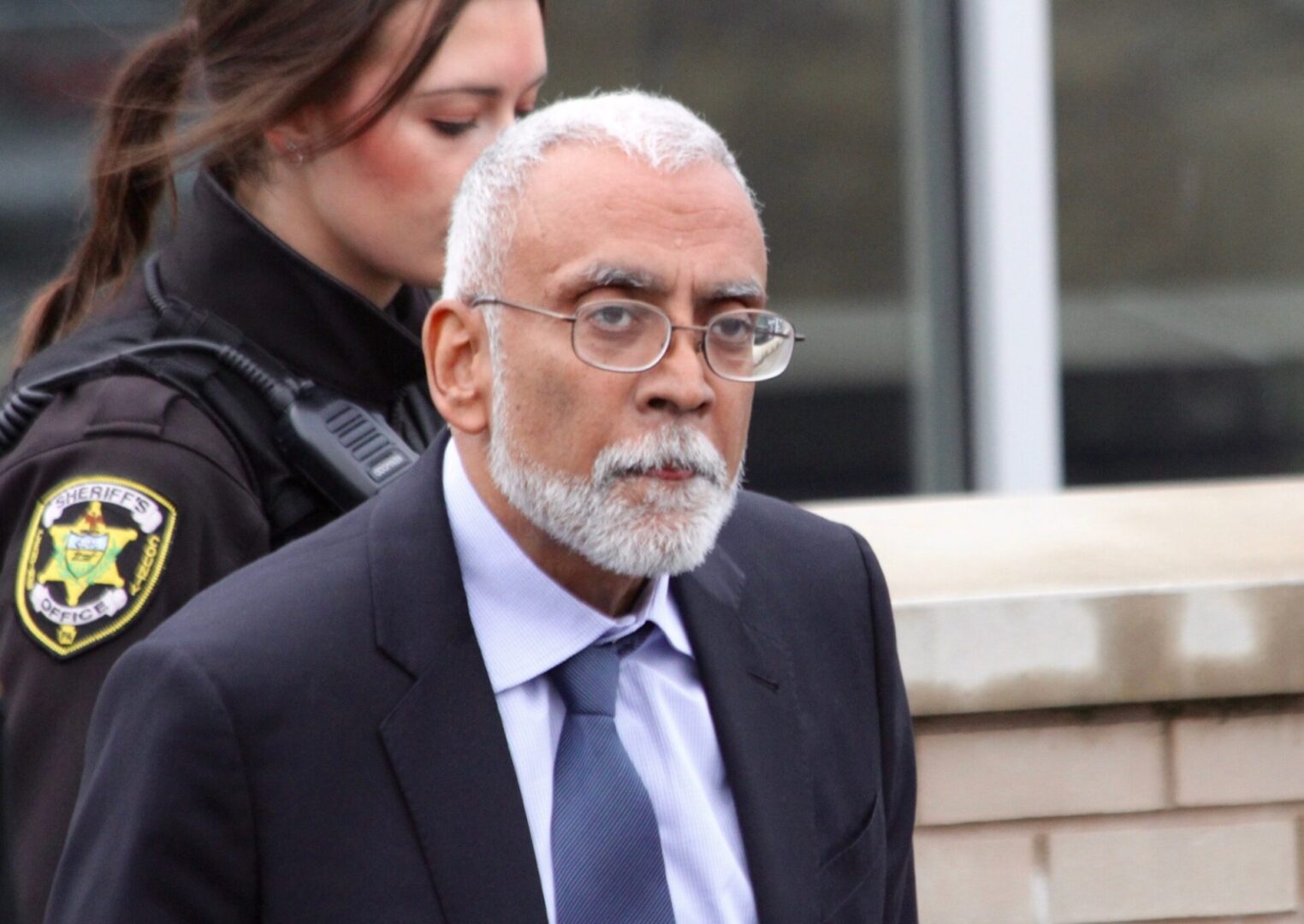
Vedam, now 63 and serving a life sentence in the state prison at Huntingdon, appeared in court in a suit and tie – and shackles, until defense counsel Gopal Balachandran asked President Judge Jonathan Grine that they be removed.
Also on hand were Vedam’s sister, his nieces, his baby grandniece, friends of the Vedam family and other members of the community.
Because of overnight snow and rain, the proceedings were delayed until noon. They will continue Friday morning at 8:30 in Courtroom 1 with more testimony from forensic anthropologist Ann Ross, who spent four hours being questioned by Balachandran and then cross-examined by Assistant District Attorney Joshua Andrews.
At issue is whether measurements of the bullet hole in Thomas Kinser’s skull — discovered in an FBI report turned over to Vedam’s attorneys last year — might have resulted in a different verdict if they had come to light when Vedam’s case went to trial. Balachandran contended that the measurements would have undermined the Commonwealth’s contention that Vedam bought and then used a .25-caliber handgun to kill Kinser, who had been his roommate when both were 19-year-old Penn State students.
Ross, a professor at North Carolina State University who studies bullet wounds, supported Vedam’s petition for a new trial by testifying that the hole in Kinser’s skull was too small to have been made by a .25-caliber bullet.
In his opening statement, Balachandran argued that a prosecution witness’s false claim that the bullet hole was consistent with a .25-caliber bullet meant that Vedam had to defend himself “with one hand tied behind his back.”
Things quickly got technical when Ross took the stand, with citations of academic journal articles, the introduction of such terms as keyhole defects and full metal jackets, and discussion of how such variables as bullet casings, entry angle, velocity and the relative thickness of the different bones of the skull could affect the fragmentation and exit of a bullet.
Andrews challenged Ross’s method of measuring the bullet hole from photographs rather than from the skull itself. He also cited studies that show that a .25-caliber bullet encased in a “full metal jacket” can make a smaller hole than a .22, noting that a .25 casing was found at the crime scene in the Rothrock Forest.
Ross stood her ground, saying there is no evidence that that bullet caused Kinser’s death, while observing that.22 casings and other bullet casings were also found at the site.
Ross also contended that the irregular keyhole shape of the hole was consistent with a bullet that had fragmented, which she said is less likely if the bullet is covered with a full metal jacket, as a .25-caliber bullet would have been.
Andrews also suggested that the bullet hole might have shrunk, a proposition Ross rejected in the absence of evidence that the skull had been heated.
After Ross’s testimony concludes Friday morning, Balachandran will call a homicide investigator, and then it will be Andrews’ turn to call his three expert witnesses.
If Grine grants Vedam a new trial, the Commonwealth would then have to decide whether to appeal, go ahead with the trial or drop the case.