
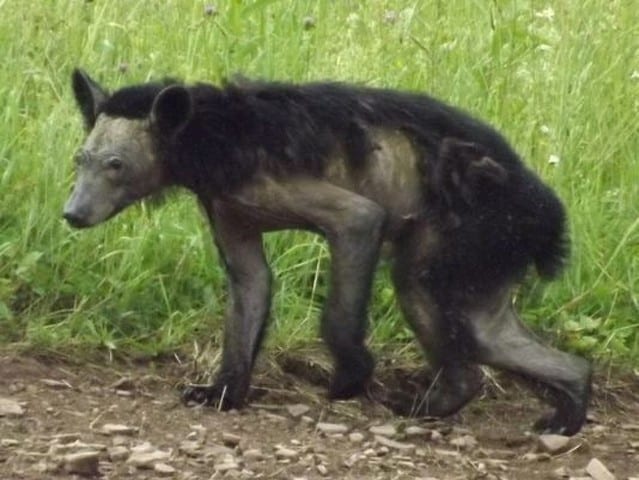
A Penn State research team and the Pennsylvania Game Commission are working together to better understand and manage the mange epidemic plaguing Pennsylvania’s black bear population.
Caused by parasitic mites, mange is a contagious skin disease that causes hair loss, and sometimes emaciation and death. Though the disease has affected mammals for centuries, researchers from Penn State’s College of Agricultural Sciences are studying bear ecology, movement and immune response to learn why mange among Pennsylvania black bears has been so widespread in recent years.
They’ll also study the genetics of the sarcoptes mites the bears are carrying.
Lead researcher Erika Machtinger, assistant professor of entomology and a certified wildlife biologist, said in a release that while mange is not uncommon in Pennsylvania, it seems to be accelerating at an unprecedented rate among bears.
‘We want to work with the Game Commission to try to figure out what’s going on,’ she said. ‘Different species of skin mites can be found in bears in other states but this severe outbreak of sarcoptic mange is a unique Pennsylvania situation.’
Over a two-year period, researchers and the Game Commission will trap, radio collar and track 36 bears, taking tissue and blood samples for analysis.
They began trapping in April and will continue through the summer. The first group of 12 radio-collared bears will be healthy. The next 12 will be bears with moderate cases of mange, and the final group will be bears with moderate cases, but dosed with a medication called Ivermectin, which is used to treat animals with parasites.
Researchers will see over that time how many bears’ cases of mange resolve on their own, how many resolve with the medication and how many develop mange.
‘That should give us an idea of how mange affects denning and potential reproduction, and that ultimately should show how mange actually is affecting the bear population,’ Machtinger said. ‘We’ll also see how mange may affect bear movement, home range size, and use of human habitats.’
Suresh Kuchipudi, clinical associate professor of veterinary and biomedical science, will analyze blood and tissue samples to study if there is a difference between the immune systems of between bears with mange and healthy bears. Machtinger said little is currently known about the immune function of black bears and the research will help identify immune genes that help fight off mange.
Researchers also will try to determine if the sarcoptes mites causing the epidemic have adapted to bears. They’ll also look at whether bears with mange are carrying more ticks and lice than healthy ones, and if that may depress the immune system.
Usually, bears exposed to mites experience an initial reaction but their immune systems can fight off the parasites.
‘But that doesn’t seem to be happening with sarcoptic mange in some bears in Pennsylvania,’ Machtinger said. ‘And we need to find out why.’
Anyone who sees a bear with mange in Pennsylvania should contact the closest Game Commission regional office. For Centre County, that’s the Northcentral office, which can be reached at 570-398-4744.
Other regional offices are:
Northwest, 814-432-3187;
Southwest, 724-238-9523;
Southcentral, 814-643-1831;
Northeast, 570-675-1143;
Southeast, 610-926-3136.
More Latest Penn State News
View all Latest Penn State News
Penn State Urges Prevention as Measles Cases Rise in Pa.
Penn State officials on Thursday urged community members to ensure they are protected against the measles as cases of the virus continue to rise across Pennsylvania and nationally. No confirmed […]

Big Ten Blood Drive Puts Penn State in Race for $1M Grant, Seeks to Boost Supply Amid Critical Shortage
Penn State is asking students, alumni and fans to donate blood as the university joins all 18 Big Ten schools in a competition that could bring a $1 million grant […]

New International Students Adjust to Happy Valley With Hearts Still Connected to Home
Each August for the last 10 years, I’ve written a column about Penn State’s newly-arrived international students. Why that emphasis, you ask? Well, to put it bluntly, our campus and […]


