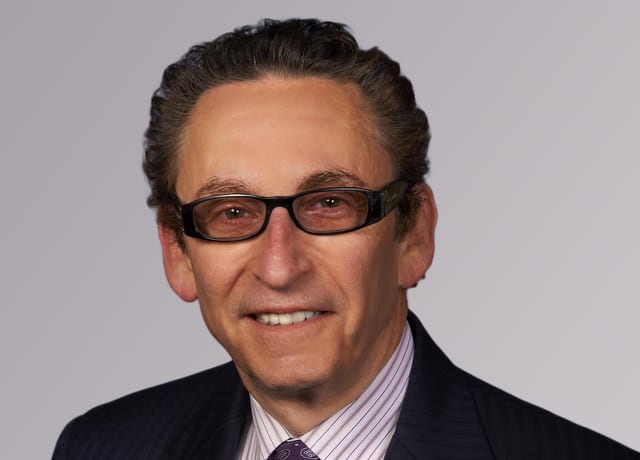
When he was a 3-year-old living in Philadelphia, he would sit by the window when it snowed – a rarer occasion than what he would come to find in his later home of State College. His mother would later tell him that as the flakes began to fall, he would rock back and forth, saying “snow, snow, snow,” as if he might will it to come down harder.
It would, in retrospect, be the earliest sign that Joel Myers was meant for a life in meteorology. By the age of 7 he was keeping a diary of the days it snowed. Nearly 70 years later he vividly recalls a storm in February of 1947, his aunt trapped in his family’s house because of the snow and he unable to sleep with excitement.
“I was pretty well smitten by it and decided to be a meteorologist some time after that,” Myers said.
That career path would lead him to founding AccuWeather, the world’s largest weather media company that today reaches 1.5 billion people daily, with global headquarters on Science Park Road. That path also became, over the course of six decades inextricably intertwined, with Penn State, where he has been a student (earning bachelor’s master’s and doctoral degrees), faculty member, trustee and benefactor. And this week, he is the Penn State Homecoming Grand Marshal and will be in Friday’s Homecoming Parade.
The student-run Homecoming committee announced his selection in September, and for Myers, it was unexpected.
“It is a tremendous honor,” he says. “I was thrilled. I’m excited. Having been associated with Penn State for six decades, I never thought about it. It was a complete surprise.”
‘We are excited to have Dr. Joel Myers represent Penn State Homecoming as our 2016 Grand Marshal. He has put so much passion into his field and it is clear that he is committed to giving back to Penn State,’ Shannon McConnell, Homecoming Alumni Relations Director, said in announcing Myers’ selection. ‘Dr. Myers and AccuWeather are significant supporters of both the University and our organization through various scholarship, donations, and continued dedication to Penn State’s success.’
Budding Meteorologist and Entrepreneur
Entrepreneur Magazine named him one of America’s greatest entrepreneurs, and the New York Times has called him “the most accurate man in weather.” But before all that, Myers was just a kid who wanted to learn more about the weather, and he had a burgeoning entrepreneurial spirit.
At the age of 11, he remembers, his father showed him a newspaper story about someone who was trying to sell weather forecasts. That raised the interest of a boy who was often trying to find small businesses he could give a go – from making and selling potholders to fudging his age to get a paper route for the Philadelphia Evening Bulletin. During his free time though, he’d work on his homemade weather station and write up his own forecasts.
“I wanted to become a meteorologist,” he says. “I didn’t have much money, my parents didn’t. Penn State was affordable, probably the only place I could afford to go… It turned out Penn State had the best meteorology department in the world so I was extremely blessed and very fortunate.”
After spending a year at the Abington (then called Ogontz) campus near Philadelphia, Myers arrived at University Park in 1958 and quickly went about getting his weather forecasts published. He went to the Daily Collegian and asked the city editor if he could do the forecasts for the paper.
He ended up with more of a journalism career than he expected.
“She said ‘Joel we’ll take your forecast and put it in the paper everyday and even put a byline. But only if you cover the police beat.’”
As it happened, the paper was short on male reporters, and women students at the time were restricted in leaving campus at night. So Myers accepted the job of going to the State College Police station, then on South Fraser Street, each night and bringing the police blotter back to the Collegian’s headquarters, which were in Carnegie Building at the time.
That grew into stories profiling Penn State science professors and their research, news stories on major weather events and opinion columns on national politics and local issues. “I became persona non grata in Old Main,” he says, “They instituted a student fee of $25 and I attacked that.”
One of those science professors he profiled would become one of the great influences in his life and career. Charles Hosler, a Penn State professor of meteorology and later dean and vice president for research, is a pioneer in meteorology and using media to broadcast weather forecasts. Hosler spent his entire career at Penn State.
“Charlie Hosler was a great influence,” Myers says, adding that he still has Hosler over for dinner a several times a year. “He was a great orator, he is a great mind.”
Dick Hallgren, then a Penn State Ph.D. student who would later go on to become director of the National Weather Service, once recounted to Myers the first time they met. Hallgren and Hosler had been poring over maps deciding on the forecast for “Farm, Home and Garden,” which was broadcast locally on what was then WFBG channel 10 out of Altoona. Hallgren and Hosler agreed there would be a soaking rain. Myers walked by and said “I don’t think there will be any rain at all.”
“Of course it was a sunny day,” Myers says.
Learning By Teaching
He counts other Penn State meteorology greats like John Cahir as formidable influences, but it was professor Robert Duquet who, intentionally or not, had a significant influence on what would become Myers’ nearly 20-year tenure as a meteorology faculty member.
During Myers’ first year as a graduate student, he was assigned to be an assistant for a 400 level forecasting lab taught by Duquet three hours a day, three times a week. Duquet didn’t show up on the first day, Myers talked to the 40 students for about a half hour and sent them on their way.
His efforts to find Duquet before the second class failed so he stayed up until 2 a.m. the night before in case he had to teach the class. After two weeks, Myers was teaching the course before he found Duquet in a hallway. The professor, Myers says, told him he was doing a great job, and to just turn in the grade cards at the end of the semester.
Myers taught the course for three years before, in 1964, department head Hans Neuberger informed him Duquet, who was an early adopter of computer science, was moving on to another university. He told Myers he would make him an instructor and let him teach Duquet’s course.
“I said ‘With all due respect I’ve been teaching this course. Dr. Duquette hasn’t shown for it for three years. I’m delighted to be officially recognized as teaching this course.’ I taught that course until I retired in 1981. So really I had been teaching that course for 20 years, but 17 officially.”
By 1964, Myers had already founded AccuWeather. In 1962, as a second-year grad student, he created it as a consulting business. It wasn’t an overnight success – he estimates that as he tried to build the business he called more than 25,000 potential customers for customized weather forecasts who told him no.
But as he grew AccuWeather – today it serves 240 of the Fortune 500 companies and thousands of other businesses worldwide – his experiences informed what he could bring to the classroom.
“I brought a lot of practicality into the classroom and fortunately became popular,” said Myers. “Building AccuWeather and forecasting for businesses and media and bringing all those experiences into the classroom made it practical. It made the equations and theory make sense and come alive. I got a lot of joy out of that.”
At the end of the semester, Myers would hold a forecasting contest. If a student’s forecast beat Myers’, the student got an A and didn’t have to take the final.
“Probably over the years there were 18 or 20 that did that and many of them got an automatic job offer with AccuWeather,” he says.
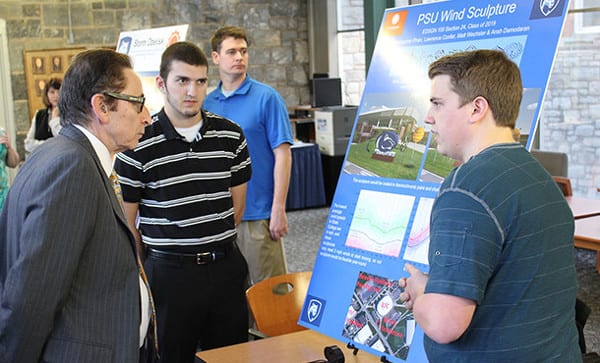
Myers discusses the design of a prism transit center with Penn State engineering students at a showcase for weather-related monument designs earlier this year. Photo: Penn State
Giving Back and Difficult Decisions
Myers, who said teaching students ended up teaching him a great deal, retired from the Penn State faculty and focused on AccuWeather, where he is still president and chairman. But his connection to the university never stopped.
He considers himself a huge Penn State football fan, having missed only six home games since 1958, and the weather vane that sits atop Beaver Stadium, one of the largest in the world, was his donation.
He also donated the interactive sundial at The Arboretum at Penn State and walk-in sundial at The Nittany Lion Inn. He’s awarded dozens of scholarships to meteorology and information sciences and technology students, as well as creating an endowed scholarship for the football team.
Perhaps the most direct connection to his roots is the meteorology department’s Joel N. Myers Weather Center teaching facility, for which he donated $2 million.
“It’s very exciting I’ve been in a position to do that to help create an environment that is so much further advanced than what was possible when I was a student,” he says. “To see the impact of that – it just keeps getting better all the time.”
Myers also was elected 11 times by Penn State alumni to the university’s Board of Trustees, serving a total of 33 years and is now a trustee emeritus. He says that among the achievements during that time that he is most proud is the advancement of Penn State’s online education.
“Being aware of and leading AccuWeather into the digital age… [I recognized] the tremendous changes that were coming and are now under way and accelerating, and the tremendous impact that would have on higher education both positive and negative,” he says. “So helping Penn State be a leader in online education, having many meetings with the beginning of the World Campus and pushing that hard so Penn State would be at the forefront of that.”
In November 2011, Myers and the rest of the board were met with what had been an unthinkable crisis – the fallout from the Jerry Sandusky scandal.
Recognizing that some alumni were and remain angry about the board’s removal of Joe Paterno as head football coach and Graham Spanier as president in the wake of the charges against Sandusky and other Penn State administrators for allegedly concealing his crimes, Myers calls the decisions “difficult but necessary,” to demonstrate that the university was exercising institutional control.
“It was devastating,” he says, adding that he knew both men for many years and considered Paterno among his heroes and Spanier a friend. “I can only speak for myself, but I felt there was no choice but to do what we did.”
He adds, however, that he believes the NCAA had no place in levying sanctions in 2012, most of which were ultimately repealed or ended early, and he has previously said that he argued against the university’s signing of the consent decree that imposed that sanctions. And he believes Louis Freeh “grandstanded in the press conference,” announcing the results of his university-commissioned investigative report, making statements that weren’t supported by the report and unfairly harming the university.
Myers’ term as an elected board member came to an end in 2014 when he lost re-election, as the other alumni-elected trustees on the board in 2011 did in the ensuing years. He was named a trustee emeritus in 2014 and remains committed to serving and advocating for Penn State.
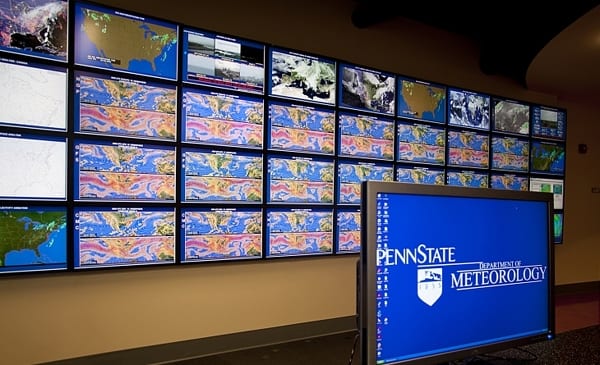
The weather wall, located at the Joel N. Myers Weather Center in Walker Building on Penn State’s University Park campus, consists of 36 LCD monitors that display current weather conditions as well as forecasts from around the world. Photo: Penn State
Focus on the Future
Myers is optimistic for the future of Penn State and wants to see it continue to provide the kind of opportunities it did to him.
“Penn State plays a very important role,” he says. “I was the first in my family to go to college and it meant all the difference to me. Higher education in this country is the envy of the world, that’s why there are so many foreign students who come here. To preserve that is so important to our society and progress and all the people who attend Penn State now or will come to Penn State in the future.”
He says he’s happy he has been able to employ countless Penn State graduates over the years, playing a role in building the local community and economy and giving Penn Staters an opportunity to stay in the area. Places like Penn State and AccuWeather, he says, play a special role in the local economy by bringing in money from all over the world that is then circulated in the local community.
And he is grateful for all Penn State has done for him, including the latest honor as Homecoming Grand Marshal.
“Penn State has been great to me,” he says. “Naming me a Distinguished Alumnus (earlier this year) was a tremendous honor. Receiving this totally unexpected honor is just amazing.”
Editor’s Note: Joel Myers is the father of Dan Myers. Dan Myers is the owner of Lazerpro Digital Media Group, the parent company of StateCollege.com.