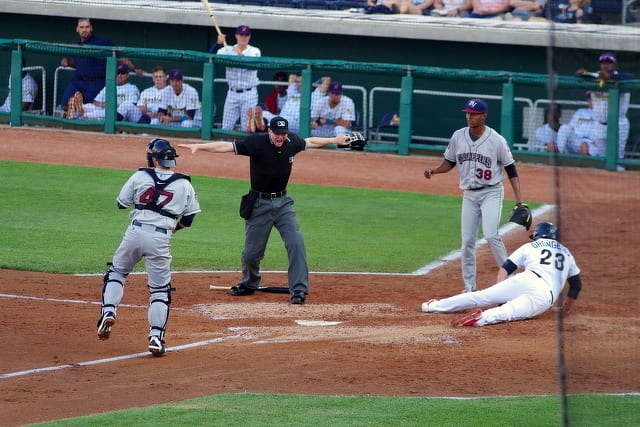
At the dawn of the 2016 New York Penn League season, the State College Spikes welcomed a new roster full of new draftees, experienced prospects looking to continue their development and even some minor league faces with no clear idea where their career might take them.
Their fans love the team, and there is a special bond between minor league players and their fans.
There is a tangible sense of pride observed when hearing fans talk about a prospect’s chances at the majors, or how players touch their lives, and their family’s lives, in ways big and small.
It’s a closeness that is rarely felt at the major league level, if at all.
Right now, unbeknownst to many who feel that closeness every time they catch a game at Medlar Field, there are very powerful forces at play fighting over that relationship.
You may not be familiar with the Senne v. Office of the Commissioner of Baseball lawsuit, and that’s okay. Not many are. It is a lawsuit brought forth by former career minor leaguer Aaron Senne, along with others. Senne was a first baseman in the Miami Marlins system from 210 to 2013. The 10th-round pick could never recover from Tommy John surgery and other injuries, retiring in 2013.
In early 2014, Senne along with other retired minor leaguers Michael Lierto and Oliver Odle, filed a lawsuit on behalf of all minor league players. Their assertion is that Minor League Baseball, and Major League Baseball, by proxy, rampantly violates state and federal minimum wage laws by underpaying minor league players at all levels. The case has snaked its way through the legal system and was granted conditional certification – the first step towards class-action status – in October of 2015.
Moving to a class action lawsuit would allow nearly 10,000 current and former MILB players to join the suit.
The goal of the suit is a complete overhaul of the manner in which MLB treats its minor league employees.
In response to the lawsuit, members of Congress have introduced the “Save America’s Pastime Act.” The bill hopes to discredit the Senne lawsuit by invalidating minor leaguers right to be included under the Fair Labor Standards Act of 1938. Unaspiringly, Minor League Baseball has announced its full support.
Much like the debate over on-the-field matters, the debate over the act rages.
Rep. Cheri Bustos (D-IL) had initially supported the act before withdrawing her support, commenting that “Whether it’s on the factory floor, in classrooms or on the playing fields…I strongly support raising the minimum wage and the right to collective bargaining for fair wages.”
The lawsuit and its corresponding grassroots movement were dealt a near-crushing blow on July 22nd. A judge in California struck down the motion to transform the suit into a class action. The court felt that the individual players’ suits were not factually similar enough to proceed.
Baseball undoubtedly breathed a huge sigh of relief at this news. Without the backing of a class action lawsuit, real change will likely be hard to come by, and individual settlements may only wade towards the low-thousands side of the pool.
And so it seems that the inherent challenges of a minor league player trying to pursue a dream and make a living at the same time continue to play out.
Though the information is hard to find, most minor league players at the Spikes’ short-season level make about $1100 per month. Increases follow with each promotion up the organization’s ladder, to say nothing of any signing bonus for higher-round picks.
If projected to a full-year salary, the resulting $13,200 figure would be just above the current Federal Poverty Line of $11,880.
Still, when fans first learn of the standard salary figure, the resulting conversation is often very divisive.
“The players work so hard. They deserve more pay.”
“These guys will be millionaires one day, and they’re getting paid to play a game.”
The hard truth is that only 16 percent of drafted players will make the major leagues. The others may toil away at places like State College, hoping to refine their craft to simply set the stage for their dreams to be realized.
When viewed in that light, is any wonder that players who aren’t a sure shot for a major league roster are fighting for better pay?
The other side of the coin is not without merit.
If the bill doesn’t pass and the lawsuit succeeds, Major League Baseball – which entirely funds player contracts and development costs – would likely have no choice but to consolidate levels. Rather than carry five minor league levels, clubs would very likely consolidate, and carry half of the total number of prospects and play them at the Double-A and Triple-A levels.
Good for towns like Altoona.
Bad for the State Colleges of the minor league landscape.
Minor league clubs such as the Spikes are businesses, and are well within the rights of capitalism to make money. Teams such as State College are aware of the challenges the low salaries of minor leaguers bring about, and are looking to help bridge the gap, if nothing else than to make their players a little more comfortable during their time in Happy Valley.
Enter the concept of “host families,” a group of fans who take in player – and often, more than one – into their home for the duration of the season. They eat with the player(s), provide room and board and sometimes even provide them with transportation to use.
Nick F., a husband, father and host family underlines how vital a host family can be. “We had one player tell us that they shared an apartment with 10 other guys, had no bed and it cost about $1,000 a month after they paid their portion of rent, food and utilities.”
Though they can vary, the living arrangements with host families are undoubtedly more desirable than the scenario pictures. Dale M. is a long-time player host who has cultivated his own traditions with his charges.
“This year we have three players.” he told me. “Two are returnees, and our ‘new’ player is our 30th player hosted over the last ten years. Just one has made it to the Major Leagues.”
“We have never charged rent, or asked for anything in exchange for the hosting,” he continued. “Position players are encouraged to sign their first broken bat of the summer, for my ‘wall of fame’ in the basement.”
In talking to several current Spikes, the theme that pops up every time that I ask a player about his host family is nourishment, both physical and emotional.
“Sometimes, it’s usually just really nice to come home after a long day at the park and have a home cooked meal,” a player new to professional baseball told me. “Being on the road, or even here the park – you long for just going home and sitting down and unwinding.”
“I truly feel as if they’re my family,” another player told me. “I hope that I can be like family to them also.”
If you listen to some of the host families relate their experiences, you quickly learn that forging the bond between player and family is perhaps the easiest part of the process.
“Last year was our first year hosting a player, and while he was only with us for seven weeks, I was surprised at how melancholy we were with his departure.” said Gena H. “I’ll never forget getting his text as we were attending one of the Little League World Series games in Williamsport, Pa. He said ‘I have some good news and some bad news. I’ve been promoted!’ … that was at 9:30pm. He was on a plane at 5 a.m. the next day.”
“My kids were so upset they made us leave the game immediately to head home to see him. He had become part of our family, and we missed him.”
Dale echoes Gena’s sentiment.
“My wife truly takes being ‘mom’ seriously, including doing all their laundry like she would for her own children. Mom is the nurturing mother type and I’m the coach, always trying to build them up and get them to the next level.”
“It’s always hard to say goodbye to the guys. We have been blessed with the right mix of guys.” Nick tol me. “they’re showing my boys how to act when they get older and how to treat others.”
“We have been invited to (their) weddings and now they are having babies…we keep in touch with many of the players.”
Though the emotional bonds are brought about naturally, they are a byproduct of the logistical advantages of using the host families. Many minor league players are without transportation to come to and from their many commitments. Many host families provide that transportation.
Some even cash their paychecks for them.
For the Spikes, host families help keep operating costs low, allowing funds to be reinvested back into the customer experience. Not every minor league teams provide host families, and they are not mandated from Major League Baseball. However, the alternative of providing hotel lodging for an entire season — as some teams do — is a logistical nightmare, one that could have a crippling effect.
Storm clouds may be gathering around the minor league game, but in adopting initiatives such as host families, the State College Spikes are seeking shelter from economic uncertainty.
Much like the players themselves, who value the safety, the feeling of family and the comfort of a true home away from home.