
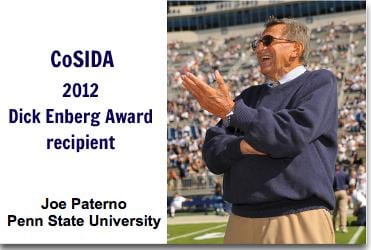
This past Monday, I found myself lucky to be among incredibly accomplished men and women. I was asked to accept the Dick Enberg Award on my father’s behalf. That was the reason I was there, but I quickly realized there was more to be gained.
I knew if I was alert and listened, I’d grasp information to better illuminate some things in my own life.
Part of the College Sports Information Directors of America event in St. Louis was the induction of five former student-athletes into the Academic All-American Hall of Fame. These people represent the very best in college sports, successful men and women on and off the field and in their post-college life’s pursuits.
As ESPN’s Reese Davis introduced them as they came up individually to talk about their lives. I listened to the new members’ stories, gleaning something from each one. The list included NCAA champions, Olympic Gold medalists, NBA and WNBA finalists, and a United States cabinet secretary. All shared one thing in common; as much as they excelled in their sport, they were even greater giants in the classroom and in life.
They represent what intercollegiate athletics is and should always be all about.
From the start, I knew if I listened, really listened, I could get something from every one of them.
From USC’s John Naber, the 1976 Male Swimmer of the Year, a year he won four Olympic gold medals and one silver, I learned his coach’s valuable lesson.
“It’s not how fast you can swim, or how hard you swim or how far you swim. It is how far you can swim hard.”
John is using his life after athletics to help disabled student-athletes and raise money for charities in southern California. He’s continued to “swim” long distances with intensity helping others in his life.
Former Oklahoma basketball and Phoenix Suns standout Alvan Adams made a point when asked why he had chosen to go to a “football school” rather than play at places like UCLA or Duke. He and some fellow Oklahoma all-state players decided they could do something special in a place where it hadn’t been done. His unconventional wisdom led to a huge collegiate and professional career, one he used to bridge into a life of service off the court in Phoenix.
He also had the funniest line of the night. He played in maybe the greatest Game 5 in NBA Finals history, a game his team ultimately lost. That game regularly re-airs on ESPN Classic, each time prompting someone to call him.
“Call me back if we win.” He tells them.
Notre Dame basketball and WNBA standout Ruth Riley won’t have to take those calls, winning team titles in college, the pros and the Olympics. As with all of these honorees she hasn’t let that be the only thing she does. She’s served on the President’s Council on Physical Fitness and written a children’s book. She spoke about her drive to win and to prepare to compete in all she does.
As a father with daughters, I’m glad they can find student-athlete role models like Ruth Riley. Riley’s presence served to remind all of us of the impact of Title IX, federal legislation that helped insure equality of educational opportunity for women.
But as Riley’s fellow 2012 Hall of Fame, inductee US Secretary of Education Arne Duncan, reminded us, there was no mention of athletics in that 1972 law. It was applied to athletics.
Secretary Duncan called it “one of the biggest pieces of civil rights legislation over the last several decades.” It has given women more opportunity to play sports, activities proven to increase academic success and improve life skills in young women.
Secretary Duncan, a standout Harvard basketball player, stressed the enormous value of extra-curricular activities in our secondary schools. As school budgets get tight, sports, drama or music get cut despite the tremendous positive impact on the schools and the students.
He’s right, but I may have learned the most about sport’s impact from Lynchburg College women’s soccer coach Dr. Todd Olsen. An Academic All-American at Slippery Rock, Todd shared the motto he teaches his team.
“Finish every day on empty.”
That has carried his teams into the NCAA Final Four. But it’s also taken them on team trips to places such as Kenya and Uganda, using soccer as a bridge into minds halfway across the globe.
As unselfish as that may be, it is what Todd said, “You don’t change Africa, Africa changes you.” He told a story about one of his student-athletes killed in an accident. Her father made the African trip to see the well they had built there in her honor. Todd saw that father’s loss transformed when he saw rebirth in a life-giving well.
Sitting in the audience, I listened to that story of transforming one’s self after loss. What we give to others is what really comes back to change our hearts.
You don’t change others when you give, your gifts change you. It was a lesson I had certainly learned from my family, but on that night hearing it from so many others helped reinforce it to me.
Recent Columns:
- Jay Paterno: Already Faced with Toughest Path to a Championship, College Football Needs a Playoff – June 14, 2012
- Jay Paterno: Radio Program Sparks Memories of Birthday Celebration on TV Quarterbacks – May 31, 2012
- Jay Paterno: Facebook IPO — Believe The Hype? – May 17, 2012
More Columns
View all Columns
Matt Campbell Is Good for Penn State. And Vice Versa
Two things can be true: Matt Campbell is good for Penn State. Saturday was proof positive of that — on, going onto and off the field. Also, though: Penn State is […]
With a Career-High 4 TD Passes, Penn State QB Rocco Becht Shows He’s the Real Deal
Penn State’s Rocco Becht made his 40th start as a college quarterback on Saturday in Beaver Stadium. No one playing in the FBS season has more — and that would include […]
Penn State Game-Planning and Play-Calling: What Campbell, Mouser and Becht Have to Say
Over the course of his 2024 and ’25 seasons at Iowa State, offensive coordinator Taylor Mouser called 1,813 plays. Give or take. The Cyclones’ offense ran that many. But head […]


