
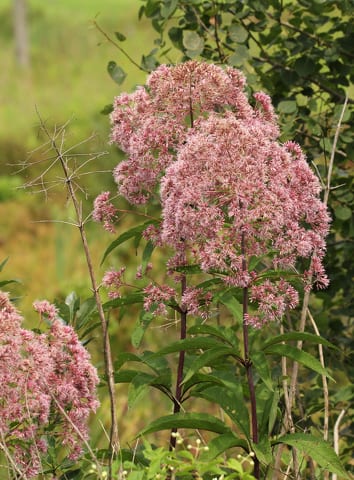
The tallest wildflower to bloom at this time, or maybe any time of year, is the stately Joe-Pye weed. Its domes of pink flowers are perched atop stems that can reach heights of eight feet. However, heights of 10 to 12 feet are not uncommon when growing conditions are ideal.
Look for Joe-Pye weed along streams and other areas that have damp soil. In some areas of the United States, the U.S. Army Corps of Engineers uses Joe-Pye weed as a wetland indicator. It is often seen growing in association with New York ironweed, boneset, green-headed coneflower, bur-marigold and jewelweed. Joe-Pye weed can easily be spotted in roadside ditches and along Spring Creek, Marsh Creek, Bald Eagle Creek and other Centre County streams.
Watch a clump of Joe-Pye weed and you will see that there is constant insect activity. Their flower clusters attract bumblebees, honeybees and many butterflies — including the red-spotted purple, monarch, fritillaries, swallowtails and others. Swamp sparrows and other bird species are known to eat the seeds. According to the Xerces Society for Invertebrate Conservation, the plant is of special value to honeybees.
Plants next to deer trails are sometimes browsed in the spring, which can lower their maximum height. Overall, Joe-Pye weed is considered deer resistant. Leaf miners sometimes attack their leaves — eating the thin mesophyll layers on the inside, but the plant does not suffer major insect damage.
Four similar species of Joe-Pye weed are found in the northeastern United States, but hollow Joe-Pye weed (Eutrochium fistulosum) is the most common in Pennsylvania and also the tallest. The others include Joe-Pye weed, spotted, and sweet Joe-Pye weed. These native perennial herbs are still closely related to boneset and ironweed.
Hollow Joe-Pye weed, as its name implies, has a hollow purplish-green stem that supports tiered whorls of four to seven (usually six) leaves. The pointed leaves have a crinkled surface and are 5 to 12 inches long. Leaf whorls are spaced six inches to a foot apart along the stem.
The clumps of towering plants are supported by a tough and massive root system. Those wishing to transplant it from the wild often give up in frustration.
However, there is never a need to dig up these beautiful plants from the wild. Cultivars, especially bred for size, color and drought tolerance are available from native plant nurseries.
According to folklore, Joe-Pye weed gets its unusual common name from a Native American healer named Joe Pye, a Mohican. As the story goes, during colonial times, Joe Pye used the plant to treat typhoid fever and other ailments. It is also possible that the name comes from a Native American word, jopi, which means typhoid.
The original genus name for Joe-Pye weed was Eupatorium. That word also has medical or magical origins. It was named after the Persian King Mithridates Eupator, who supposedly used this plant as magic to help his soldiers defeat the Romans in battle. Just a few years ago, Joe-Pye weed was classified in the same genus with boneset and New York ironweed. However, it has since been separated into a new genus.
Various concoctions of Joe-Pye weed were used by several Native American tribes and colonists as an aphrodisiac, as well as to treat fever, kidney disease, colds and skin disorders. Although this plant has no known pharmaceutical value today, some herbalists continue to suggest its use as a tea to treat urinary problems, gallstones and to break a high fever.
Even though its medical value is questioned, Joe-Pye weed still adds beauty to streamside meadows and moist bottomlands. Wild or propagated cultivars also add grace and height to naturalized or more formal landscapes, while their blooms provide nectar for bees and butterflies. While Vacationing in Delaware, I noticed several places where dwarf cultivars of Joe-Pye weed were being used in formal landscaping at Fenwick Island and Bethany Beach.
More Columns
View all Columns
If We’re Doing Corporate Names for Berkey Creamery Ice Cream Flavors Now, Here’s Some Other Suggestions
On a recent trip to the Berkey Creamery, I noticed what I thought was a new flavor on the board called Three Stripe Delight. I have a usual go-to list […]

Q: Who Blocks for 534 Pass Plays and Doesn’t Give Up a Sack? A: Penn State’s Trevor Buhr
Former Iowa State offensive lineman Trevor Buhr — now a Nittany Lion for the 2026 season — was a definite burr in the butts of opposing defenses on passing downs over […]

Battista: Our Summer Adventures Continue
“Life is either a daring adventure or nothing.” —Helen Keller Our 27-day summer adventure is finally coming to an end. Just one more day in our nation’s capital, then we […]


