Many birders have a “spark bird”— a single species that begins a lifelong interest in birding. My own spark wasn’t so much a bird as it was a bird feeder, which I was given several years ago. At the time, I didn’t know a warbler from a chickadee, much less how to feed, watch, and identify the more than 350 regularly occurring species in Pennsylvania. Very quickly, however, I had two epiphanies: birds are incredibly addicting and learning about them is a lifelong pursuit.
Today, I can attribute much of what I know to an abundance of local resources, because if Centre County is one thing, it’s bird-centric. The region, through the community and Penn State, has a prominent bird club, a large raptor sanctuary, and a multitude of avian. Enthusiasts can be found banding birds to collect data, sharing sightings on social media, and competing annually to find the most birds in a day. And rare migrants, such as the Rufous hummingbird of 2013, can impel a stream of traffic to an otherwise quiet neighborhood. In addition, annual citizen science events such as the Big Sit, Christmas Bird Count, and Hawk Mountain Migration Count help assist organizations such as the National Audubon Society in gathering valuable data on a local scale.
For the uninitiated, this legion of activities might seem surprising, but they are actually a microcosm of a larger whole. In its most recent “Birding Trends” survey, the US Department of Agriculture reported birding to be the 15th most popular outdoor recreational activity in the United States, practiced by more than 46 million people. This phenomena is no less apparent than in Centre County, where for many, birding is a way of life.
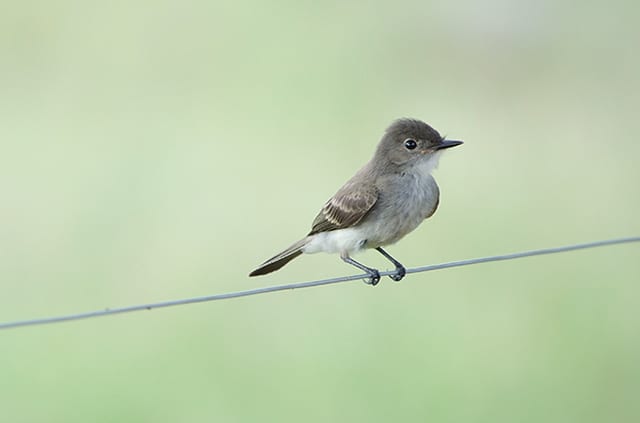
One such person is Doug Wentzel, program director and naturalist at Shaver’s Creek Environmental Center. A 1989 graduate of Penn State with a degree in wildlife and fisheries science, he recalls becoming interested in birds after seeing an Eastern phoebe for the first time. Since then, he has endeavored to share his knowledge of birds — as well as trees, plants, and wildflowers — with others.
“The mission of Shaver’s Creek is to connect people to the natural world,” he says. “We provide places where they can see birds and fall in love with them.”
Every fall and spring, he leads guided trail tours called Migration Mornings, which have introduced hundreds of visitors to Pennsylvania birds during the past 17 years.
Although most birding begins in the field, there are exceptions. College student Saleem Salahuddin was inspired by The Big Year, a movie that chronicles a real-life competition among birders.
“I love to travel,” he says. “When I saw the characters trekking across the world to see as many birds as possible, I realized it was something that I could do.”
For a novice birder, Salahuddin has big dreams: “My goal is to see every bird out there,” he laughs, “and maybe, if I’m lucky, find something that no one knew existed.”
Fortunately for students such as Salahuddin, and the community as a whole, Penn State is committed to advancing avian education as part of its outreach efforts. Dr. Margaret Brittingham, a Penn State professor of wildlife resources, teaches ornithology classes, educates visitors about the university’s bird-banding program, leads campus bird walks (open to both students and the general public), and oversees avian curriculum at the Arboretum at Penn State.
“We want visitors to become excited about birds,” she says, “because through them, people can explore everything from pure nature to ecological questions to just enjoying birds for their beauty.”
Her own interest in birds stems from a scientific bend.
“As an avian ecologist, I use birds as a tool to address questions about the environment, from climate change to natural gas development,” she explains. “In many ways, birds are bioindicators, which means they give us clues about the health of their ecosystems — and ours.”
Despite her analytical skills, she fondly remembers her own spark bird, a Northern flicker, that was the impetus of her career as an ornithologist.
“When you think about it, birds are a part of art and science and nature, so they appeal to people on many levels,” she says. “What’s truly amazing is that we’ve had kids who have attended our activities and then gone on to become wildlife majors in college.”
With a new generation of birders comes an evolution in birding. Today, user-driven databases such as eBird and NestWatch have largely fueled the growth of online citizen science programs. Traditional field guides and paper checklists are making way for digital applications and social-media collaboration. Even John Mackin, a local hobbyist birder, has replaced his pocket field guide with a smartphone identification app, and birders often bump into each other on avian Facebook pages. But Mackin believes that digital tools will never become substitutes for the real thing.
“Birds are like little jewels when I’m out in nature,” he says, with a glimmer of awe, sharing his wonder at seeing a harlequin duck for the first time. “There’s a joy in finding something I haven’t seen before, because birds in their natural environment are full of color and life. I come from a faith-based background, and seeing purpose behind such beauty encourages me every day.”
This sense of excitement, whether scientific or spiritual, seems to permeate the psyche of all birders.
Much of the thrill for enthusiasts is discovering where to find birds locally. With its woods, fields, marshes, and streams, Millbrook Marsh Nature Center attracts a delightful array of spring species, including red-winged blackbirds, Eastern bluebirds, and tree swallows. In Bellefonte, the fish hatchery and legendary fishing locale called Fisherman’s Paradise has been home to a nesting pair of bald eagles for several years. Other popular territories include Toftrees and Walnut Springs, but Scotia Barrens, a favorite among birders, is perhaps one of the most visited hotspots. Here, birders can find snow geese and other migratory waterfowl through March, and come early May, one may spot kinglets, flycatchers, and a host of colorful warblers.
Occasionally, birders also gather here to witness American woodcocks practicing their unique courtship displays. Another popular location with varied habitats, Bald Eagle State Forest often boasts migrating tundra swans in the spring, as well as resident species such as belted kingfishers, killdeer, and American kestrels.
“March is an exciting time for new arrivals coming through,” Wentzel says. “One of my favorites is the ruby-crowned kinglet — it’s such a small bird with a tremendous song.”
Yet perhaps one of the most inviting aspects of birding — unlike many other hobbies — is that it can be enjoyed almost anywhere. For those who simply want to observe birds from their homes, very little is needed: an entry-level pair of binoculars, a field guide, and a bird feeder (Wiscoy for Animals has dozens).
“The best way to begin birding is by learning the common birds,” Brittingham suggests. “Pay attention to the robins, the grackles, and the starlings. Once you start becoming aware of them, you’ll become more aware of the uncommon ones.”
Salahuddin agrees that having a feeder can be a good “rehearsal” for more serious birding later on, or simply a way to relax after a busy day. He points out that the expense of birding “just depends on how hardcore you want to be. After you have binoculars and a guide … well, the birds are free!”
For those who aren’t quite ready to venture into backyard birding, Shaver’s Creek and the Arboretum at Penn State each offer a free alternative. Their feeding stations are open year-round and attract a variety of birds during every season. Additionally, morning bird walks and introductory identification classes at Millbrook Marsh Nature Center offer great opportunities for novices and enthusiasts alike.
Regardless of one’s preference for bird-watching — in the field, at home, with a friend, or by oneself — the allure of our feathered friends is how they connect us to the natural world. The “spark” that birds generate in our lives inspires us to see above and beyond our everyday existence in a new and exciting way.
“Letting birds into your life and putting yourself into a position to see them is an excuse to get outside, to go to places where you’ve never been before,” Wentzel explains. “We can be better neighbors just by learning the names of the things that inhabit our world, as we inhabit theirs.”
As he talks, he watches tufted titmice flitting from branch to branch as the sun filters through the trees.
“Magic happens all the time, and we are often simply not paying attention,” he muses. “I try to encourage people to observe the life that’s around them, and birds are great ambassadors for doing that. They’re here with us always, they’re beautiful, they’re lively, and they enrich us with their song. So just be curious. Allow them into your landscape, and who knows — they might just change your view of the world.”