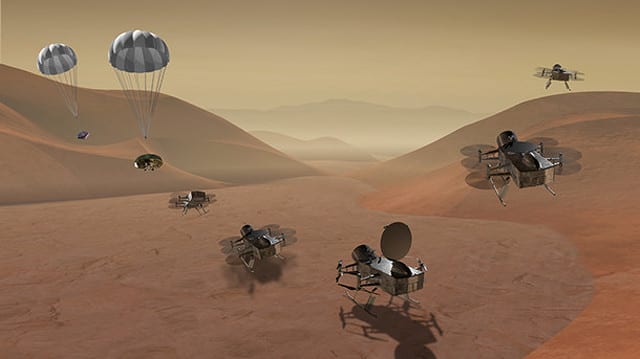
Penn State aerospace engineers are developing a drone for a NASA concept mission to Titan, Saturn’s largest moon. If selected, the drone, Dragonfly, would have an estimated mission launch by the mid 2020s and would last more than two and a half years.
The engineers, along with their team led by the Johns Hopkins Applied Physics Laboratory, have been selected as one of two finalists. The other is the Comet Astrobiology Exploration Sample Return (CAESAR), led by Cornell University and NASA Goddard Space Flight Center.
“We’re using technologies developed for drones that fly here on Earth and modifying them so we can enable science missions on different planets,” Penn State associate professor Jack Langelaan said in a press release.
Titan, the moon being investigated, has seven times less gravity than Earth, and an atmosphere four times denser than Earth’s. Dragonfly’s objective is to investigate Titan’s organic chemistry and habitability, monitor atmospheric surface conditions, and perform seismic studies.
“Titan’s environment is ideal for flying, and the mobility of a flight vehicle will give planetary scientists access to a broad area of Titan, letting us see variations in geology, surface and subsurface geochemistry and atmospheric conditions,” Langelaan said.
The selection of either the Dragonfly mission or the CAESAR mission is planned for spring of 2019, and will be the fourth in NASA’s New Frontiers portfolio, a series of planetary science investigations.