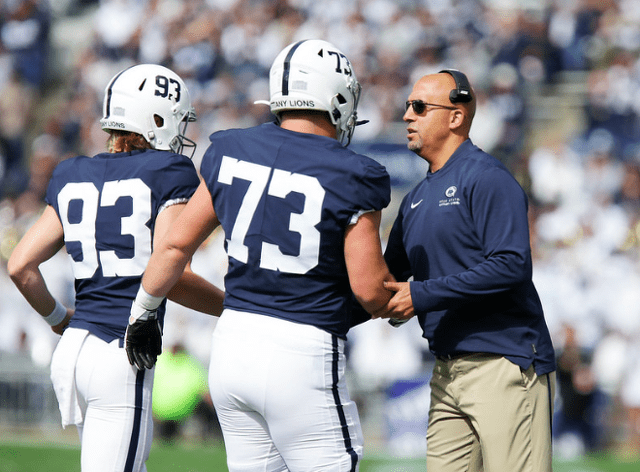
Since the end of the 2015 season Penn State has gone 25-6 in Big ten play and 37-9 overall.
For any given shortcoming or any particular game that fans or Penn State might want back, it is a fairly remarkable streak of success. Critics might say that the Nittany Lions might only beat who they should, but the other side of the coin is also true: Penn State has gotten to a place where it should beat just about everyone.
So how exactly do you go about winning far more often than not? Penn State has won 22-straight games against Big Ten teams not named Ohio State, Michigan State or Michigan. It’s a level of success that speaks for itself even if six losses against those three teams above give fans more heartburn than joy.
“We talk about it a lot,” James Franklin said after practice earlier this week. “In terms of winning traits and winning characteristics, there are a lot of college football programs out there that are going to beat themselves. I think that’s the first thing you’ve got to do as a program is teach your program what those things are and how to avoid them.”
Aside from simply poor execution the areas of turnovers and penalties are the two easiest ways for a team to self-destruct.
In the penalty department Penn State sits 11th in the nation with 4.7 flags per game, the Nittany Lions have finished in the Top 25 of penalties per game for each of the past six seasons including Top 18 finishes each of the past two years.
In Big Ten play alone Penn State has been the second least penalized team in the Big Ten twice over that same span and never lower fifth since 2014.
As far as coughing up the ball, Penn State at its best has the led the way. In 2017 the Nittany Lions were the best team in the Big Ten in terms of turnover margin. Penn State on the whole has finished with a positive turnover figure three of last four years, currently +3 during 2019.
“After that it comes down to the programs that are left and how fundamentally sound they are, is there a strategic advantage from a scheme perspective? Yes,” Franklin added. “Is that magnified some weeks compared to others where you’re just a better physical match up for a certain opponent or whether your scheme is a problem for that opponent? A lot of it is based on what offense and defense they run every day and what they’re used to defending, that factors into it.”
From there it comes down to talent, Penn State’s recruiting success no secret to those who follow the program. The Nittany Lions have finished with Top 20 classes nationally every year except Franklin’s first in 2014. The blue chip ratio continues to rise and with it the depth across the program.
In essence Penn State’s four-man rotation at running back is a good problem to have, the kind where you have plenty of good choices to work with.
“And obviously talent,” Franklin concluded. “There is a talent gap with some programs and that factors into it as well. It’s kind of a combination of those things every single week, but as we both know, you also see a lot of other things: we see talented teams that don’t play up to the level that they should, we see talented teams that are inconsistent that play really well one week and not the next.”
“That’s where you hope your process helps with that. So it’s kind of all that, you’re taking all those different pieces and you’re trying to come up with a formula that’s best for you and your program week in and week out.”
So the equation isn’t overly complicated when it comes to how Penn State approaches the consistent success it has had in the past few years. Don’t commit penalties, don’t turn the ball over, scheme well and stockpile talent.
Of course that all sounds easy, but it isn’t, and it also doesn’t look to be changing in State College any time soon.