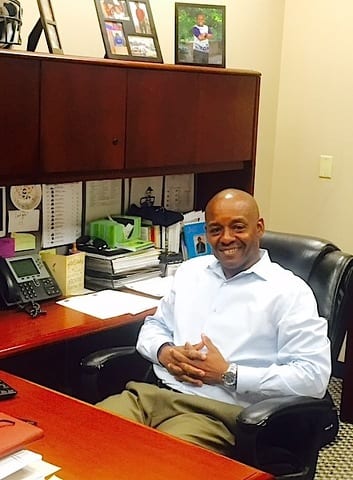
Jemal Griffin may be the most important person in the Penn State football program you never heard of.
Yet he doesn’t call one play or coach a single player.
What Griffin does do is manage the program’s $35-million-plus budget.
And serve as head coach James Franklin’s chief of staff.
And oversee upwards to two dozen full-time staffers and, when counting a spate of interns, 65 overall employees.
And lead Penn State’s key quartet of football administrators – the directors of player personnel (Andy Frank), player development and community relations (P.J. Mullen), football administration (Kevin Threlkel) and football operations (Michael Hazel).
And serve as the football program’s liaison with Penn State’s athletic administration — including deputy A.D. Phil Esten, intercollegiate athletics CFO Rick Kaluza, the department HR director, the university’s athletics integrity officer and the PSU head of compliance — as well as the Big Ten and Nike.
“Anything that doesn’t involve the X’s and O’s, that’s me,” Griffin said during an interview in his Lasch Building office last week. “My job is the off-the-field operations.”
Griffin is Franklin’s right-hand man whose public face is rarely seen, in part because his work is most often behind the scenes – from negotiating contracts to supporting the business side of Franklin The CEO. Griffin is “totally OK” with that.
“I don’t need to be out front. I don’t need the spotlight,” he says. “I do my job through the days and months and years and try to do what is right. The people who matter to me show me appreciation — the players, our staff, the university. That’s enough for me. I think Coach (Franklin) appreciates what I do.”
THE VANDY MODEL
The two met at the University of Maryland, where Griffin was first a recruiting assistant and eventually the director of football operations. He followed Franklin to Vanderbilt in 2011-13, and it was there Franklin’s front-office hierarchical org chart took root. It was new to Penn State, which had operated with a much smaller front office under Joe Paterno and a somewhat smaller one under Bill O’Brien.
“When we went to Vanderbilt we created the model we have now,” Griffin says. “It was unknown here; they didn’t have it at Penn State. It took time to see how it works and is coordinated – a matter of everyone learning it and getting comfortable with it. It was such a change from what they were used to at Penn State. Once everyone saw it worked, they became comfortable with it.
“It has a purpose. Coach says to all of us, and we talk about it as a program, that we want to be the best at everything. Everyone takes pride in that. We want to be the best football team on the field, we want to be a first-class organization. We put a lot of emphasis on all areas achieving at the highest level.”
For Griffin, the best part of the job is working with the Penn State players.
“What I like best is the interaction with the student-athletes,” he says. “Our job is to create successful young men who are prepared to move on to the next phase of their lives, whatever that is for them. That is what I enjoy the most – to see them come in as freshmen and leave ready for what’s next. I’ll go out of my way to talk to them, if I think they need it. I’ll text them or ask them to come see me. Or talk with them at the training table, or when we’re traveling. I try to stay engaged with them. That’s the end-all and be-all.
“At the end of the day I see myself as an educator. We’re all mentors, we all take pride in being positive role models for them. It’s what God’s purpose is for me.”
THE BUSINESS OF JEMAL GRIFFIN
That one-on-one interaction is why Griffin got into the world of sports – first at the high school level, then collegiately – in the second place.
Yes, second place.
Griffin’s path to his current position wasn’t easy, beginning in the tough neighborhoods of Baltimore and making its way into corporate America. That he ended up running a multi-million dollar college football program wasn’t part of his original plan. But in the end, where his daily tasks include business, sports and education, it makes sense.
Griffin grew up in the Park Heights section of Baltimore, with sports as a touchstone and the means to an end. A quarterback and shortstop for Northwestern High School, Griffin earned a baseball scholarship to Coppin State and became the first member of his family to graduate from college.
“Growing up in the inner city, not having much with a single mom and the youngest of three boys – the older two having made some mistakes in their lives – I always had coaches who I could depend on,” he says. “When I was going off the road they got me back. When I was younger, I took that for granted. But as I got older, I realized that they were a blessing to me to keep me on the right path. And as I got older, I realized I need to give back. Life for me became much clearer when I discovered what the purpose of my life was meant to be.”
After college, that purpose was putting his degree in business management to use, by taking a succession of jobs with brand-name firms – Maryland National Bank, T. Rowe Price and then All-State. He was 30, successful and unfulfilled.
“I always felt like I needed to do more, but I didn’t understand what it was,” says Griffin. So he left the business world, starting coaching at Woodlawn (Md.) High School and went to work as a vocational coordinator for a transitional center for foster children entering the world of independent living. A year later, he started teaching math at Woodlawn.
“The defining moment of my life was as a teacher at Woodlawn,” he says. It came in a meeting when Griffin wondered if he was going to get stuck with a tough group of kids for the second year in a row. “There was this lady named Miss Conway,” he recalls. “It wasn’t her meeting, but she turned to me and said, ‘You have a way with those kids and I think that’s what God wants you to do.’ ”
Griffin went home that night, told his wife Carla what happened and she sided with that other teacher. “I think Miss Conway is on to something,” Carla told her husband. “Think about your life. A lot of the kids, including the difficult ones, have always been attracted to you. You’ve always had a way with them. You’re the one who brings them back.”
“That,” says Griffin now, “is when I said my move from corporate America was not by chance.”
So Griffin stayed the course, teaching and coaching football and baseball at Woodlawn High. From there, he caught the eye of Maryland football coach Ralph Friedgen, who hired him to work for the Terps. That’s where Griffin met Franklin and their friendship and eventual partnership was cemented. As was Griffin’s career direction.
MOTHERS AND FATHERS
“You get an inner peace about where you are and what you’re doing,” says Griffin, crediting his late mother, Marjorie. “My mom instilled a lot of things in me. She was a woman who didn’t mess around. It was, ‘You’re going to do this.’ I didn’t really understand what it was all about, but now I do. It’s who I am. It became embedded in me. She taught me to care about others and not be self-centered or selfish, to always look to God for guidance. These are things I try to do.”
Griffin is the father of three. His 19-year-old son Brandon is a redshirt sophomore linebacker for Morgan State, while his younger kids Joshua (8) and Billie Grace (6) are still at home. That role drives a lot of his thinking, at home as well as at the office.
“When you like working for someone with integrity like Coach – someone who has the well-being of the players, the university and me at heart – it makes a difference,” Griffin says. “It’s a good work environment. He’s supportive of my continued development, while understanding the family dynamic and the balance of it all.”
Griffin’s ultimate goal is to be a collegiate athletic director. And he says his experience at Penn State is helping him move in that direction.
“At the end of the day, any job is about the people,” Griffin says. “In any job, you want to feel like what you’re doing is important and meaningful. That’s why I got out of corporate America to do something where I can” – he uses air quotes here — “ ‘make a contribution to the world.’ And I think we do that at Penn State.
“It’s the people here who make Penn State special. The community is great. We love it as a family. The administration is good to us, Coach is good to us. The pride that Penn Staters have in this institution is unique.”