
Don’t accuse Penn State of not going the extra mile.
Trying to recreate a Whiteout atmosphere is impossible, nothing about that crowd and environment can be replicated. The noise though, you can do a little bit with that.
The only problem, Beaver Stadium’s speakers are all over the place and aren’t really made for the job. If you want the noise to be even on all parts of the field, the normal PA system wouldn’t do the trick.
‘500 feet away [from the stadium speaker system] we’re standing on the north side of the field. We’d be at a disadvantage […] if they’re on the north side of the field or in the case of an overtime situation or whatever else that they decided to go towards the north they wouldn’t be getting hit with all that sound.,’ Penn State Director of Marketing PJ Mullen said.
So why not do a little science, and install a few speakers.
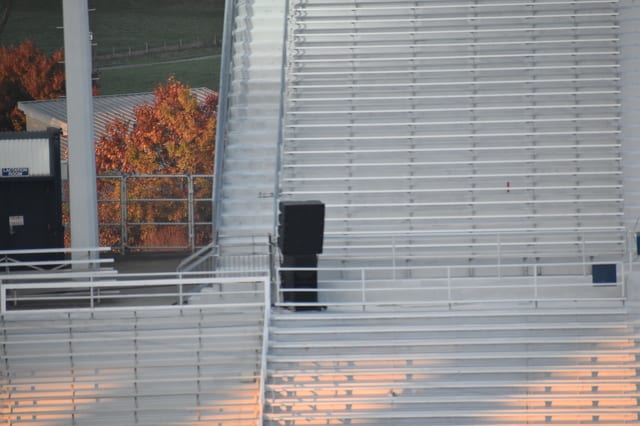
‘We had a group of sound engineers up here, and put in speakers all around the the main bowl inside the stadium,’ Mullen added. ‘We worked with heat charts [which measure decibel levels] and brought speakers in and did a test all over the field and made sure we had it equal.’
So Penn State did and now there are a half dozen speakers like the one pictured above around the lower bowl. All are tuned to a specific angle, and specific level to ensure that nowhere on the field is above or below the threshold
Of course there are rules about these things, the Big Ten will only allow stadiums to pump in crowd noise up to a certain decibel level and the conference will test the levels prior to the game to make sure things are on the up-and-up. But once they get the green light, expect just a bit of noise to still cascade down from the stands.
It won’t be the same, but for once, Penn State can pretend to hear you as you yell at your TV.



