Quantum computing offers the promise of computers that could be millions of times more powerful than even the most potent of silicon microchip-based computers. They have for years been predicted as a potential revolutionary breakthrough in the types of calculations a computer can achieve that simply aren’t possible on the conventional computers we’re familiar with.
The problem has been making it work. Quantum computers require the manipulation and precise control of atoms — as opposed to binary bits on a microchip. They require harnessing an enormous amount of power in a tiny space. But new research by a Penn State physicist and a team of graduate students brings useful quantum computing closer to reality.
Professor David S. Weiss led the research, published in the current issue of the journal Science, which has devised a new way to pack more quantum computing power in a smaller space and with greater control than ever demonstrated before.
‘Our result is one of the many important developments that still are needed on the way to achieving quantum computers that will be useful for doing computations that are impossible to do today, with applications in cryptography for electronic data security and other computing-intensive fields,’ Weiss said.
Using laser light and microwaves, the Penn State researchers found they could precisely control the switching of individual quantum bits, or qubits, from one quantum state to another without altering the other atoms in a three-dimensional, cubic array.
That means this technique shows how atoms can be used as the building blocks for circuits in quantum computing.
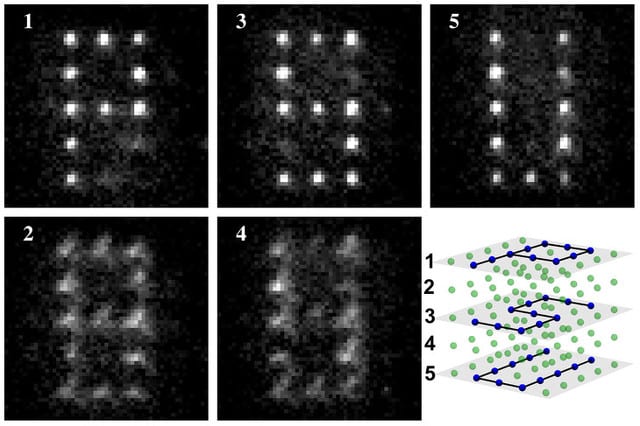
To do this, Weiss’s team corralled quantum atoms into an orderly pattern by constructing a lattice of light beams to tap and hold the atoms in a cube arrangement of five stacked planes — imagine a sandwich that uses five slices of bread. The arrangement formed a pattern of locations for 125 atoms.
Using crossed beams of laser light, they targeted individual atoms, shifting energy levels by twice as much as other atoms in the array, including those in the path of the beams on the way to the target. Bathing the entire array in microwaves, the state of the atom with shifted energy is changed, while the other atoms are not.
Essential to quantum computing is a central feature of quantum mechanics called superposition. Unlike the bits in a classical computer that exist either as ones or zeros, qubits have the ability to exist in more than one state at a time. This ability to exist in multiple states simultaneously, with qubits working together as both memory and processor, means a quantum computer could be exponentially more powerful than classical computers, performing many computations at once while a conventional computer does one at a time.
‘We have set more qubits into different, precise quantum superpositions at the same time than in any previous experimental system,’ Weiss said.
One way the researchers demonstrated the ability to change the state of individual atoms was by changing the states of selected atoms in three of the planes to draw the letters ‘P,’ ‘S’ and ‘U.’
‘We changed the quantum superposition of the PSU atoms to be different from the quantum superposition of the other atoms in the array,’ Weiss said. ‘We have a pretty high-fidelity system. We can do targeted selections with a reliability of about 99.7 percent, and we have a plan for making that more like 99.99 percent.’
The other members of Weiss’s research team are Penn State graduate students Yang Wang, Aishwarya Kumar, and Tsung-Yao Wu. The National Science Foundation funded the research.