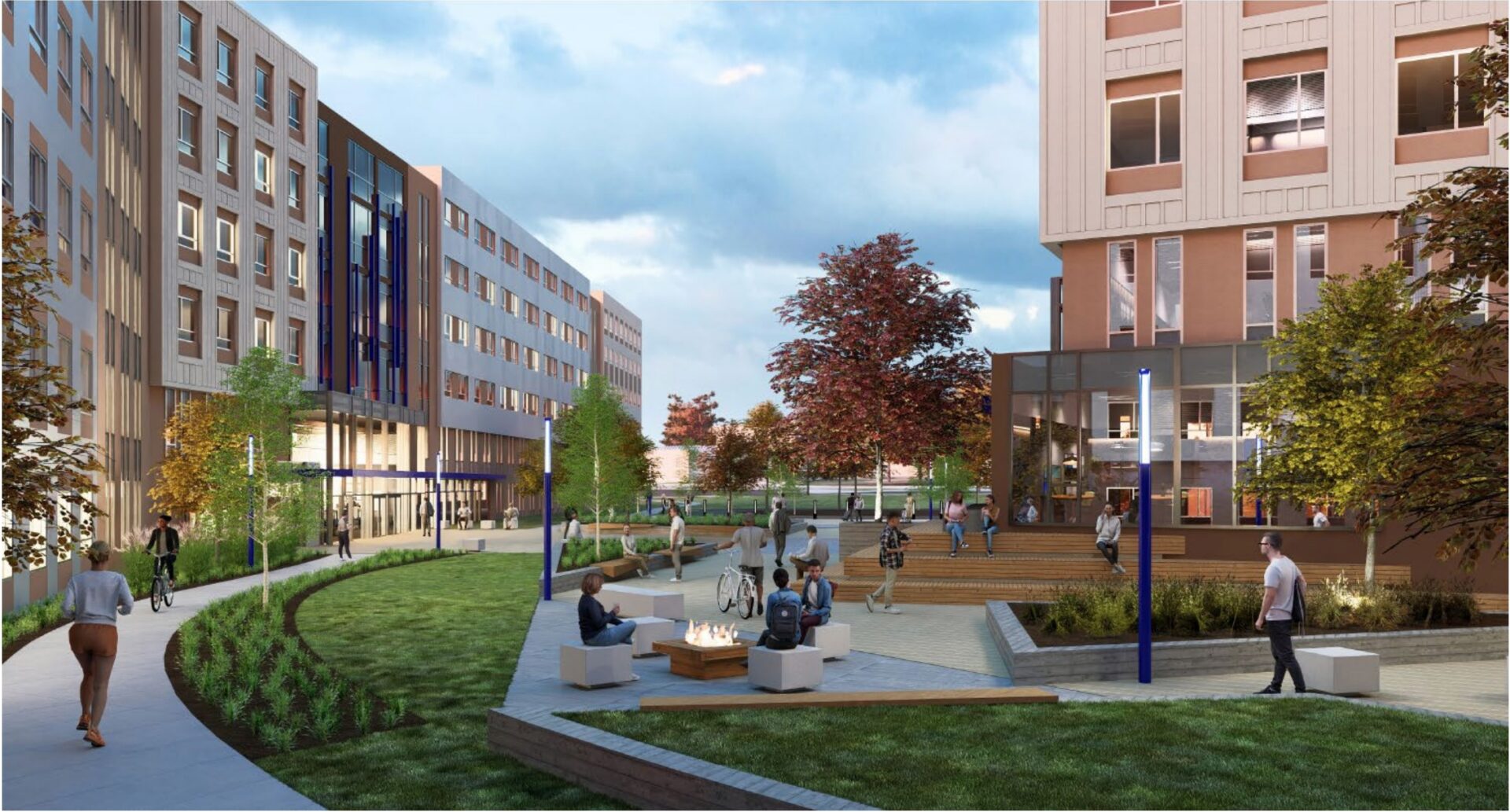
State College Planning Commission on Wednesday night reviewed preliminary plans of a new student housing project at Penn State’s University Park Campus to be constructed in a public-private partnership.
South Carolina-based developer Greystar’s preliminary land development plan includes four buildings with a total of 1,503 beds at the southeast corner of University Drive and Hastings Road. The area to be developed is currently a long-term parking lot with one small utility building on site.
After issuing a request for proposals last summer, Penn State’s Board of Trustees in November approved a ground-lease with Greystar to build and operate the complex on the university-owned land. Terms of the lease were not disclosed.
The apartments will be for sophomores and above. Asked about speculation that student-athletes would be given priority, Nickerson said that is not the case.
“That’s against fair housing [laws], so we wouldn’t do that,” he said.
Each six-story building will have apartment-style units with their own kitchens, washers and dryers, Greystar development director Dan Nickerson said. Among the four buildings, 55% of units will be four-bedrooms, 25% will be three-bedrooms and the remaining 20% will be one-bedroom and studio apartments.
Amenities will be focused on studying, gathering and fitness spaces, Nickerson said. A variety of study areas for groups and individuals will be incorporated throughout the buildings, and each will have year-round fitness centers that are “not as elaborate as Penn State’s on campus but a place for people if they need to ‘hey i want to get a quick work out in’ that they’ll be able to go,” he added.
The design philosophy focuses on providing “additional, affordable student housing that really focuses on the amenities that students need,” Nickerson said, noting that “the affordable component was the number one priority during the RFP process.”
That led to back and forth with planning commission member Anita Genger, who said “affordable” was vague and pressed for a definition of what it would mean.
Esch McCombie, Greystar’s land use attorney for the project, said it is not the legal definition used for affordable housing tax credits, but “the common understanding of affordable,” for “everyday students” within market rates. Greystar is working with Penn State to determine the rates, he said.
“Two years out we’re not in a position to tell you exactly what the rates will be,” McCombie said. “We’re able to tell you, though, that the intent as you saw with these is that they don’t have large swimming pools, they don’t have massive workout facilities that increase the cost when you’re talking about kind of luxury apartments versus market rate apartments. The idea is to provide housing that more people can afford.”
The design of the complex will include a large central lawn will be centered between three of the buildings, “which is saving some landmark trees that have been there a very long time and providing a central green and more of a campus-like atmosphere to this development,” Nickerson explained. Additional green spaces with historic trees preserved and new native plantings are also included.
Greystar is coordinating with College Township for a planned bike path to run through the project. The “Path to Campus” is intended to run from Puddintown Road parallel to College Avenue then connect to the existing path at Hastings Road and University Drive.
The complex will include indoor bicycle storage and will maintain the existing on-site bike rental station. The project also has direct access to two nearby CATA bus stops.
For the buildings, exterior materials will include brick, fiber cement cladding, glazed aluminum storefront for entrances and some amenity spaces on ground floor and metal accents. The architecture is designed to make the scale of the buildings less imposing, Nickerson said.
“Some of these buildings are very long and so we don’t want a big kind of monolithic feeling for these buildings,” he said. “So we’re trying to break up the facade using a variety of different materials, textures and different roof heights to give it a different feel and more pedestrian friendly.
“We’re trying to look for buildings that rhyme. They’re not going to be exact replicas of each other. We’re going to borrow architectural elements so that they fit in with each other but that they also feel cohesive both for here as well as the campus surrounding.”
The buildings will have all LED lighting, low-flow plumbing fixtures and operable windows. In response to a planning commission question, Nickerson said the developers are “investigating” the possibility of conduit for solar arrays.
A total of 752 parking spaces will be included — about one for every two residents — with 330 on-site and the remainder leased from the lot adjacent to the property. Each building will have four ADA spaces for a total of 16, and conduit for electric vehicle charging stations will be installed.
Bioretention basins for stormwater peak rate and water quality control will be located around the perimeter of the site, with some flowing to Penn State’s Bathgate facility and the rest under College Avenue to Thompson Run, Chris Nasuti of project engineer HRG said.
A traffic impact study is currently under review by State College and College Township.
Construction is currently planned to begin in spring of 2026 and be completed in phases. The first two buildings, with 850 beds, are expected to open in 2028, and the last two in 2029.
Greystar will be required to submit a final land development plan for approval before construction can begin.