
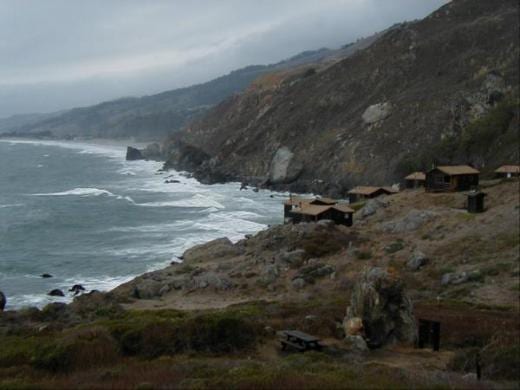
STEEP RAVINE, CALIF. – Waking before dawn, I lift the curtain and see a fishing boat floodlit like a little ballpark on Bolinas Bay. Time to pull the nets.
The tide is in. The breakers pound the cliffs. You can buy a machine that makes this noise to help you sleep. We doze until the sun flashes in the window, then take our coffee out to a warm rock.
I am a 20-minute drive from San Francisco on the Marin County coast. North are Stinson Beach and Point Reyes National Seashore. South are Muir Woods, Muir Beach and the Golden Gate.
We’re talking zillion-dollar real estate here, even in these lean times, but the lodgings are primitive: Our cabin has neither plumbing nor electricity. A wood stove provides the heat. Water comes from an outdoor spigot. At night you need a headlamp to find the bathroom – and to use it.
We hauled our bedding and provisions from car to cabin in a wheelbarrow when we took possession yesterday. We had reserved the place for two nights but wimped out on the first one in the face of heavy weather. True, the waves would be dramatic, but we feared instant cabin fever.
A day later the weather turned fine, but by fine I don’t mean San Diego fine. This is northern California. Since I got here the best days have been like what we had in State College in the first part of November: clouds and sun, highs in the mid-50s. Not paradise, perhaps, but good walking weather. Especially cliff walking.
More about the cabin: The bedroom has platforms for a double bed and a single bed. An alcove between the bedroom and the living room has bunk beds. The living room has a table and the wood stove. The whole works might be the size of my garage. I don’t know that I’ll need much more space or stuff than this once my youngest child leaves the nest.
I think of the attic of my house in State College, crammed with belongings we moved from California to Pennsylvania back in 1995, the basement crammed with the detritus of three childhoods, the hallways with books, the cupboards and closets with linens and cookware and clothing. I daydream of pitchforks and garbage bins but last night I dreamed about a lion – the bobcat I had seen during the day, perhaps, aggrandized in the transit from waking to sleep.
I had seen a bobcat near the same spot when I visited this coast last year, which might only confirm that this is a place where the bobcat roam, but I’d like to think that this was the selfsame cat.
It would have been nice of the dream lion to open wide and swallow all my possessions so I could move into a two-room cabin, but it only looked at me, the way the bobcat did. I feel better about my clutter since I heard there’s a reality TV show about pack rats. One of the featured hoarders can’t even bring herself to throw out the garbage. I’m bad, but not that bad.
This is an apt time to dream of the simple life. Tomorrow, when we head over the hill and back into cell phone range I will start holiday shopping in earnest. The kids are easy. The oldest, embarking on life after college, wants kitchen stuff. The middle one wants books and music. The younger one, who prays daily for snow, wants skiing gear.
When my kids asked me what I wanted I gave my usual don’t-need-a-thing speech, then thought of all the things I could use: a new backpack because my old one broke, a new comforter because my old one is too small for my bed, a hands-free phone so I can clean house while yakking…
Better to think about giving than getting. In her otherwise heartbreaking book “Enrique’s Journey” about Central American children who begin their search for their mothers in the United States by riding north atop Mexican freight trains, Sonia Nazario offers the most astonishing example of generosity I have ever heard of.
Elsewhere in Mexico, these children, some younger than 10, are robbed, beaten, raped, betrayed to the authorities and deported. But when the abjectly poor people in the southern states of Oaxaca and Veracruz hear the trains approach they race to the tracks and fling bundles of food and drink to the hungry and thirsty children clinging to the tops of the train cars.
When Nazario asks how people who have so little can give so much, one man answers with a question of his own: How can you enjoy your food when you know someone else is hungry?
That is a question worth pondering as I gaze out to sea from this primitive paradise.
Want to “rough it” at Steep Ravine? Reserve early. For more details write to Russell Frank at rfrank@psu.edu.
More Columns
View all Columns
Paterno: Keep the Faith and Stand Your Ground, Penn State Fans
One of the great leadership lessons from Lincoln was the lesson of the letter. When he was angry, he would write a letter to the person who’d angered him. He’d […]

For Starters, the Nittany Lions’ Identity? 42% Penn State, 40% Iowa State
Matt Campbell uttered the same three words again and again and again on Tuesday in his press conference in Beaver Stadium — where he and his Nittany Lions return on […]

100 Years for State High’s Band: Time Flies When You’re Having Fun
Since its inauguration in October of 1937 as the State College High School football field, Memorial Field has produced some remarkable memories. It has showcased the shining talents of six […]


