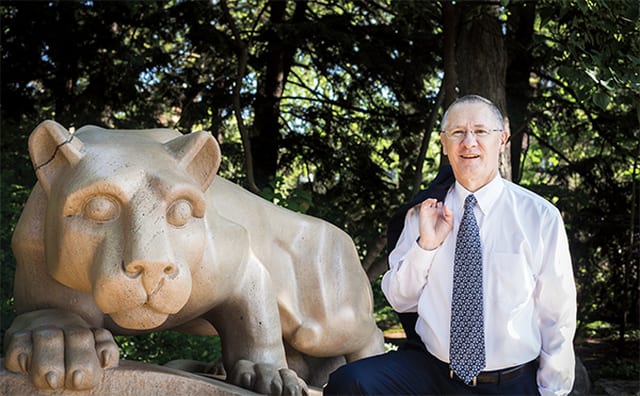
When I first spoke with Rod Kirsch, Penn State’s senior vice president of development, he had just come from a half-hour meeting with the 16 interns who had been assisting his department over the summer.
“Half just graduated,” explains Kirsch, “half are going into their senior year. I’m telling them how rewarding this work can be in an intangible way — that it’s not all about how much money you earn but how you feel about yourself and about helping others.”
That may tell you as much about Rod Kirsch as anything else, and about what kinds of considerations form the foundation of his values and of his professional practices. And it suggests some of the reasons he’s had the kind of success in fund-raising and management that he’s had with Penn State. During his 20-year tenure he has managed two, seven-year, billion-dollar-plus campaigns from beginning to end and has helped Penn State raise more money during his first decade as vice president than the university had raised over the previous 140 years of its existence.
And consider these highlights, as noted by Penn State’s development administration:
• The “For the Future: The Campaign for Penn State Students,” overseen by Kirsch, garnered more alumni donors than any other public or private university in the history of American higher education.
• Kirsch was instrumental in securing gifts for the Schreyer Honors College, H.O. Smith Botanic Gardens, Stuckeman School of Architecture and Landscape Architecture, Weiss Breakthrough Scholars Program, Huck Institutes of the Life Sciences, and the Presidential Leadership Academy.
• He provided oversight of more than $300 million in private fund-raising to support nearly four dozen capital projects, including the Children’s Hospital at the Milton S. Hershey Medical Center, Pegula Ice Arena, the Business School Building, Hintz Family Alumni Center, Pasquerilla Spiritual Center, Tombros/McWhirter Academic Commons, The Bank of America Career Services Center, and the Huck Life Sciences Building.
And there’s plenty more that could be cited, of course.
Jean M. Songer, assistant vice president for development administration, has known Kirsch since 1988 when he interviewed her for a different position. She’s worked with him since 1999 and reported to him in her current capacity for the past eight years.
“As a person, Rod cares,” she says. “That’s the simplest way to put it. He cares about what this office does. He cares about students and education and providing scholarships. He cares about Penn State’s mission as a land-grant university. And that’s genuine with him. It comes from the heart. The fact that he cares is why he’s good at everything he does. He’s all-in with whatever he’s doing. He’s here to work, and he works hard. He wants to get things done. He doesn’t stop until they’re done right. That’s what it’s all about for him.”
Songer also touched more directly on how all of those qualities and more make him someone she has learned a great deal from.
“He leads by example, and he’s a great mentor,” she says. “Somebody described experiencing Rod as taking a master’s class in how to be a leader. I could not agree more. And he’s also the most ethical leader I’ve ever served with. The rules apply to Rod, and he sticks to them by the letter.”
Penn State and the Penn State Alumni Association granted Kirsch Honorary Alumnus status in 2014.
This year, Kirsch, who is in the middle of retiring, is Penn State’s Renaissance Honoree of the Year, and he will be honored at the 40th annual Renaissance Fund dinner November 10. The fund helps raise money and endow scholarships for academically talented Penn State students who have financial needs.
Kathy Kurtz, an associate director with Penn State’s Office of Annual Giving, explains that Kirsch fit the mold for a Renaissance honoree quite well.
“The Renaissance board looks for someone who has had an impact on both town and gown in Centre County,” she says. “Rod has had such a strong impact with his fund-raising experience and by inspiring people to make both Penn State and Centre County stronger. Whether it’s with scholarships or working with [Centre Foundation], he has inspired both communities to be better. That cumulative good work put him on the top this year as our honoree.”
Kurtz notes the remarkable historical symmetries of Kirsch’s honorific.
“What’s unique about this year is that it’s the 40th anniversary of the Renaissance Fund dinner and we’re celebrating 20 years of Rod’s service to Penn State,” she says. “I can’t think of a better way to honor those two things. And we are creating the Rodney P. Kirsch Renaissance Fund, a scholarship endowment in his name — which is only fitting. Rod has helped raise millions of dollars for scholarship support because he believes in higher education.”
As if all that weren’t enough, Kirsch and his wife, Michele, associate dean of Student Affairs in the Schreyer Honors College, have personally committed nearly $200,000 of their own resources to support Penn State.
The harvest of a rural Midwestern upbringing
Rod Kirsch grew up on a farm/ranch in rural North Dakota and worked closely with his father from a young age. He remembers the time fondly and believes it was clearly a major factor in the personal and professional path he ended up taking.
“I grew up in what most people consider fly-over country,” he says. “It was a pretty remote part of the world. I had a great experience growing up on a farm, where we also did ranching. We had dairy and we had range cattle and we had horses, hogs, chickens, and turkeys, and on and on. The biggest thing I remember about growing up was that I spent a lot of time working in the fields. We put up a lot of hay in the summertime for all the cattle. I worked a lot of time side by side with my father. I learned to get up at 5 a.m. in the summer and work until sundown. My mother had a huge vegetable garden, and in the summertime everything that was on the kitchen table to eat was something we had raised. There’s a lot of life lessons and values you pick up when you did that.”
Kirsch also got his first taste of fund-raising during his childhood in North Dakota.
“The very first fund-raising experience I recall having I was probably 11 or 12 years old and I sold raffle tickets for a snowmobile for my church,” he says. “It happened to be during what to this day was one of the warmest winters ever in North Dakota. So I was in this mall on Saturdays asking them to buy this raffle ticket, and it was 60 degrees outside in the middle of February. Everyone was kind of laughing in my face. I don’t know if it kind of marred me in some way (chuckling) or made me resilient or what, but I still remember that.”
Though neither of his parents had gone to college, he notes that education was “just a part of the fabric of our family” and that his folks were intent that he and his older sister would have a higher-education experience. His sister went on to teach high school English and German.
“Education was probably the most important value we had,” Kirsch says. “My sister and I were the first generation in my family to be college-educated. My parents did everything they could — mostly hard work and saving money — to make sure that my sister and I could go to college. For them, that represented the possibility of a better life — even though, I think, they appreciated the life they had.”
Kirsch’s father has been deceased for about 10 years, but his 91-year-old mother, Pauline, is still living independently in North Dakota.
“It was just a neat experience, and I wouldn’t trade it for anything,” Kirsch says. “That life, all of that grounding, helped me along the way in terms of the world of work at all these universities I worked at. I am grateful for it. It was a great way to grow up.”
University days
Kirsch’s first exposure to more serious fund-raising was when he worked for his University of North Dakota college fraternity’s headquarters in Indianapolis after graduating with an undergraduate degree in English. He was one of several hired by Delta Upsilon as a kind of liaison to all of the fraternity chapters in North America. Within about two years, he visited 85 campuses and was exposed to volunteer boards and fund-raising and became very interested in staying in higher education for work.
“If I hadn’t worked in that capacity for my fraternity I might never have ended up in university fund-raising,” he says.
After working a couple of years with Delta Upsilon, he enrolled in graduate school at Indiana University in Bloomington, Indiana, initially with an eye toward admissions. But an internship with the Indiana University Alumni Association made the whole idea of university advancement real for him, and he started knocking on doors on campus to gain some experience with development work. The development office at the College of Arts and Sciences at Indiana was happy to have him volunteer up to 12 hours a week. It was the early 1980s.
After graduate school, he applied for fund-raising positions and went to work at Drake University in Des Moines, Iowa, in annual giving and alumni relations. He ended up back at Indiana for almost seven years as the number-two person and began to feel that he was ready to step up a level.
“I got the [Penn State] job in the fall of 1995 and started in early 1996,” he says. “I was pretty young for the job at the time — 39 — so they kind of took a chance on me. Dr. Graham Spanier had just become president and he hired me. He was relatively new, I was brand new. We were getting to know each other, we were getting to know the alumni constituency, we had organizational structures to set up, we had staff to hire. It was a lot of work the first nine to 12 months when I came here — a tough stretch. I still enjoyed it, but it was a lot of hard work.”
Penn State development inside and out
“There are lots of interesting aspects to this job,” says Kirsch. “There are about 400 people in our division of Development and Alumni Relations, so there’s a large management piece to it. I really believe in this idea of servant leadership, where you’re serving others to try to help make them as effective and productive as they can be. That’s how I’ve always thought about being a vice president — How can I serve the institution? How can I serve the people who I’m working with in development and alumni relationships to make them as effective as possible? My job managerially is to try to make everyone else productive and make their job easier.”
There also is, as Kirsch notes, the “outside” aspect of the job that involves dealing with potential benefactors.
“The real work of development in this capacity is ‘chief relationship builder’ really,” he says. “I have had the pleasure of working with almost all of the largest Penn State benefactors. I have really deep relationships with them and have worked with them on their philanthropy to the university. So building their trust and confidence and doing the things that create these bridges between an individual and an institution like Penn State is a very important part of what the job is about. We live in an amazing country where philanthropy has been an important part since its founding. There are lots of people out there who want to be generous, and it’s our job to help them achieve what they want to achieve in that part of their life. It may sound a bit corny, but that’s kind of a noble calling — to work with people who are good people and have been successful people, who have wealth and want to make something better.”
But Kirsch is quick to note that fund-raising takes a team effort and that he’s been blessed with good, competent people who have worked with him along the way.
“Almost all of them could go into the private sector and make more money doing what they’re doing here,” he says. “But they’ve got a passion about their work and being part of a nonprofit organization like the university. I’ve been really lucky to work with some really great people, from the university academic administrative team to the development staff.”
The future
As he heads into retirement, Kirsch says he feels good about the future of Penn State philanthropy and giving.
“This is a strong community in terms of the university, strong in terms of the State College community,” he says. “And people like to support excellence. This university just gets better and better in terms of its academic excellence, and it gets more recognition every year. That makes fund-raising better. And we have this enormous base — the Penn State Nation — of 645,000 alumni.”
He feels good about his own future as well, even though he has no firm plans for after his retirement.
“The first thing on my docket after leaving is to go back to North Dakota to spend some time with my mother,” he says.
He also mentions he has about 15 books on his coffee table that he’s been trying to find time to read, and he’s been approached about, and is interested in, writing a book about the challenges of development and fund-raising. He’s also been approached by several nonprofits to serve on their boards.
“I’ll probably also end up doing some consulting,” he says. “I want to keep my hand in the world of philanthropy, and there are opportunities to do some kind of mentoring with young people. I’d jump at the chance to do that kind of thing.”
He and his wife have two daughters — Kelsey, who graduated from Penn State, and Mackenzie, who will graduate from the university next year.
“This is really a town-and-gown award in many respects,” he says. “Our daughters were very young when we moved here. So for us kind of growing up as a family in the State College community and for our daughters having the Penn State experience as students, we are really blessed to have had that kind of quality of life in a community like this one. There are maybe a handful of universities in the country that are at the level Penn State is that are sited in a community like this where you have the quality of life, the ease of life that you have here. There has been really great community leadership in State College for a long time and a really great relationship between the university and the community. We feel lucky as a family, and it’s been a really good place to be a professional.”