
Here’s how you get to Penn State’s hall of fame:
Enter the front doors of Rec Hall. Walk nine steps into the 87-year-old building and turn left.
Walk 34 steps, heading down a quiet corridor of cluttered trophy cases and well-worn team photos from yesteryear.
Go through three sets of heavy, dark blue double doors. (Actually, two-and-a-half sets – one of the two doors is missing from set No. 3.)
Continue for 34 more steps down a hallway framed by yellowish walls and faded white linoleum. Pass an adjacent hallway featuring the entrance to a Penn State athletics study hall and six racquetball courts – five of them operational; the sixth and final court is blocked off with a crossing of yellow caution tape.
This is where the Penn State hall of fame leads you:
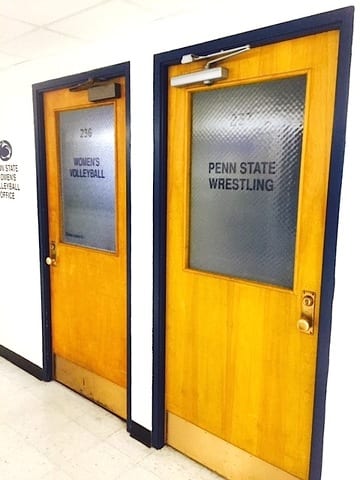
There, halfway down the hallway and under a smattering of fluorescent lights – some off, some on – to your left you will find two separate doors. Their doorways trimmed in Penn State blue, the wooden doors feature thick smoky glass.
“Room 236 Women’s Volleyball,” reads the first in black block letters.
“Room 237 Penn State Wrestling,” reads the second. (The official main door of PSU wrestling, to Room 238, is about a dozen steps more down the hall.)
Champions enter the doors to 236 and 237 and 238 on a stunningly regular basis. As in a combined 11 NCAA championships over the past nine years.
HALL DWELLERS
Here is who resides in Penn State’s hall of fame:
There’s Russ Rose, a 62-year-old cigar-smoking, campus bench-sitting, speak-his-mind genius coach who has led Penn State women’s volleyball team to seven NCAA titles – six in the last nine years. In 37 seasons at Penn State, his teams have had a 1,189-186 record, with 16 Big Ten titles, 89 All-Americans and a record-tying 35 consecutive NCAA tournament appearances (out of the 35 NCAA women’s volleyball tournaments that have ever been held).
And then there’s Cael Sanderson, a 36-year-old square-jawed Adonis who had 159 wins, zero losses and four national titles as a collegiate wrestler and just guided the Nittany Lion wrestlers to their fifth NCAA title in the past six seasons. In his seven years at Penn State, his teams have been 98-14-2, with eight national champions, 31 All-Americans and five Big Ten team titles.
The two men – legends in their sports and undeniably on the Mount Rushmore of Penn State head coaches – and their next-door proximity came to mind again last week as the heels of a Penn State press release titled:
“Penn State Boosts National Lead in NCAA Championships Win Since 2007; Wrestling Crown Lifts Nittany Lions to 18 NCAA Titles Since March 2007.”
The Lions’ share of those championships are thanks to Russ (six – 2007, 2008, 2009, 2010, 2013, 2014) and Cael (five — 2011, 2012, 2013, 2014, 2016), as well four more under former fencing coach Emmanuil Kaidanov (2007, 2009, 2010) and his longtime assistant and successor, Wes Glon (2014).
Glon and his fencers work out of the White Building basement, far from that hallowed hall in Recreation Building, which was opened on Jan. 15, 1929, and underwent renovations in the 1960s, 1990s and 2005-06. Both women’s volleyball and wrestling pack ’em in at Rec, although wrestling journeys across campus to the BJC on occasion when crowds of over 15,000 are called for.
NEW CHAMP ON THE BLOCK
Russ and Cael’s neighborhood got a bit tonier in December, when the coach around the corner from Room 236 and a quick 56 steps down the hall from Room 238 won an NCAA title of her own. That would be Erica Walsh Dambach, the latest and most successful head coach in the dynasty that is Penn State women’s soccer.
Room 262 in Rec Hall is the home of both the head coach of the 2015 women’s soccer national champions and the NSCAA 2015 Coach of the Year. Dambach is one and the same. In her nine years at Penn State, she has guided the Nittany Lions to eight Big Ten team titles and a 157-50-10 record.
For those of you keeping track, the coaching truimvirate of Rose-Sanderson-Dambach now has 28 Big Ten titles, 13 national championships and an aggregate winning percentage of .879 with a combined record of 1,444-250-2. Quite a haul. Quite a hall.
Penn State’s 18 titles over the past nine seasons includes the 2008 men’s volleyball championship, under Mark Pavlik, and the 2007 men’s gymnastics championship, under Randy Jepson. Both Pavlik (Room 207, Rec Hall) and Jepson (Room 101, White Building) have been with their programs as players, assistants and head coaches.
HALLMARKS OF GREATNESS
What is about Rose and Sanderson that have made their programs so great, for such a sustained period, overlapping a time when the Sandusky scandal brought massive turbulence and myriad changes at Penn State and in Penn State athletics? (In other words, “If,” as Kipling wrote, “you can keep your head when all about you are losing theirs…”)
Their sports differ in many ways; gender and team vs. individual, first come to mind. So do their situations. Rose is a quarter-century older and a Penn State lifer who was never a star in his sport, while Sanderson was an Olympic champion featured on a Wheaties cereal box before going on to coach at Iowa State, his alma mater.
But they are the same in many ways as well. They have incredibly high standards for their athletes that the coaches – and hence, the athletes themselves – expect as routine. They have great minds, not only for the technical aspects of their sports, but for the mental and emotional sides as well. That intelligence yields a distinct humor for them both, and they are buttressed by coaching and support staffs that are as loyal as blood brothers – which, in Sanderson’s case, is literally true.
Rose and Sanderson have developed programs and philosophies that work, individual frameworks that are unique in their singular sphere given their national scope. Not just on an occasional basis, but those that are self-sustaining and perpetuating as well.
It doesn’t hurt, either, that their Rec Hall of fame is in a non-descript, nearly-hidden wing of the oldest athletic building on campus. There, they are in the far northwestern corner of campus, tens of thousands of steps away from the daily machinations of the overall business and busyness of intercollegiate athletics.
That’s not to say they and their programs toil in anonymity. Far from the truth, actually. They are two of the most popular teams and coaches on campus, in addition to being the most successful. But being tucked away in their hall does allow Rose and Sanderson to be far from some of the maddening crowds. That helps with their focus, as well as their autonomy.
That may be their greatest strength: In their neighborhood, the No. 1 thing is being – and staying — No. 1.
More Columns
View all Columns
The 2 Kinds of Penn State Football Adversity: In-Game and Post-Game
Penn State coach Matt Campbell talks a lot about handling Adversity. A lot. It’s going to come, he says. It’s how you handle it. Adversity came to Beaver Stadium on […]
Penn State Lost to Wisconsin: How Bad Was it?
How bad was it? Ahead 17-0 just 18 minutes into the game and lost bad. Ahead 20-10 until Wisconsin scored with just 211 seconds left in the game and lost […]
Penn State Football: Tonight, the Haters Were Right
On Dec. 11, 2023, Twitter user @drewjanda put out a since-deleted post that now lives in sports meme infamy. It read as follows: “The haters said I couldn’t do it. […]


