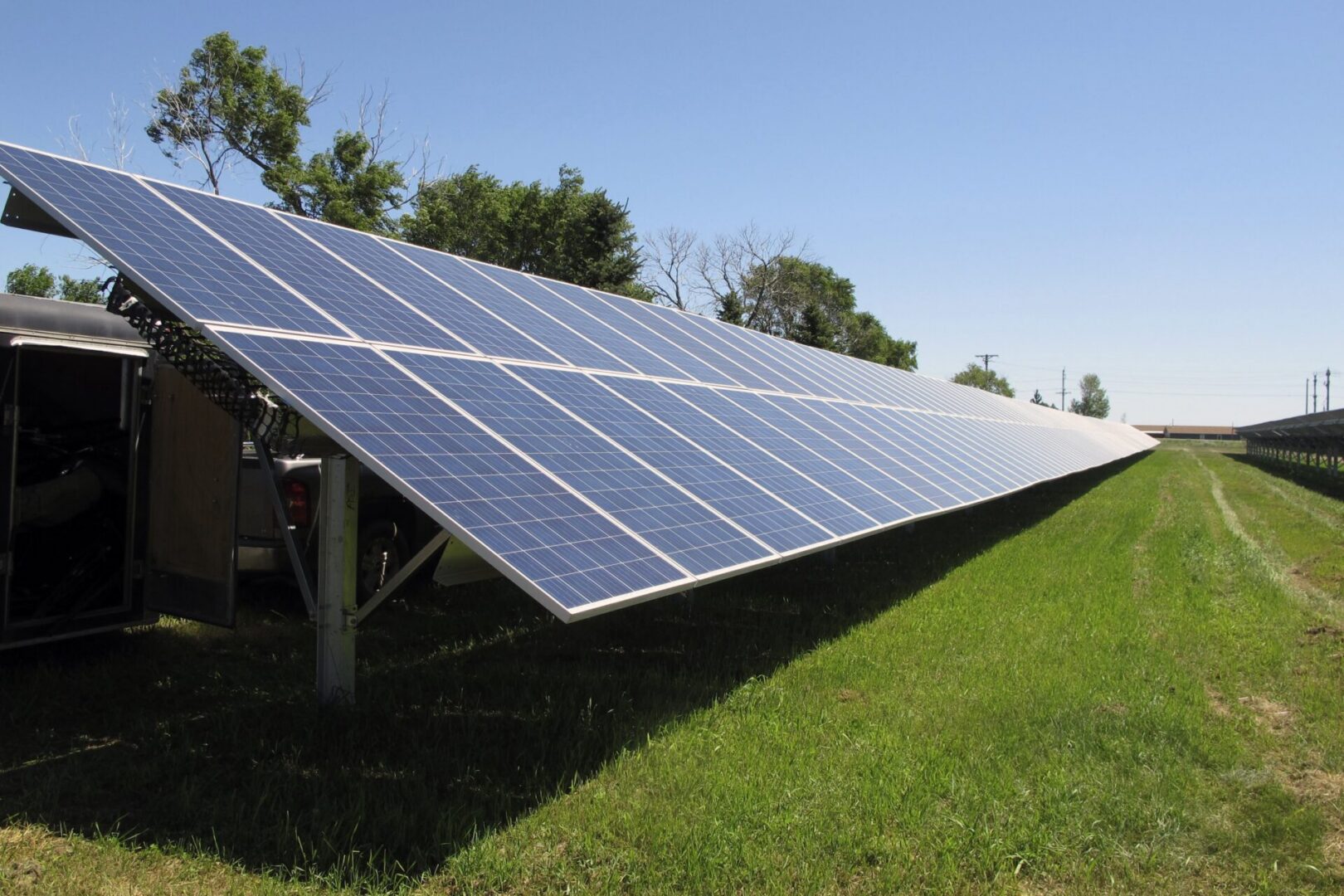
Ten government entities in Centre County are poised to pull the plug on a years-in-the-making and at times controversial solar project after the contracted developer said the terms of the agreement were no longer financially viable.
The Centre County Solar Group, which was formed last year to manage the Solar Power Purchase Agreement, met Friday morning to discuss the mutual termination agreement with developer Prospect 14, which cited federal changes that altered the project’s financial frameworks.
Governing boards for each participating entity now will be required to vote on approving the termination agreement by the end of March. Reading from a prepared statement during Friday’s meeting, Randy Brown, solar group coordinator and State College Area School District business and finance officer, said the project “will not move forward,” leaving little doubt about the collapse.
The project would have been the first of its kind in the state. It was designed for the member entities to achieve upwards of $1 million in collective electricity cost savings and meet environmental goals through a 15-year agreement to purchase renewable energy from an array to be constructed by Prospect 14 in Clarion County.
SCASD, State College Borough, College, Ferguson, Harris and Patton Townships, the State College Borough Water Authority, College Township Water Authority, Centre County Government and the Centre Region Council of Governments approved signing on to the agreement last winter and contracts were completed in the summer.
But in the fall, Prospect 14 told the solar group that it would need to amend the terms of the agreement due to changes at the federal level, including the demise of tax credits for solar projects in the “One Big Beautiful Bill” signed into law in 2025, increased tariffs and Trump administration executive orders that made the development more costly.
Prospect 14 asked to increase the base rate from $0.04459 per kilowatt-hour to $0.05755 and the annual escalator from 1.5% to 2.5%. With that, the solar group members’ savings would have evaporated and instead cost a collective $650,000 over the 15-year term.
“CCSG made efforts in good faith to work toward a solution, instructing its consultant to continue negotiations with the developer,” Brown said. “Following these discussions and a review of the proposed terms, the participating organizations determined the project could not proceed under the revised terms. These new terms no longer align with the project’s original goals of long-term cost stability and fiscal responsibility for stakeholders in Centre County. Collectively, we are disappointed by this outcome as there are also financial losses from costs associated with attorneys and consultants.”
Contract language allowed Prospect 14 to ask for renegotiation if economic conditions made financing difficult, or to simply walk away from the project. The company has, however, volunteered to reimbursed the participating entities $135,000.
The members have spent approximately $400,000 combined to date on legal and consulting fees, paid proportionally by the volume of electricity they planned to receive through the agreement.
“It is not the result that we wanted to have with this power purchase agreement either,” Brendan Neagle, of Prospect 14, said. “We worked very hard over the last many years to try to make this a reality.”
Neagle added that his company worked with members of the solar group and its consultant, Gregg Shively of GreenSky Development Group, to try to find a resolution
“We tried longer terms, lower escalations, shorter terms, higher escalations, different starting points of power pricing, and despite a lot of back and forth, we weren’t able to get a price that worked for both parties,” he said.
The situation is not unique to the Centre County group or Prospect 14, Neagle said, noting that solar projects around the country have been derailed since 2025.
Work on the SPPA began in 2020, and encountered several delays since then.
It’s also been the subject of criticism by some elected officials and others who said there was a lack of transparency (and alleged possible illegality) in how excess legal fees beyond those originally approved by the members were paid, and derided the overall project management.
Former State College Borough Council member Josh Portney was among the chief critics of the payment of the legal fees and the viability of the project. He said on Friday that the impact of federal actions was not included in a risk profile presented by the consultant during the project’s development.
“The taxpayers never knew about that, yet we were faced with a bill to foot,” Portney said. “… I know there is no such thing as a sure bet… but when we look at things and when we do things, we need to have all of the risks really fully relayed out, and we need to trust in our vendors. When our vendors start to overspend more than the budgets that they set. There needs to start be red flags, and those red flags cannot be ignored.
“I really hope that there’s some accountability here. And I appreciate all of your work. I know this is a hardworking team, but I really have been hoping for answers here, not just simple affirmations.”
Halfmoon Township Supervisor and former Centre Region COG General Forum Chair Ron Servello has previously written to state Attorney General Dave Sunday asking that his office look into the payment of legal fees by the entities and other transparency issues. He also said on Friday that changing political winds and their effect on the agreement should not have come as a surprise.
“For the life of me, I can’t understand how this could have gotten to this point without there being questions along the way and very careful consideration of what was being done,” Servello said. “I think the end goal was put before a supposed end goal was put ahead of anything else, including practicality. And I think we, the taxpayers of this center region, are going to pay.”
Millheim Borough Council member Robert Zeigler said he was initially supportive of the SPPA, but after looking at the numbers years ago his borough decided to implement its own array that saves $10,000 to $15,000 a year. He said that Prospect 14 advancing the project without first securing funding, and longstanding supply issues with regional grid operator PJM Interconnection are more to blame than federal legislation and executive actions.
Several officials who have been involved with the project, though, said that while it encountered challenges over the years, they agreed with Prospect 14’s position that its unraveling is due to the federal changes.
“This group was incredibly accountable communicating those challenges and communicating where we were in the process,” said Peter Buck, a former school board and SPPA Working Group member who introduced the idea in 2018 and was a driving force behind the project. “The ‘One Big Beautiful Bill’ killed this project… It took the full power of the federal government attacking clean energy in the United States to kill this project. This project was perfectly viable until the ‘One Big Beautiful Bill’ passed. And that is a fact. There is no way around that. We would not be sitting in this room were it not for that bill.”
While some individuals involved with the project have been with it from the start, some have left and others have joined over the years, but the goals remained the same, said school board member Amy Bader, who noted that a years-long endeavor would be subject to some volatility.
“The intimation that something nefarious happened or any other kinds of commentary, I think is really hard to stomach when this number of people have been involved,” Bader said. “Individuals involved have changed and yet the decision has still been made to move forward. And I think that was grounded in legitimate benefits and intents to help the community and to benefit our society and to save taxpayer dollars in the long run. Unfortunately, it didn’t play out to the way we would have hoped.”
WHAT’S NEXT?
After the participating governing bodies approve the termination agreement, Prospect 14 will pay out the $135,000 in three installments: the first when the termination is executed, the second in June and the third in August.
The SPPA involved a six-year contract with GreenSky Development to provide ongoing management services and a five-year contract with Direct Energy/NRG as the retailer for distribution from the project and energy not covered by the purchase agreement.
GreenSky’s contract will terminate with the SPPA, and Shively said his company will forego its final payment for consulting services.
While the servicing agreement with Direct Energy/NRG will also terminate with the SPPA, participants will have the option of continuing or terminating agreements for the company to provide retail electricity supplier.
“I think that the agreements would serve the group well, and the agreements right now are that you would receive market-based power with the ability to fix that price at any point in time,” Shively said. “What that allows the group to do is to essentially obtain fixed-price electricity, much the same way you always have in a very efficient manner through an existing agreement. And that would last up to five years, at which point we would recompete that agreement.”
“And we would like to continue to help collaborate new ideas across the group while serving as an energy broker to help purchase the electricity or manage electricity through the NRG agreement that is already in place, So that’s kind of a path forward that we suggest. Obviously, alternative paths forward are to move forward without any support from Green Sky, without the NRG agreement and just go back to square one. But we believe a lot of good has been built here in relationships and in contract vehicles that we should continue at some level there and try to find a new way forward on solar.”
Some of the group members have existing solar programs already in place. Centre County Government, for example, operates an array at the county correctional facility, and SCASD has included solar on its new construction in recent years.
State College Borough purchases renewable energy credits and has been working with other Pennsylvania boroughs on a Consumer Choice Aggregation Project designed to allow local governments to procure automatic renewable energy sources for residents. Borough Manager Tom Fountaine said State College is also looking to implement solar projects on municipal facilities over the next five years, though suggestions for larger-scale arrays are hindered by a lack of undeveloped land and ill-equipped buildings that would need substantial modifications.
Whether and how the SPPA members will continue to collaborate on joint solar projects remains to be determined.
“To be clear, our goal from the beginning of this project was to save money for the taxpayers of Centre County while at the same time working toward our sustainability goals,” Brown said. “Even though this venture will not work out, we remain committed to our cause.
“As we move on, we’d be remiss if we didn’t thank all the people who worked tirelessly to bring this project together. While the result is not what we had hoped for, the way our respective communities came together over the last six years is an example of how valuable intergovernmental work can be. No doubt, the relationships and connections that have been made will continue and make our collective work better in the future.”