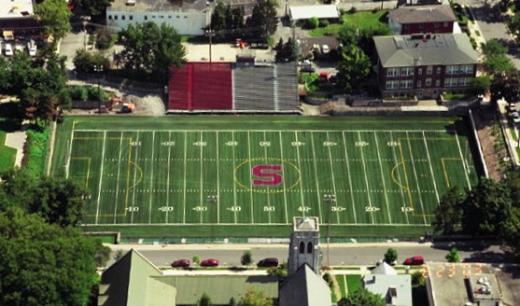
Proposed designs for key improvements at Memorial Field are expected to undergo public review by this fall, setting the stage for a long-awaited overhaul at the storied athletic venue, school leaders said this week.
Nearly 10 years ago, the State College Area school board identified the stadium as a target for comprehensive renovations. With a 7-0 vote Monday night, board members hired the firm of Palumbo Skibinski Crawford to develop schematic designs for the project. The company is to be paid no more than $156,750, according to an agreement.
The board decision capped a decade-long series of reports and studies focused on Memorial Field, on the 200 block of South Fraser Street, between West Nittany Avenue and Central Parklet. With 4,400 seats, the stadium was built during the Great Depression and has since become a State College landmark, largely as a football field.
But time has taken a toll: Bleachers, a press box, fencing and parts of the stadium’s stone walls all need to be replaced, said Ed Poprik, the district’s director of physical plant. The school board also is looking to upgrade the aging locker rooms, public bathrooms and concession stands that serve the facility.
Poprik said the deterioration of a retaining wall beneath the west bleachers has intensified the push for comprehensive improvements. A section of those bleachers has been cordoned off since 2008 because of fears that the weakened wall could cause a collapse.
‘That’s really prompted, I think, this recent desire (among school leaders) to put together a schematic plan that really shows the big picture,’ Poprik said. He said the comprehensive approach will prevent the district from ‘dropping $1 million on a new retaining wall without knowing what we want the final, overall renovations to look like.’
Poprik said the school district will solicit input from a variety of stakeholders, including borough representatives and local athletes, as the board moves toward a final renovation plan in the coming year. ‘We’re trying to make this a joint process where everyone feels like they have some input into the final product,’ he said.
In other business Monday night, the school board heard from State High North Building Principal Craig Butler about an ‘administrative realignment.’ The school’s North and South buildings have had separate administrators — a half-dozen overall — in recent years. The new arrangement will appoint Butler later this year as the sole top administrator for both buildings.
The plan also calls for four grade-level principals — one each for the freshman, sophomore, junior and senior classes — and for a dean of students. That newly-formed job will be centered on student issues and concerns, including discipline, said Superintendent Richard Mextorf. The position will be held by a faculty member.
District spokeswoman Julie Miller said the reconfiguration emerged partially as a cost-control measure. As Debra Latta, the current South Building principal, moves to become principal at the Boalsburg and Panorama Village elementary schools, the new alignment will allow the district to rely on current State High personnel without growing the overall administrative ranks, Miller said.
She said the changes are designed to promote ‘a more positive climate’ at State High as well. The freshman-level principal will lead an academy-style approach to help incoming students adjust, Mextorf said. Other grade-level principals will stick with their respective classes as they matriculate through the school. This year’s sophomore-level principal, for instance, will be next year’s junior-level principal.
On a separate front, faculty and staff members at the Young Scholars of Central Pennsylvania Charter School voted 18-11 Monday to unionize. Outside of Philadelphia and Pittsburgh, no other bricks-and-mortar charter school in Pennsylvania has taken that step, said Lucy Harlow, communications manager for the Pennsylvania State Education Association (PSEA). At least one virtual charter school in the state — Pennsylvania Learning Online — organized some time ago.
Harlow said the Young Scholars employees, like other public-school workers, wanted ‘a sense of security, a salary schedule, a voice in the organization.’ About 115 charter schools are open in Pennsylvania, most of them in the major urban centers, she said.
She said she knows of no unionization movements in other local charter schools.
Thirty-three Young Scholars employees will be represented through the PSEA and the National Education Association. Contract negotiations are expected within several months.
The principal at Young Scholars could not be reached immediately on Tuesday.
More thorough reports on all of these issues will appear at StateCollege.com.