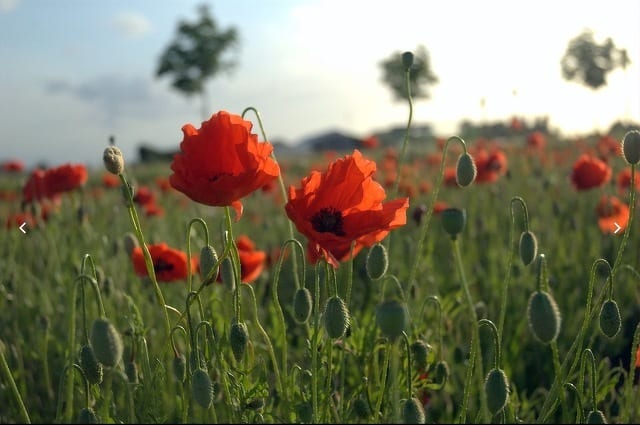
“We cherish, too, the poppy red
That grows on fields where valor led;
It seems to signal to the skies
That blood of heroes never dies.”
— Moina Michael
There are few national holidays that evoke as reverent a response as our Memorial Day, for there are not many among us who are untouched by war.
My father and uncle fought in World War II in the European theater, leaving loved ones behind. I cherish a black-and-white photo of my smiling young mother, newly engaged in the early 1940s, and wonder how she could have dealt with the daily uncertainty of whether her fiancée would return.
The emotionality of this May commemoration touches our national collective memory as well, and it is not surprising that flowers have played a central role.
The establishment of the holiday is rooted in the aftermath of one of worst conflicts in our history — the American Civil War — which bitterly divided the country. It was in 1865, after the establishment of the first national cemeteries, that Decoration Day, as it was originally known, began in individual communities with the visiting of cemeteries or memorials to lay flowers and flags and recite prayers.
According to History.com, it was on May 5, 1868, that Gen. John A. Logan, who was a leader of an organization for Civil War veterans of the North, called for a nationwide day of remembrance called Decoration Day to be held later that month.
“The 30th of May, 1868, is designated for the purpose of strewing with flowers, or otherwise decorating the graves of comrades who died in defense of their country during the late rebellion, and whose bodies now lie in almost every city, village, and hamlet churchyard in the land,” he proclaimed. It is said that he chose that day because it was not the anniversary of any particular battle and many spring flowers would be in bloom.
On that first Decoration Day, Gen. James Garfield made a speech at Arlington Cemetery, where the graves of 20,000 Union and Confederate soldiers were buried. This tradition was carried out in other communities in both the North and South as the years went by, eventually becoming state holidays for many. It was established as a federal holiday in 1971, and eventually moved to the last Monday of May.
Our own town of Boalsburg has laid claim to being the holiday’s birthplace, as the women there began decorating graves each year as early as 1864 (the women have been honored with statues and the ceremony is reenacted each year). Each community’s history with the day has become a personal badge of pride, which no one can discount.
After World War I, the holiday evolved to honor all American military personnel who lost their lives in all wars. One woman who then began a movement to aid surviving veterans was an American teacher and humanitarian from the state of Georgia by the name of Moina Michael.
Her inspiration, described at greatwar.co.uk, came from a poem called “In Flanders Fields,” written by Canadian military doctor and artillery commander Maj. John McCrae. McCrae was asked to conduct a burial service for a young friend, artillery officer Lt. Alexis Helmer, killed during the early days of the Second Battle of Ypres in 1815.
Michael, who after the war taught a class of disabled servicemen, was so affected by the poem that spoke about the red poppies that abundantly grow on the former battlefields of Flanders (an area spanning southern Belgium and northwest France), that she wrote her own response to the poem. She then began to sell silk poppies to raise funds to assist disabled veterans.
In 1921, the poppy was adopted as a symbol of remembrance for war veterans by the American Legion Auxiliary, what became the Royal British Legion and, eventually, by military veterans’ groups in Canada, Australia and New Zealand. Today, it continues to be an enduring global symbol to remember those who have suffered in war and to raise funds for veterans’ groups.
Historically, flowers have been a visual expression of the love, sympathy and respect felt for a loved one. This has become especially true at funeral rites and religious services.
The Victorians, who elevated the language of flowers to use in daily life, carved flower representations on grave markers as a permanent representation of these feelings. Daffodils indicated grace, beauty and deep regard. A carved morning glory could symbolize mourning, mortality and farewell. A substantial number of floral marker representations and their meanings, many originating with the Victorians, can be found at www.agraveinterest.com.
During the first half of the 20th century, there was an “In the Garden” movement in the United States, based on the famous funeral hymn of the same name. In the hymn, widely sung at Protestant funerals, the loved one walks with God in a garden. Funeral homes began to develop facilities which used indoor gardens as backdrops. Some of these chapels had plants, flowers, waterfalls and even live birds where the loved one was in repose, as Todd Van Beck relates in his In Lieu of Flowers website.
In the Midwest, there were even six flower ladies, analogous to pall bearers, whose job it was to carry the flowers from the funeral home to the flower vehicle and to then assist in placing them in the cemetery. These women were usually close friends of the family, and it was an honor to be chosen.
Today, families have continued to pay respect to loved ones by placing cut flowers or wreaths on graves or plantings at the site.
This Memorial Day, as local communities honor all those who have served, the tradition of placing flowers on graves will send a powerful and patriotic message of sympathy and respect for men and women who made the ultimate sacrifice.