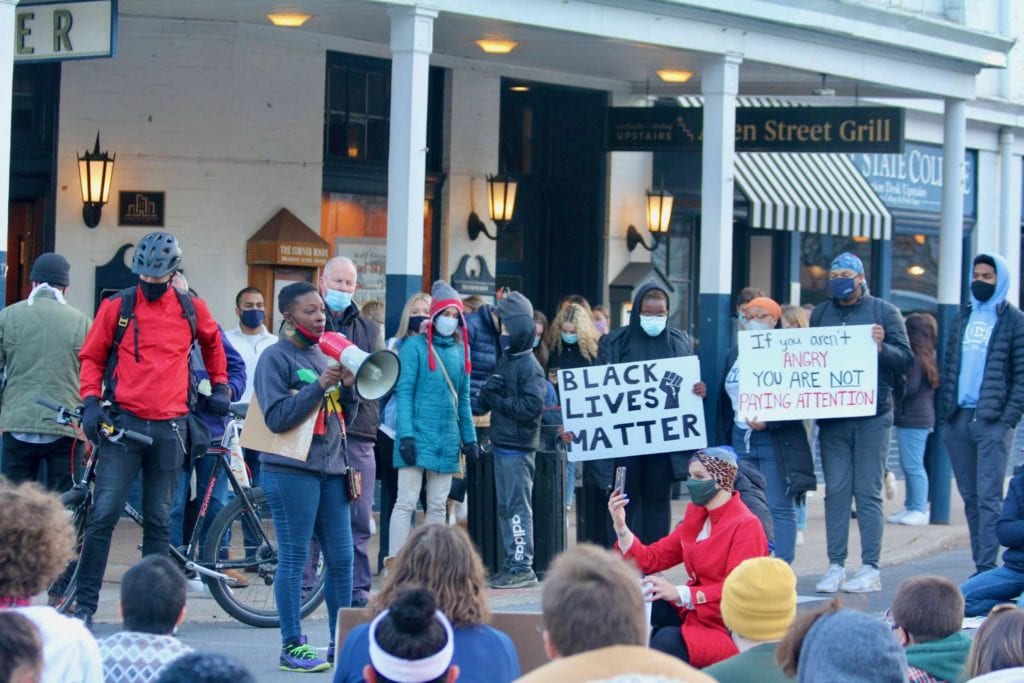
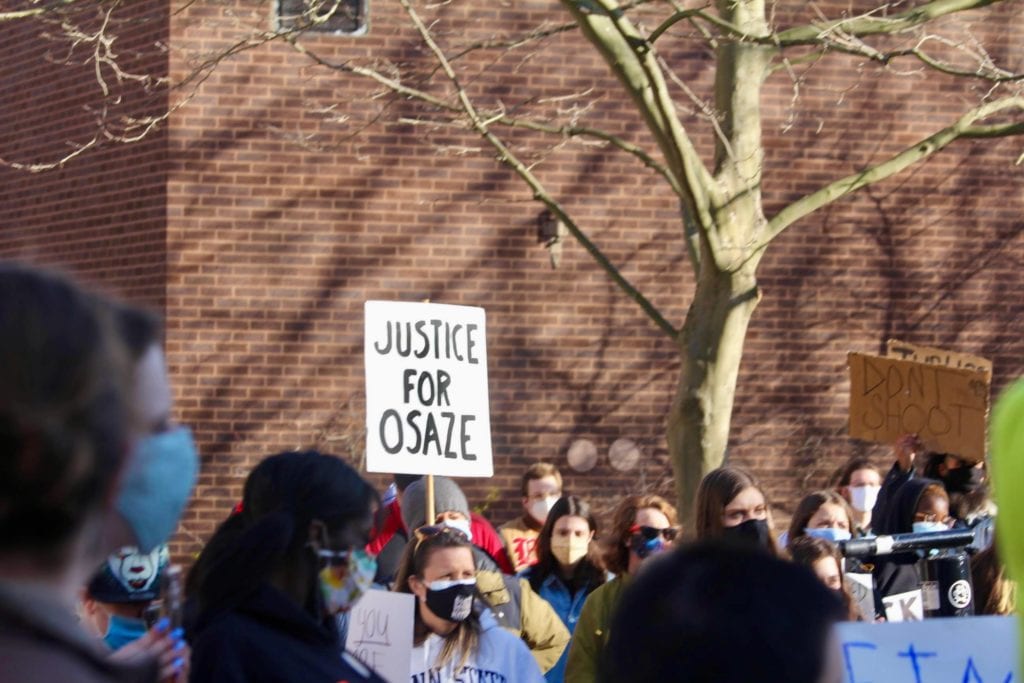
On the eve of the second anniversary of Osaze Osagie’s death, community members gathered Friday night in downtown State College for a march and demonstration to remember the borough man who was shot and killed by a police officer and to continue calls for change.
The march was part of “10 days of action” organized by the 3/20 Coalition, the advocacy group formed following Osagie’s death, that will culminate with a day of activities on Saturday.
“Osaze was a person and many of us in this coalition knew him, knew his family, knew the impact he had on his community, on those around him,” Geoff Landers-Nolan, a coalition member, said across from the State College Municipal Building at the start of Friday’s event. “We will never stop honoring, promoting, supporting his memory and his legacy to make sure our community is the community that would have kept Osaze safe, that would have him standing here with us celebrating for some entirely different reason.”

On March 20, 2019, one of three State College officers who went to Osagie’s Old Boalsburg Road apartment to serve a mental health warrant shot and killed the 29-year-old, who was in the midst of a mental health crisis, after he charged at them with a knife in a narrow basement hallway.
Following an investigation by the Pennsylvania State Police, Centre County District Attorney Bernie Cantorna cleared the three officers involved, saying they were in a “life-or-death” situation after one officer’s Taser failed to subdue Osagie. The state police Heritage Affairs Section concluded racial bias did not play a role in the shooting of Osagie, who was Black.
For the past two years, the coalition has raised issues about policing, mental health and race while calling for changes in local systems, as well as consequences for the officers involved.
In the months following Osagie’s death, the borough undertook some efforts, including forming a task force with the county to examine and make recommendations for mental health crisis services, commissioning an independent review of police department policies and practices, training and development for a borough equity plan and creating a borough equity office.
The mental health task force issued its final report in November with 19 recommendations for improving services and procedures. A new committee is being formed to monitor progress for implementing those recommendations.
But it wasn’t until June of 2020 that borough council agreed to move forward on many of the coalition’s demands, such as creating a community oversight board for the police department. That came as regular local demonstrations occurred — drawing hundreds, sometimes more than 1,000 participants — in conjunction with a national movement following police killings of George Floyd and Breonna Taylor, among others.

Still, criticisms have remained about how the community oversight board will be implemented, and how it and a civilian response team will be funded.
“They can act that fast when we demand it and when there are enough of us to force their hand,” Landers-Nolan said. “When we are told to disconnect things, there is a reason behind that. The reason is that our connections are the most powerful thing we have. The lesson is be here. Show up… These moments when people are in the streets en masse, these moments when we learn critical information, these moments when we get the answers we have been demanding, all of the sudden we can make things happen. We can make things happen because we have been there from the beginning.”

One demand that was not met until this January was the disclosure of the names of the officers involved in the shooting. When they were revealed, in a borough filing in the lawsuit brought by the Osagie family, it ignited a new set of issues.

After the names were divulged, the Osagie family’s attorneys filed an amended complaint alleging the now former officer who shot Osagie, M. Jordan Pieniazek, was “unfit for duty.” It also claims that a now-retired police captain, who oversaw the department’s internal review of the shooting, had received information about Pieniazek’s alleged “excessive drinking and domestic abuse” and did not take steps to ensure Pieniazek was fit for duty in the days leading up to the shooting.
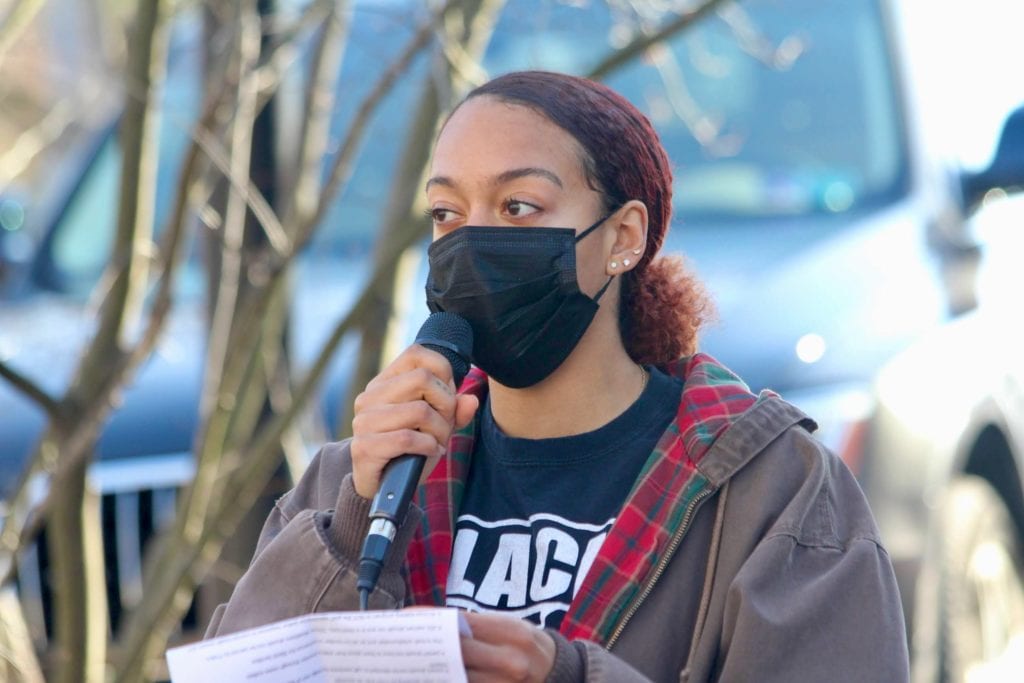
“Not fit for duty but fit to hold a gun and pull the trigger? It makes me wonder, are you trained to de-escalate or trained to shoot?” Audra Koopman, a leader of the group Black Student Athletes at Penn State, said on Friday. “A life was taken prematurely at the hands of those who have sworn to protect us. It feels like they’ve sworn to protect themselves from us. They covered the peephole for their safety when they were endangering his.”
Borough council issued a statement supporting Cantorna’s decision to ask state police investigate the new allegations, of which, like Cantorna, all seven council members said they previously had been unaware.
Coalition members and the Osagie family’s attorneys have said another agency should investigate.
“No amount of money, apologies or legal reparations can replace what the State College police took away from their community members,” Koopman said. “Osaze was remembered as peaceful and nonviolent. But even if he had opposite characteristics, he deserved to survive an interaction with police.”
Friday’s march took participants down South Allen Street to Easterly Parkway and then paused at Marvin Gardens, the Old Boalsburg Road apartment complex where Osagie died.

There, his friend Yum Yum Abdul read an emotional remembrance.
“My best friend was a great man who shared similar mental health struggles as me and racial barriers,” she said. “Osaze wouldn’t want me to keep grieving and giving up. He would want me to use his murder as a way to be a beacon and a light for other people.”
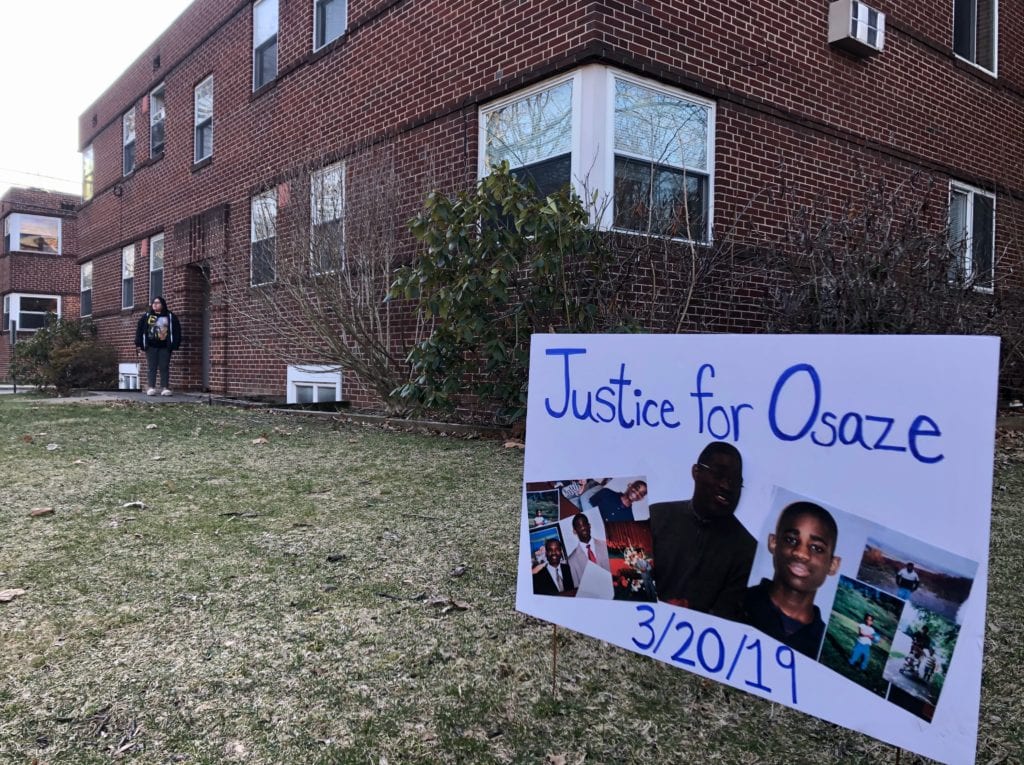
Coalition co-leader Nanre Nafziger placed a sign with photos of Osagie and the text “Justice for Osaze 3/20/19” outside the apartment building before the group marched north on South Pugh Street to College Avenue. Stopping at the Allen Street gates, participants remained in the road, writing chalk messages.

On Saturday, the coalition will host a community festival benefiting the Osaze Osagie College Scholarship Endowment, kicking off at 10 a.m. in Sidney Friedman Park with a memorial run/walk. Entertainment and educational activities will take place throughout the day downtown and a moment of silence will be held at 2:02 p.m., the time of Osagie’s death.
The State College Chapter of the NAACP also will hold a virtual event at noon on Saturday honoring Osagie and benefiting the scholarship endowment.
For community members seeking to address the issues raised by Osagie’s death, theefforts won’t end until they see change.
“Two years later and we’re still angry,” Koopman said. “Two years later, we’re still demanding answers and challenging explanations. Two years later and we have not forgotten. Two years too late SCPD, but two years and counting for waiting for all of our demands to be met.”