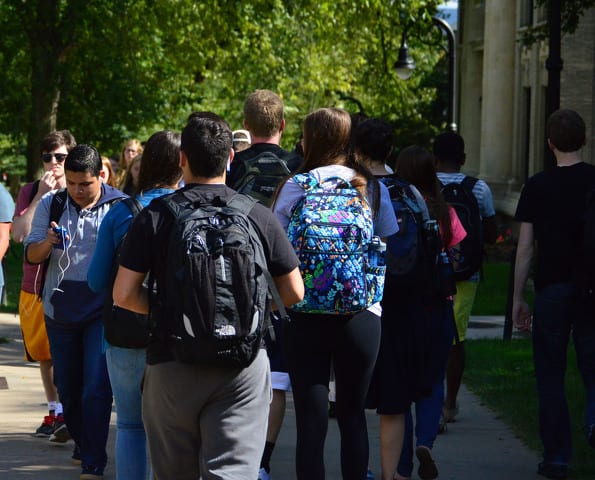
Each semester in my intro class at Penn State, I assign the students to a meet-and-greet with me. For this assignment, they fill out a brief self-assessment, identifying their strengths and goals as well as identifying something unique about themselves that can’t be seen by just looking at them, and then come into office hours for a 15-20 minute, one-on-one casual conversation. The goal is to help with career planning and guidance but also to help them connect with the university and the department resources. Most of my students are new to the university, or to the campus or to the major or minor. This assignment is my favorite part of my job.
I am noting a pattern of late that seems to be growing every semester. I am seeing an increasing number of students who report serious struggles with anxiety. Feelings of stress and worry. Fear of not being good enough or smart enough – of just not being enough. They seem to be afraid to take risks and of somehow failing. Sometimes they are able to articulate it. Other times it manifests with other problems. Some with debilitating, life limiting panic and anxiousness. I’ve been teaching for almost 28 years and have seen the shift. There used to be a smattering of kids who didn’t manage stress well but this trend is very troubling.
Sadly, my conclusions are supported by the data.
But, how can it be true? How can today’s teens be more stressed than teens who faced the Depression and a country doing without? What about those young adults who faced the draft, war and serious risk to health and safety? Hasn’t each generation had our own stressors that seem somehow worse as we are going through the transition from youth to adulthood? Could the results possibly be skewed by other factors such as how we ask the questions? Could it be greater awareness of symptoms or how we define anxiety?
Regardless of how we look at it, an alarming number of children are reporting anxiety that limits some area of life function. Those children become anxious teenagers. Those anxious teens become troubled young adults. The result is a very anxious university community.
In a study that surveyed university counseling center staff, respondents reported that anxiety is the top reason that students sought services at university mental health centers. In a similar survey of college freshmen, one in three reported that they felt anxious “most of the time.” In that same survey, 60% of those survey reported that they wished they had been more “emotionally prepared” for college and 50% reported their independent living skills “needed improvement.”
There are plenty of theories as to what is causing this trend. Perceived pressure from families. Helicopter parenting that doesn’t allow children and then teens to fail, problem-solve on their own or learn basic coping skills because an adult always rushes in to “fix” things. The superficiality and fakeness of social media in which other’s lives seem so perfect when ours is not. The Everyone Gets a Trophy phenomenon. A public education system that focuses on test scores rather than on learning. Twenty- four hour news and the wild, wild internet in which our kids are exposed to images and information sometimes before they are mature enough to process it. Threats of school shootings and other disasters as just an expected part of our day-to-day existence. Not enough time outside or not enough exercise. Poor diets. Lack of sleep. Schools that are pressured to cut the arts and music, in addition to physical education. Several studies link the loss of free, unstructured play in our kids’ schedules as creating a generation of stressed and worried adults.
We can theorize on the whys but it’s the what-to do that provides the challenge.
Universities are aware of the issues and are trying to address mental health concerns in a variety of ways. From the expansion of the number of support personnel to innovative programs and services that address stress management and coping, the effort is underway to address the growing numbers. Developing physical spaces where students can gather and meet to make connections to faculty and staff. Health and wellness programs through student affairs departments and campus recreation. Improved transition programs for new arrivals to the university. Improved training for resident assistants, support staff and faculty in the areas of awareness and referral.
Individual faculty members are addressing it as well. From open office hours to meet and greets like mine, we are trying to help and support students. A well-respected colleague starts every class of the numerous courses she teaches with two to three minutes of breathing exercises and/or guided meditation with her students (including large lecture classes). She shared that students tell her that it is very helpful and that they look forward to it. Teaching while teaching. I might give it a try.
Ultimately the goal is for students to be successful and to learn while also having a positive, stress-manageable university experience.
With so many of the roots of stress and anxiety at the larger societal level, the plan to fix this is going to need to be a big one. The obvious answer is that we need to address the issue before they hit the university gates. Education and awareness programs for children. Similar programs for parents. Stress management as part of elementary curricula. Creating environments that lets kids be kids so that teens can be teens and teens can be happy, healthy adults.