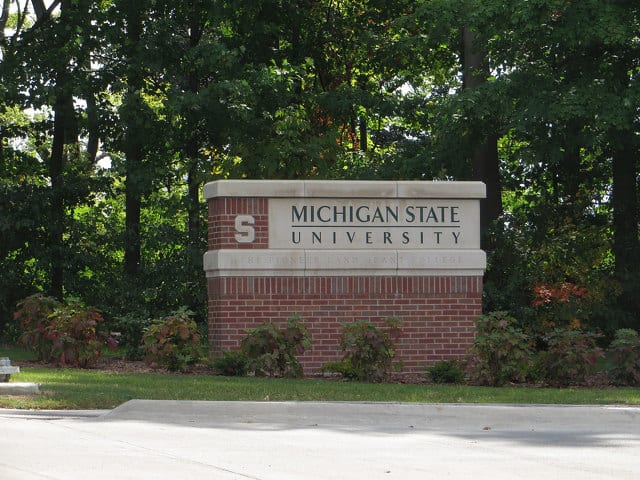
Sorry, Michigan State. I’m going to have to disagree.
We learned this week that in a letter to the NCAA, legal representatives for Michigan State University acknowledged that at least 25 of the school’s athletes may have been victims of sexual abuse by Larry Nassar, but concluded they did not believe any violations of NCAA rules had occurred.
No violations? This is a joke that isn’t funny.
Nassar, a sports physician for both MSU and USA Gymnastics, was recently sentenced to up to 175 years in prison for his decades-long sexual abuse of what may be hundreds of young female athletes.
With the long list of women lining up to file lawsuits against USA Gymnastics and Michigan State, “no violations” sounds to me a lot like a CYA defense.
You don’t have to go too far into the NCAA’s 2017-2018 bylaws to find Article 2, “Principles for Conduct of Intercollegiate Athletics.” Principle 2.2 states “Intercollegiate athletics programs shall be conducted in a manner designed to protect and enhance the physical and educational well-being of student-athletes.”
Note the focus on “physical well-being of student athletes.”
Article 2.2.3 of the NCAA bylaws is titled “Health and Safety” and states, “It is the responsibility of each member institution to protect the health of, and provide a safe environment for, each of its participating student-athletes.”
Underscore “safe environment for each of its participating student-athletes.”
Women and girls were sent to Nassar for treatment of their sports-related injuries. Many of them were mistreated at the hands of Larry Nassar. Some of those who were mistreated reported it. Possibly up to 14 different people who heard the reports of Nassar’s crimes were “on the staff” at Michigan State at the time. NCAA bylaws outline who is considered to be “on the staff” and therefore responsible for complying with NCAA rules. Not reporting the allegations, or worse, telling the women to keep silent, in this writer’s opinion, violated the NCAA’s well-being and safety guidelines, if not a basic moral code to protect the young people who were under their supervision.
The next play in this legal chess match is on the NCAA. What will the NCAA do in response to this horrific situation at Michigan State?
My guess is that the NCAA will do nothing.
With the exception of the sanctions levied against Penn State in the wake of the Sandusky scandal, the NCAA is known for focusing on the small stuff and ignoring the things that matter.
The NCAA is infamous for inane rules about things like food for student-athletes and prioritizing their scrutiny of recruiting activities (for both high school players and for college players going into the pros) while turning away at the big stuff.
I remember when my son was playing for the local lacrosse club and the kids were invited to go out on the Penn State lacrosse field at halftime to do some drills. We had to identify any child who was over a certain age and tell them he or she couldn’t go out on the field with their friends because it could be a potential recruiting violation. A middle schooler spending 10 minutes on the field at a collegiate lacrosse game, while the coaches and staff were in the locker room, was of great concern.
On the other hand, the University of North Carolina offering fake classes that were never taught and for which student-athletes earned As was deemed a “no violation” by the NCAA under the lame rationale that the course was open to non-athletes as well.
In the NCAA bylaws, Principle 2.4 is the “Principle of Sportsmanship and Ethical Conduct.” It says in part: “For intercollegiate athletics to promote the character development of participants, to enhance the integrity of higher education and to promote civility in society, student-athletes, coaches, and all others associated with these athletics programs and events should adhere to such fundamental values as respect, fairness, civility, honesty and responsibility. These values should be manifest not only in athletics participation, but also in the broad spectrum of activities affecting the athletics program.”
Respect. Fairness. Civility. Honesty. Safety and well-being. These aren’t words I generally associate with the NCAA. What and how much a student-athlete eats gets more attention than cheating or programs that look the other way at rape.
In July of 2012, the NCAA handed down program-crippling sanctions against Penn State football in the wake of the Sandusky scandal. The sanctions included a five-year probation, a four-year ban from bowl games, a reduction in the number of scholarships, the vacating of wins and a $60 million dollar fine. They threatened the death penalty. They subjectively announced we had a “culture” issue. (I’m still looking for where “culture” is outlined in any of the 428 pages of the NCAA manual). The crimes for which Sandusky was convicted did not involve any Penn State student-athletes.
With pressure that it had overstepped its reach with an emotion-laden decision, the NCAA eventually walked back the sanctions, and returned the wins and the scholarships. They then nervously patted Penn State on the back and said “Good job” with all of the changes that have been implemented at the university for reporting, access and policies related to children on our campus, almost as if that would help us forget that they overstepped their bounds.
Someone owes Penn State $60 million.
We will be watching the NCAA to see how they respond to the situation at Michigan State. Athletic department staff violating the safety and well-being of students by either abusing students on campus or not reporting that abuse to the proper authorities seems like at least a couple of violations to me.